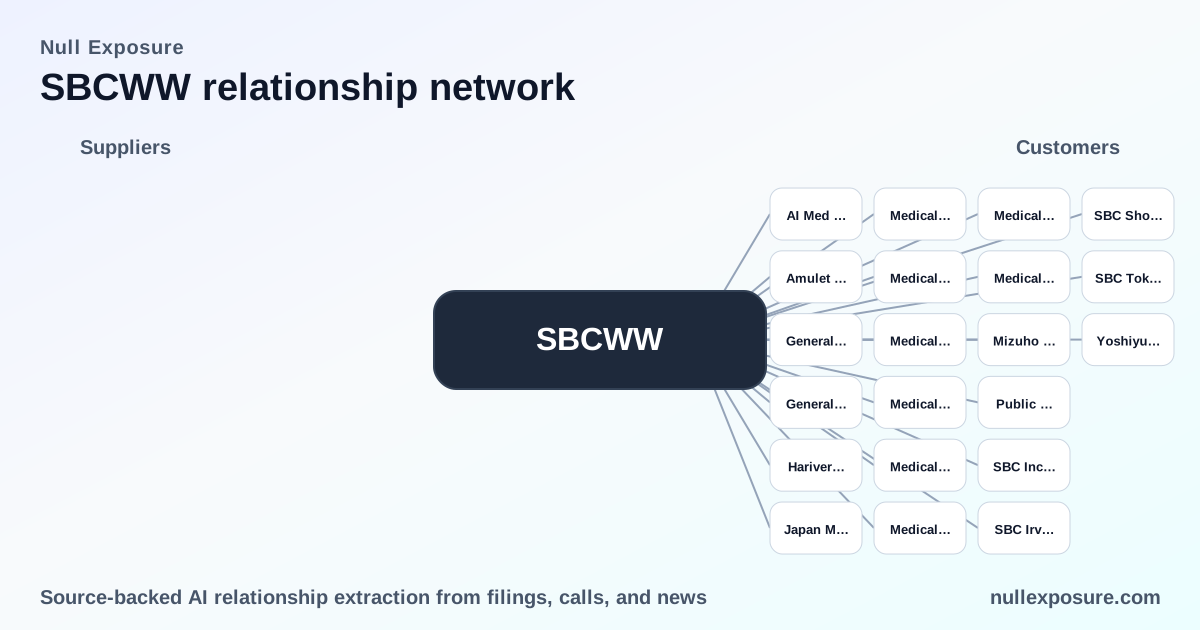
SBC Medical Group Holdings (SBCWW): Franchise-driven revenue, Japan-centered customer base
SBC Medical Group operates and monetizes as a franchisor-management platform: the company licenses the "Shonan Beauty Clinic" brand and related IP to medical corporations (MCs), provides comprehensive management services to franchised clinics, and earns royalty and service fees—with over 90% of revenue derived from management services to MCs according to the FY2024 10‑K. The company's business model is a service-and-licensing hybrid with durable contract terms and material concentration in Japan, creating a predictable cash flow profile but concentrated counterparty and regulatory risk. For more on relationship-level analysis and disclosures, see Null Exposure’s coverage at https://nullexposure.com/.
How the FY2024 10‑K frames SBCWW's customer relationships
The FY2024 Form 10‑K catalogs a broad set of named related parties and MCs across Japan and selected international subsidiaries. The filing reports related-party revenue of $195,173,889 for 2024, signaling that related-party clinic operations represent a material and recurring revenue stream. The agreements underpinning those revenues are long‑term and auto‑renewing, and the company combines licensing fees with ongoing management and support services—creating both stability and concentration risk.
The named customers and related parties the filing lists
Below are the relationships disclosed by name in SBC Medical Group’s FY2024 10‑K, each summarized in plain English with the filing as the source.
AI Med Inc.
The 10‑K lists AI Med Inc. with numeric entries alongside the name (items shown as "787 556,397"), indicating recorded transactions or balances with this related party in FY2024. This disclosure is from SBC Medical Group's FY2024 10‑K.
Amulet Inc.
Amulet Inc. is named in the FY2024 10‑K with a numeric line "3,587", reflecting a recorded FY2024 transaction or balance with the company. Source: SBC Medical Group FY2024 10‑K.
General Incorporated Association SBC
General Incorporated Association SBC appears with numeric entries "801 569" in the FY2024 10‑K, marking it as a disclosed related party in the filing. Source: SBC Medical Group FY2024 10‑K.
General Incorporated Association Taiseikai
Taiseikai is listed with the figure "692" in the FY2024 10‑K, showing it as a named related party or customer in the company’s disclosures. Source: SBC Medical Group FY2024 10‑K.
Hariver Inc.
Hariver Inc. shows as "19,810 21,740" in the FY2024 10‑K, indicating material recorded activity between SBC and Hariver during the reported period. Source: SBC Medical Group FY2024 10‑K.
Japan Medical & Beauty Inc.
Japan Medical & Beauty Inc. is recorded with entries "39,620 488,023" in the FY2024 10‑K, reflecting significant transactional lines with SBC in FY2024. Source: SBC Medical Group FY2024 10‑K.
Medical Corporation Aikeikai
Medical Corporation Aikeikai appears with the substantial figures "17,997,072 21,521,302" in the FY2024 10‑K, identifying it as a major related-party client or affiliate in the filing. Source: SBC Medical Group FY2024 10‑K.
Medical Corporation Association Furinkai
Medical Corporation Association Furinkai is disclosed with "11,708,183 2,923,608" in the FY2024 10‑K, listed among the MCs with recorded financial activity. Source: SBC Medical Group FY2024 10‑K.
Medical Corporation Association Junikai
Junikai is listed with "3,923,228 851,105" in the FY2024 10‑K, reflecting its role as a franchised MC or related party in the company’s disclosures. Source: SBC Medical Group FY2024 10‑K.
Medical Corporation Jukeikai
Jukeikai is disclosed with amounts "5,666,907 4,518,846" in the FY2024 10‑K, confirming transactional relationships with SBC during the fiscal year. Source: SBC Medical Group FY2024 10‑K.
Medical Corporation Kowakai
Kowakai appears with very large figures "46,756,189 45,115,149" recorded in the FY2024 10‑K, indicating one of the largest single related-party balances or transaction totals disclosed. Source: SBC Medical Group FY2024 10‑K.
Medical Corporation Nasukai
Nasukai is shown with "46,355,437 45,893,461" in the FY2024 10‑K, another major MC-level relationship with substantial recorded activity. Source: SBC Medical Group FY2024 10‑K.
Medical Corporation Ritz Cosmetic Surgery
Ritz Cosmetic Surgery is listed with "7,435,446 2,603,405" in the FY2024 10‑K, identifying it as a material related-party clinic operator in the reporting period. Source: SBC Medical Group FY2024 10‑K.
Medical Corporation Shobikai
Medical Corporation Shobikai is specifically called out with revenues from related parties of $53,862,520 in 2024 (down from $56,554,316 in 2023), making Shobikai a highly material and recurring counterparty in the filing. Source: SBC Medical Group FY2024 10‑K.
Mizuho Yamashita
Mizuho Yamashita is named with an entry "19,214" in the FY2024 10‑K, indicating a recorded transaction or balance with the company. Source: SBC Medical Group FY2024 10‑K.
Public Utility Foundation SBC Foundation for Medical Promotion
The public utility foundation is reported with figures "107 387" in the FY2024 10‑K, showing an organizational relationship captured in related‑party disclosures. Source: SBC Medical Group FY2024 10‑K.
SBC Inc. (previously SBC China Inc.)
SBC Inc., noted as previously known as SBC China Inc., is listed with "2,512 467" in the FY2024 10‑K, marking a corporate affiliate or international subsidiary in the disclosures. Source: SBC Medical Group FY2024 10‑K.
SBC Irvine MC
SBC Irvine MC shows as "1,204,107 1,298,539" in the FY2024 10‑K, reflecting recorded revenue or balances for the Irvine management entity. Source: SBC Medical Group FY2024 10‑K.
SBC Shonan Osteopathic Clinic Inc.
SBC Shonan Osteopathic Clinic is listed with "56,740 69,227" in the FY2024 10‑K, included among the MC and clinic-level related-party entries. Source: SBC Medical Group FY2024 10‑K.
SBC Tokyo Medical University (previously Ryotokuji University)
SBC Tokyo Medical University, formerly Ryotokuji University, appears with "45,286 231,191" in the FY2024 10‑K, showing activity tied to the university-affiliated medical operations. Source: SBC Medical Group FY2024 10‑K.
Yoshiyuki Aikawa
Yoshiyuki Aikawa is disclosed with figures "98,445 67,516" in the FY2024 10‑K, documenting a named individual counterparty in the related-party schedule. Source: SBC Medical Group FY2024 10‑K.
What these named relationships imply about SBC’s operating model and constraints
The collection of disclosures in the FY2024 10‑K establishes several structural characteristics of SBC’s customer relationships:
- Long-term, auto-renewing contracts dominate: the filing documents multi-year support and franchise agreements (terms of 5–9 years with automatic renewal provisions), which creates stretched contractual duration and predictable revenue streams.
- Licensing + services = the core monetization: SBC earns both royalties (monthly licensing fees stated in yen ranges) and management fees for advertising, staffing, procurement and IT support; this hybrid drives recurring cash flow but ties revenue to MC operational performance.
- High counterparty concentration and regulatory sensitivity: the company reports that substantially all long-lived assets and revenues are attributed to operations in Japan and that MC compliance (for example, under the APPI) directly affects SBC’s brand and revenue, making relationships critical to financial outcomes.
- Counterparty mix includes non‑profits and individuals: Japanese MCs are organized under non-profit rules limiting profit distribution, and the company has expanded into customer loan services to End Customers, introducing individual lending exposure as of 2023.
- Relationships are active and material: the filing shows ongoing support agreements and related-party revenues totaling nearly $195 million, demonstrating both materiality and active operational engagement.
- Service-segment orientation with global footprint: while concentrated in APAC, SBC maintains presence in Vietnam, Singapore and the U.S., consistent with a management services operating segment that sells services and IP licensing globally.
Investment takeaways and risks investors should weight
- Stable recurring revenue but concentrated counterparty risk: long-term royalties and service fees create predictable cash flow, but greater than 90% revenue dependence on MCs in Japan concentrates execution and regulatory risk.
- Contractual durability reduces churn risk: multi‑year, auto‑renewing contracts limit short-term attrition and support valuation models that assume stable franchise economics.
- Regulatory and reputation sensitivity is material: MC non-compliance with local rules (e.g., APPI) has a direct revenue impact; brand damage amplifies downside for a franchisor-heavy model.
- Large related‑party balances warrant governance scrutiny: several named MCs show sizeable transaction totals in the 10‑K, an area investors should monitor for governance and conflict-of-interest disclosures.
For direct access to structured relationship disclosures and to compare SBCWW to peers, visit Null Exposure at https://nullexposure.com/.
Overall, SBC Medical Group’s FY2024 disclosures describe a franchisor‑management platform with durable contracts, concentrated but material revenue streams, and operational exposure to Japanese medical‑corporation partners—a profile that supports stability but requires monitoring of counterparty performance and regulatory developments.