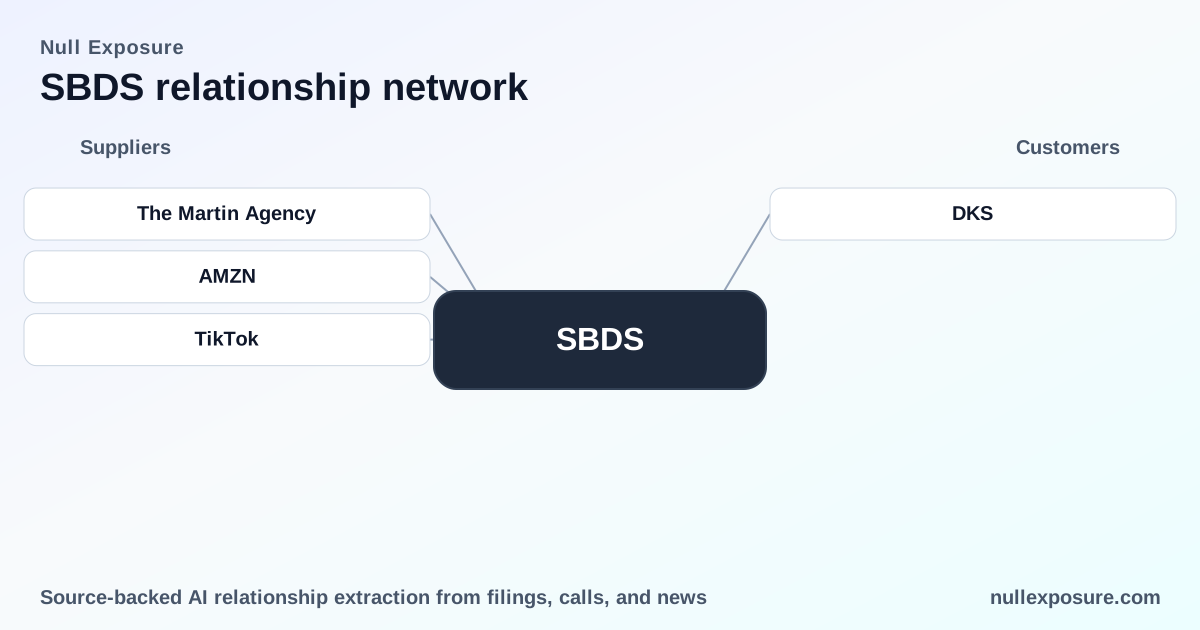
SBDS — Customer relationships and retail exposure: DICK'S under the microscope
Thesis: SBDS monetizes by selling branded consumer apparel and outdoor products through a dual channel strategy—direct-to-consumer e-commerce and wholesale relationships with large retailers—while extending trade credit to select retail partners; revenue comes from product sales across the Solo Stove and Chubbies segments, and gross-margin and working-capital dynamics are driven by the mix of direct sales versus retail distribution. For relationship-level detail and ongoing updates, visit the Null Exposure homepage: https://nullexposure.com/.
Executive summary — what matters to investors
- SBDS relies on large retail partners for a meaningful portion of Chubbies revenue while Solo Stove remains broadly diversified. The company reports a single Chubbies customer contributing roughly 20% of net sales in each of the last two years, creating a clear concentration risk.
- DICK’S Sporting Goods is explicitly identified in SBDS filings and in recent retail distribution reporting, positioning it as an important wholesale channel.
- Credit exposure to retail partners is embedded in the business model; SBDS provides trade credit and carries accounts receivable from known retailers, which makes counterparty creditworthiness and economic cycles direct drivers of cash conversion.
- Geography skews to North America with growing international reach (Europe, Canada, Australia), which moderates single-market dependency but does not eliminate concentration in the U.S.
Detailed relationship coverage
Dicks Sporting Goods — FY2024 10‑K mention
SBDS discloses Dicks Sporting Goods as a retail partner tied to customer-concentration risk and recognized in accounts receivable for FY2024, indicating DICK’S is an identified counterparty on the balance sheet (SBDS Form 10‑K, fiscal year ended 2024). According to the FY2024 10‑K filing, the company calls out concentration exposure related to its retail partners. (Source: SBDS FY2024 Form 10‑K, filed for the period ended 2024-12-31.)
DKS — duplicate corporate tag in the FY2024 filing
The filing also records the counterparty under the ticker shorthand DKS, reiterating the same disclosure that DICK’S contributes to the company’s trade receivable and concentration commentary for FY2024. This duplicate mention confirms the company’s practice of tagging major retail partners consistently in its disclosures (Source: SBDS FY2024 Form 10‑K, 2024-12-31).
DICK’S — news coverage of Chubbies distribution (FY2026 context)
A March 10, 2026 news report notes that the Chubbies brand launched a new women’s swimwear line, Cheekies, which will be available on DICKS.com and in select DICK’S retail locations—evidence that Chubbies product flows through DICK’S omnichannel footprint and that DICK’S is an active retail distribution partner in FY2026. (Source: Intellectia news report, March 10, 2026.)
DKS — parallel news sentiment entry for the Chubbies launch
The same March 2026 coverage is also indexed under the ticker shorthand DKS, confirming market reporting connects Chubbies distribution plans directly to DICK’S retail channels in FY2026 and reinforcing the operational link between SBDS brands and the large sporting-goods retailer. (Source: Intellectia news report, March 10, 2026.)
Operating-model signals and constraints investors should price in SBDS’s public disclosures surface multiple company-level constraints that define how the business contracts with customers and where operational risk concentrates:
- Contracting posture — supplier to large retailers with trade credit exposure. SBDS confirms it “provides credit to our retail partners in the ordinary course of our business,” which makes accounts receivable and counterparty credit risk key levers of working-capital volatility (company FY2024 disclosures).
- Concentration — segment-dependent. The Chubbies segment has a single customer representing ~19.8–20.3% of net sales in 2023–2024, a material concentration that raises negotiation and revenue-replacement risk; conversely, Solo Stove reports no customer over 10% of net sales, reflecting a more diversified retail/end-consumer footprint.
- Geography — North America dominant with international exposure. The company states net sales are concentrated in the United States while also selling in Europe, Canada, and Australia, signaling primary NA exposure with EMEA and APAC as secondary markets.
- Counterparty profile — large-enterprise retail partners. Management frames retail partners as “well-known businesses,” consistent with DICK’S being a large enterprise counterparty and relevant for credit evaluation and collection practices.
- Immaterial related-party spend signal. Reported related-party net sales of $1,200 suggest negligible related-party revenue (spend band: sub-$100k), a company-level signal that related-party transactions are not a material revenue driver.
For a deeper look at how these relationship signals are captured and updated, see Null Exposure’s research hub: https://nullexposure.com/.
How these constraints translate to investable risk and upside
- Working-capital sensitivity: Trade receivables tied to large retailers create cash-flow exposure across economic cycles. Investors should model receivable days and loss rates under both normal and stressed retail credit scenarios.
- Revenue concentration risk in Chubbies: A single customer at ~20% of segment sales constrains pricing power and increases the probability of step-changes in reported revenue if the customer reduces purchases; portfolio diversification or new retail wins would be primary mitigation levers.
- Channel mix impact on margin: Wholesale to retailers such as DICK’S implies lower per-unit margin but broader reach; the balance between D2C (higher margin) and wholesale (volume) will determine gross-margin trajectory.
- Geographic diversification reduces single-market shock but does not remove U.S. cyclicality: International sales exist but NA dominance means macro U.S. consumer health remains the primary demand driver.
Actionable read for investors and operators
- For investors: stress-test cash conversion under retailer credit stress and model scenarios where the material Chubbies customer reduces orders by 25–50%.
- For operators: prioritize credit monitoring and inventory cadence with DICK’S, and accelerate new retail placements or D2C marketing to dilute single-customer concentration in Chubbies.
Conclusion SBDS runs a dual-channel revenue model that trades higher-margin direct sales for the scale and penetration delivered by large retail partners like DICK’S. The company's financial exposure is characterized by a material Chubbies concentration, trade-credit to enterprise retailers, and U.S.-centric sales with growing international reach. These are the levers that will determine near-term cash-flow resilience and upside from distribution growth.
For ongoing customer-relationship tracking and firm-level signal updates, visit Null Exposure: https://nullexposure.com/.