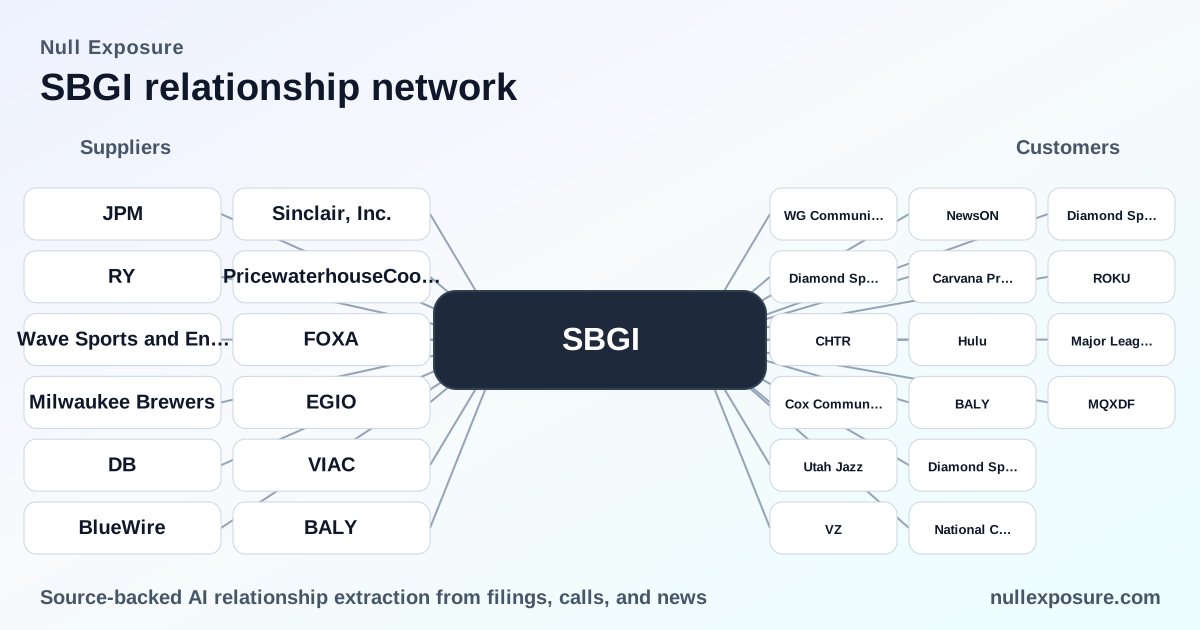
SBGI Customer Map: Who Pays, Carries, and Partners with Sinclair Broadcast Group
Sinclair Broadcast Group (SBGI) monetizes a two‑pronged media model: local broadcast advertising and multi‑year distribution fees from cable, telco and streaming distributors, supplemented by licensing and sports content monetization through Tennis Channel and regional sports relationships. Revenue flows are a mix of short‑term spot advertising and longer‑term per‑subscriber carriage contracts, with several large counterparties concentrated enough to be material to consolidated results. For a granular corporate counterparty view, see NullExposure for detailed mapping and document links: https://nullexposure.com/.
How Sinclair contracts and why that matters for investors
Sinclair’s revenue mix reflects distinct contracting postures. Distribution arrangements are multi‑year, subscription‑style licences with monthly per‑subscriber fees, creating recurring, predictable cash flows; advertising contracts are typically short‑term and spot‑based, which drives quarter‑to‑quarter volatility. The company discloses that at least one and sometimes two customers have each represented 10% of consolidated revenue, making counterparty concentration a real operational risk if carriage or advertising relationships break down. Geography is domestic‑centric — the U.S. subscriber base trend influences distribution economics — and several relationships are commercially critical given their scale and contribution to local media and sports revenues.
Key company‑level signals drawn from filings and releases:
- Distribution = long‑term subscription licensing, recognized as signal/network delivery over time.
- Advertising = short‑term, spot transactions, recognized when airtime is delivered.
- Concentration and materiality: one or two customers accounted for ≥10% of revenue in recent years.
- Counterparty profile: counterparties include large distributors and streaming aggregators, increasing bargaining dynamic complexity.
- Political and spot advertising represent a meaningful revenue band, amplifying revenue cyclicality around election cycles.
Customer relationships — concise, sourced profiles
WG Communications Group
Sinclair recorded revenue from advertisers represented by WG Communications Group of $0.3 million in each of 2022–2024 and paid WGC modest amounts for services; this is a small, immaterial advertiser relationship disclosed in the 2024 Form 10‑K. (Source: SBGI 2024 10‑K filing.)
Diamond Sports Group (DSG)
DSG is a former partner in Sinclair’s regional sports orchestration: Sinclair disclosed unpaid management service balances and a legal dispute with DSG, including a claim of nearly $147 million in unpaid management services, and settled $50 million toward a larger settlement in 2024. These items underline counterparty litigation and collection risk tied to RSN divestitures. (Sources: Front Office Sports reporting March 2026; SBGI investor release Q1 2024.)
Charter Communications / CHTR
Sinclair reached a comprehensive multiyear distribution agreement with Charter in March (for Sinclair stations and Tennis Channel), providing multi‑year carriage revenue under subscription terms. (Source: SBGI Q1 2024 financial results press release.)
Cox Communications, Inc.
A multiyear distribution agreement with Cox (announced in May) continues carriage of Sinclair’s stations and Tennis Channel and preserves recurring distribution fees. (Source: SBGI Q1 2024 financial results press release.)
Verizon Communications, Inc. (VZ)
Sinclair renewed and extended carriage agreements with Verizon for all Sinclair stations and network properties, reinforcing Verizon as a significant distributor for Sinclair content. Earlier FiOS carriage was formalized in a multi‑year agreement in January 2021. (Sources: SBGI Q4 2023 and Q4 2020 financial results announcements.)
EdgeBeam Wireless, LLC
EdgeBeam acquired Sinclair’s Broadspan Distribution Platform, signaling select asset monetization and third‑party technology transfers tied to distribution infrastructure. (Source: MarketScreener press release May 2026.)
YouTube TV (Google)
Sinclair executed distribution agreements with YouTube TV to continue carriage of Tennis Channel and multiple multicast channels (T2, CHARGE!, ROAR), reflecting strategic placement on OTT virtual MVPD platforms. (Source: SBGI Q1 2025 financial results announcement.)
Hulu
Hulu launched carriage of Tennis Channel, T2, Comet and CHARGE! on Hulu + Live TV, representing another OTT distributor relationship for Sinclair networks. (Source: SBGI Q1 2024 financial results announcement.)
NewsON
Sinclair distributes local news via NewsON, the streaming aggregator of local news content, diversifying distribution beyond traditional MVPDs and over‑the‑air. (Source: SBGI Q1 2025 and market press releases FY2026.)
Bally’s / BALY and BALY‑T
Under naming and partnership deals, Sinclair received warrants and options from Bally’s and annual naming rights and committed ad spend for its Local Sports segment; later frameworks included fees, warrants, integration and access to Sinclair sports networks. These deals show strategic commercial partnerships and non‑cash compensation tied to sports assets. (Sources: SBGI Q4 2020 filing; Bally’s SEC filing FY2024.)
Utah Jazz
Sinclair’s Salt Lake City station provided localized distribution for the Utah Jazz, an example of local broadcast licensing and event carriage to maximize reach for professional sports. (Source: NextTV interview with Sinclair CEO, March 2026.)
Carvana Professional Pickleball Association (PPA Tour)
Tennis Channel committed to producing all PPA Tour events, expanding Sinclair’s sports rights and production footprint into fast‑growing niche sports. (Source: SBGI Tennis Channel press release FY2023.)
Major League Pickleball (MLP by Margaritaville)
MLP, now merged under a unified holding company with PPA Tour, will receive broad coverage on Tennis Channel platforms, expanding Sinclair’s rights inventory in team pickleball coverage. (Source: SBGI joint venture announcement FY2023.)
Marquee / MQXDF
Sinclair’s Local Media segment reported $13 million of management and incentive fees for services provided to DSG and Marquee under management services agreements, reflecting ongoing commercial ties and revenue associated with managed RSNs. (Source: SBGI Q4 2023 financial results.)
Circle City Broadcasting and Sun Broadcasting
Industry M&A reporting references Circle City and Sun Broadcasting as station buyers in transactions affecting regional lineups, reflecting Sinclair’s market activity in station sales and strategic redeployment of assets. (Source: TV Technology M&A coverage FY2025.)
Comcast Xfinity / Comcast
News items around retransmission disputes and lineup adjustments (e.g., Scripps example) illustrate the content carriage friction that also informs Sinclair’s negotiations with major cable operators. (Source: TV Technology coverage FY2025.)
Roku
Tennis Channel international availability included distribution on Roku devices, demonstrating OTT device distribution strategies for Sinclair’s niche channels. (Source: SBGI Tennis Channel press materials FY2021.)
USC Shoah Foundation
Sinclair provided production services for USC Shoah Foundation’s “Last Chance Testimonies,” highlighting non‑commercial production relationships and community content partnerships. (Source: Business Wire distribution via Market FinancialContent FY2026.)
Jellysmack
Industry reporting of content transactions (Scripps/Jellysmack example) is included in the media landscape that affects aggregator and digital partner dynamics around station and channel assets. (Source: TV Technology FY2025.)
Sun Broadcasting (again in M&A contexts)
Sun Broadcasting’s acquisitions (e.g., WFTX) are referenced in transactional coverage that affects local station rosters and Sinclair’s strategic positioning. (Source: TV Technology FY2025.)
Implications for investors and operators
- Revenue duality: subscription‑style distribution contracts provide recurring base revenue while spot advertising injects short‑term volatility and election cycle exposure.
- Concentration risk: the presence of one or two customers accounting for ≥10% of revenue elevates counterparty dependence and negotiation leverage risk.
- Sports & RSN complexity: historical RSN spin‑outs and litigation with DSG demonstrate that sports monetization can generate both upside and significant legal/collection track risk.
- Distribution mix: carriage on cable/telco incumbents and OTT aggregators (YouTube TV, Hulu, Roku, NewsON, NCTC members) diversifies reach but requires active commercial management across different contract types.
For a structured counterparty dossier and to see source documents referenced in this overview, visit NullExposure and explore the Sinclair counterparty graph: https://nullexposure.com/.
Bold takeaway: Sinclair’s financial profile is driven by a hybrid of durable distribution contracts and transactional advertising — a structure that rewards carriage stability but exposes results to advertising cyclicality and concentrated counterparty exposure.