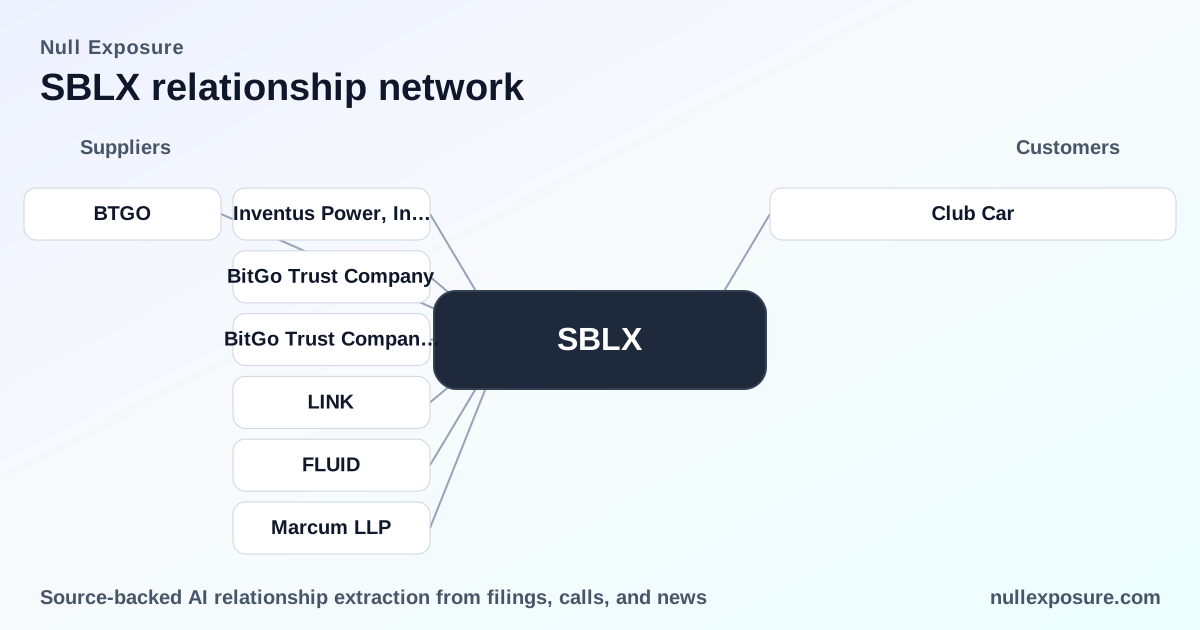
SBLX customer relationships: litigation, OEM traction, and what it means for revenue durability
Sublime Systems (SBLX) manufactures and sells minimal-footprint electric vehicles to commercial and institutional buyers and monetizes through unit sales, warranty and service arrangements, and strategic supplier deals with larger OEM channels. Revenue is produced entirely in the United States and concentrated in a single manufacturing segment, while the company is simultaneously pursuing tier-one supplier pathways into major automotive OEMs. For a concise commercial intelligence feed and deeper customer-risk mapping, visit https://nullexposure.com/.
Quick commercial thesis — one sentence
SBLX is a single‑segment EV manufacturer selling directly and through industrial partners; its near-term revenue profile depends on contract stability with commercial fleet buyers and on converting channel relationships with large OEMs into repeat purchase orders.
The Club Car relationship: contractual dispute on record
Club Car filed suit against SBLX’s subsidiary over a procurement contract, alleging breach related to vehicle defects and the termination of warranty support after the master procurement agreement ended. According to SBLX’s FY2024 Form 10‑K, Club Car lodged a complaint in the Superior Court of Columbia County, Georgia (Civil Action File No. 2023ECV0838) alleging that SBLX breached the March 5, 2019 master procurement agreement by delivering defective vehicles and ceasing warranty support following termination of the MPA. This is active litigation disclosed in the company’s FY2024 filing. (Source: SBLX FY2024 Form 10‑K)
What that dispute signals for counterparty risk
The Club Car complaint is a direct illustration of operational and contractual friction with a commercial fleet customer, showing that end‑user product performance and warranty commitments are material to customer retention and reputation. The dispute reinforces the importance of clear warranty protocols and transition plans when procurement agreements are terminated.
Company-level commercial signals and constraints (how SBLX runs the business)
The available company disclosures surface several company-wide constraints that shape SBLX’s operating model and risk profile:
-
Tier‑one OEM access: In December 2024, SBLX disclosed it was named a tier‑one supplier for General Motors through a partnership with GLV and obtained its first purchase order from a top‑three U.S. automotive manufacturer. This is a structural change to the company’s contracting posture: moving from direct commercial fleet sales to supplier relationships with very large enterprises, which introduces larger, longer sales cycles but materially higher order sizes and concentration risk. (Source: company disclosures, December 2024 / FY2024 filings)
-
Geographic concentration: SBLX reports that all revenue for FY2024 and FY2023 was generated in the United States. Revenue concentration in one geography increases exposure to U.S. fleet procurement cycles, subsidy regimes, and regional supply‑chain disruptions. (Source: SBLX FY2024 Form 10‑K)
-
Single-segment manufacturing model: The company operates as one business segment focused on manufacturing and selling environmentally conscious, minimal‑footprint EVs. This operational simplicity reduces diversification but increases sensitivity to manufacturing throughput, quality control, and component supply constraints. (Source: SBLX FY2024 Form 10‑K)
Taken together, these constraints define SBLX’s commercial posture: a manufacturing-first company that must manage OEM contracting rigor while safeguarding direct fleet customer relationships and warranty exposure.
If you want a snapshot of how these customer constraints map to counterparty risk, see more at https://nullexposure.com/.
Key takeaways for investors and operators
- Customer litigation is active and material. The Club Car complaint illustrates that warranty and defect claims can escalate to civil litigation and affect commercial relationships. (Source: SBLX FY2024 Form 10‑K)
- OEM channel upside is real but concentrates risk. Becoming a tier‑one supplier to a major OEM introduces potential for large orders but also increases dependence on a few very large counterparties. (Source: company disclosure, December 2024)
- Single‑geography, single‑segment exposure. All revenue is U.S.-sourced and the business runs one manufacturing segment, amplifying operational risk from domestic supply chain shocks and demand cycles. (Source: SBLX FY2024 Form 10‑K)
Practical implications — what to watch next
For investors:
- Monitor updates to the Club Car litigation in subsequent SEC filings and court dockets; adverse rulings or settlements could pressure margins or require increased warranty reserves.
- Track order flow and confirmation from OEM partnerships (notably the disclosed GM relationship via GLV). Sustained, repeat purchase orders from OEMs are the primary path to scale and to de‑risk unit economics.
For operators and risk managers:
- Prioritize warranty process improvements and contractual clarity on end‑of‑MPA obligations to reduce litigation risk with fleet customers.
- Strengthen quality assurance controls and supplier continuity plans given the single‑segment manufacturing profile and U.S. revenue concentration.
Final read — balancing scale and concentration
SBLX is at an inflection point: the company runs a focused manufacturing operation with direct exposure to fleet customer warranty risk while simultaneously entering high‑value OEM supply channels that can materially change revenue dynamics. The Club Car litigation is a near‑term commercial headline and a reminder that product quality, warranty execution, and contract wind‑down procedures directly affect investor outcomes. The longer-term question for stakeholders is whether OEM partnerships translate into scale before single‑customer or geographic concentration creates downside volatility.
For a structured customer-risk assessment and continuous monitoring of SBLX relationships, visit https://nullexposure.com/ to access our coverage and alerts.