Sabra Healthcare REIT (SBRA): Customer Relationships and Operational Constraints That Drive Predictable Rent Streams
Sabra Healthcare REIT owns and leases healthcare real estate—primarily skilled nursing, transitional care, and senior-housing properties—and monetizes through long-term, triple‑net leases with third‑party operators plus ancillary revenue from managed senior housing. Its business model delivers stable, contract‑anchored cash flow with geographic scale across the U.S. and Canada, while operator performance and portfolio mix drive near‑term cash variability. For a concentrated, signal‑driven read on operator relationships and contract characteristics, see the coverage at https://nullexposure.com/.
Why landlords like Sabra look like fixed‑income proxies — and where the risk lives
Sabra’s core revenue is rent collected under leases rather than operating margins from care delivery. That structure creates two defining investor characteristics:
- Predictability through contract tenure. Sabra reports a weighted‑average lease remaining term of roughly seven years for the vast majority of its leased portfolio, which yields multi‑year cash‑flow visibility and a contracting posture tilted toward long‑dated landlord claims rather than daily operational exposure.
- Operator‑execution risk, not property risk. Because most properties are leased triple‑net to operators, Sabra’s cash flows depend on tenants’ ability to run facilities and cover rent; occupancy, Medicaid rate dynamics, and specific operator performance are the principal credit levers.
- North American footprint with low counterparty concentration. The company operates across the U.S. and Canada and discloses that no single tenant accounted for 10% or more of revenue in 2025, implying diversified operator exposure — a materiality signal that reduces single‑counterparty tail risk but elevates portfolio monitoring complexity.
These characteristics make Sabra structurally similar to a fixed‑income instrument held against operating counterparties rather than an operating healthcare business. Investors should therefore underwrite both lease durability and the creditworthiness of top operators.
Contract and revenue features that matter for valuation
Sabra’s financial model is shaped by a small set of contract characteristics that investors should underwrite explicitly:
- Long‑term, triple‑net leases dominate. The company disclosed that most properties (excluding certain senior‑housing managed communities) are on triple‑net operating leases with terms up to 18 years and a weighted average remaining term of seven years — a structural source of recurring rent.
- Ancillary services generate usage‑based revenue. For Senior Housing – Managed communities, Sabra recognizes ancillary service revenue as services are provided and bills residents in arrears, indicating a usage‑based revenue component that is variable with occupancy and resident consumption.
- North American geographic scope. Properties and bed counts are spread across the United States and Canada, which reduces single‑market policy exposure while sustaining dependency on U.S. Medicaid and state reimbursement cycles.
- Low tenant concentration. Public filings for 2025 show no tenant represented 10%+ of revenue, signaling immaterial concentration risk at the top‑counterparty level but requiring breadth of operator due diligence.
- Active landlord posture. Sabra acts primarily as a lessor/licensor of real estate and collects rent rather than operating facilities directly in most instances; the company is therefore exposed to operator credit but insulated from day‑to‑day care operations.
Together, these signals indicate a business model that prioritizes contractual cash flow and portfolio diversification while retaining exposure to operator execution and reimbursement trends.
Operator‑by‑operator read: what the public reporting shows
Below are the relationships surfaced in the recent coverage and what each one implies for Sabra’s operator exposure.
Landmark Recovery
Landmark Recovery holds leases with Sabra, and the two organizations have executed a separation that extends to all facilities Landmark leases from Sabra, changing the operator‑landlord dynamic across those assets. This development was reported by BH Business in April 2026 and signals an operator transition event that could affect rent coverage or require lease enforcement actions in the near term (BH Business, Apr 27, 2026).
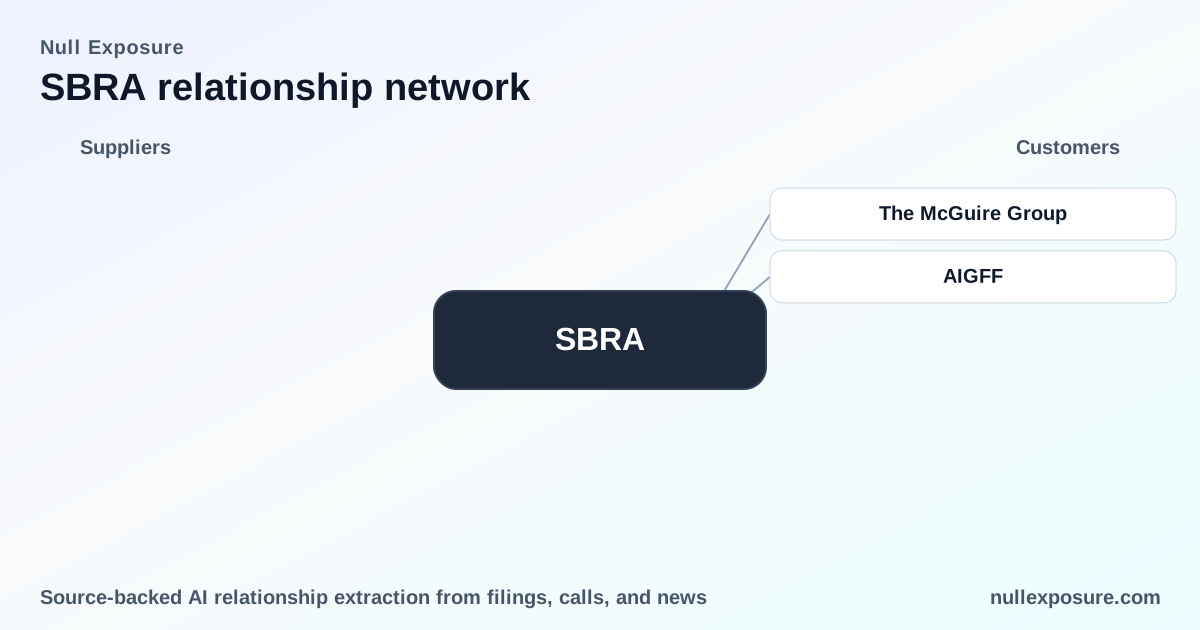
The McGuire Group
The McGuire Group was singled out in coverage as an outlier among Sabra’s top operators on rent coverage: while nine of Sabra’s top ten operators showed improved rent coverage, McGuire lagged the group. That detail was highlighted in Skilled Nursing News coverage of operator performance and Sabra’s portfolio results, underscoring the importance of operator‑level credit monitoring (Skilled Nursing News, Aug 2024).
AIGFF
A Skilled Nursing News report in May 2025 discussed Sabra’s rebalancing of operator exposure and referenced entities tagged in the article; AIGFF was included as an inferred symbol in the report tied to the broader narrative about Sabra reducing exposure to large operators. The mention signals that market watchers and tagging systems associated AIGFF with the coverage of portfolio repositioning at that time (Skilled Nursing News, May 2025).
Genesis
Genesis remains a notable example of operator restructuring in Sabra’s footprint: Sabra reduced its exposure to Genesis over time, but Genesis continues to operate a subset of facilities under long‑term lease agreements with Sabra. That dynamic—reported in May 2025—illustrates Sabra’s willingness to rebalance operator concentration while maintaining contractual landlord relationships where lease economics remain acceptable (Skilled Nursing News, May 2025).
Investor implications and risk checklist
Investors underwriting SBRA should focus on these priority items:
- Operator credit trends. Because Sabra’s income is lease‑dependent, investors should monitor coverage ratios, occupancy, and reimbursement trends for top operators (e.g., McGuire, Genesis, Landmark exposures).
- Lease durability and enforceability. The prevalence of triple‑net leases with multi‑year terms is a strength, but lease remedies and collateral values vary; legal and market feasibility of lease enforcement should be stress‑tested.
- Portfolio mix between leased and managed properties. Managed senior‑housing units introduce usage‑based revenue volatility; changes in occupancy can affect near‑term revenue more than pure triple‑net assets.
- Geographic and payor diversification. North American scale reduces single‑state Medicaid policy risk, but regional reimbursement shocks remain a primary macro threat.
If you want a structured extraction of operator signals and the supporting evidence for due diligence, visit https://nullexposure.com/ to see how relationship sourcing maps to filings and reporting.
Bottom line
Sabra’s value lies in contractual rent streams backed by long lease terms and a geographically diversified portfolio, while operator credit and occupancy trends drive the principal earnings risk. The public reporting and news coverage of operators such as Landmark Recovery, The McGuire Group, AIGFF‑tagged entities, and Genesis provide discrete readouts on that operator risk, which investors should fold into cash‑flow and stress scenarios. For relationship‑level intelligence and transparent source links, explore https://nullexposure.com/.