Sabesp (SBS) — Who bought the $500m notes, and what the counterparty map tells investors
Sabesp is the regulated water and sewerage utility serving São Paulo state; it monetizes through tariff-regulated service concessions and generates predictable cash flow from an essential services franchise that is capital-intensive and financing-dependent. The company funds network investment and working capital through a mix of retained earnings, regulated-rate revenues and access to international debt markets — the March 2026 US$500 million senior note transaction is direct evidence of that financing strategy. For a consolidated view of relationship activity and similar counterparty maps, visit https://nullexposure.com/.
The deal in plain English: a financing that signals capital market access
In March 2026 Sabesp sold US$500 million of 5.625% Blue Senior Notes due 2030 to global institutional buyers, using established international banks as initial purchasers to place the issue. The offering structure — dollar-denominated senior notes with a defined term — reflects Sabesp’s ongoing reliance on external debt to fund capex and refinance maturities while preserving operating liquidity. A White & Case press release dated March 10, 2026, documents the banks involved and the advisory roles on the transaction (https://www.whitecase.com/news/press-release/white-case-advises-initial-purchasers-sabesps-us500-million-5625-blue-senior).
Who participated — the full set of counterparties reported
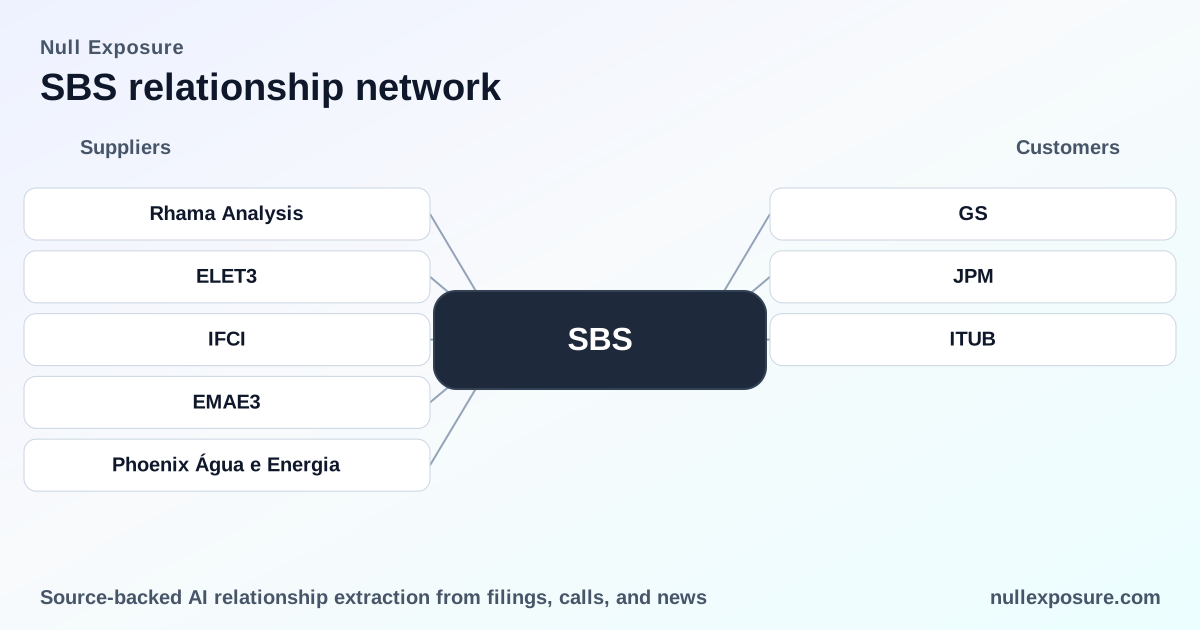
Below are every relationship listed in publicly captured coverage of the transaction, with a concise plain-English summary and the source cited.
-
Goldman Sachs & Co. LLC — acted as an initial purchaser on the US$500 million 5.625% Blue Senior Notes offering, participating in placement and distribution to investors. According to a White & Case press release dated March 10, 2026, Goldman Sachs served alongside other global banks on the transaction (https://www.whitecase.com/news/press-release/white-case-advises-initial-purchasers-sabesps-us500-million-5625-blue-senior).
-
GS — the feed records a second entry labeled “GS,” which corresponds to the Goldman Sachs franchise that served as an initial purchaser for the same March 2026 note offering. The duplication in coverage reflects multiple mentions of the same underwriting participant in press materials from March 10, 2026 (White & Case press release, https://www.whitecase.com/news/press-release/white-case-advises-initial-purchasers-sabesps-us500-million-5625-blue-senior).
-
J.P. Morgan Securities LLC — served as an initial purchaser and distribution lead on the notes, providing underwriting and market placement capability for Sabesp’s US-dollar issuance. White & Case’s March 10, 2026 announcement lists J.P. Morgan among the underwriting syndicate supporting the offering (https://www.whitecase.com/news/press-release/white-case-advises-initial-purchasers-sabesps-us500-million-5625-blue-senior).
-
Itau BBA USA Securities, Inc. — acted as an initial purchaser, representing regional Latin American distribution capacity and local institutional relationships for the offering. The March 10, 2026 press release from White & Case identifies Itau BBA as a named purchaser in the transaction (https://www.whitecase.com/news/press-release/white-case-advises-initial-purchasers-sabesps-us500-million-5625-blue-senior).
What the counterparty set reveals about Sabesp’s business model and execution posture
The composition of the underwriting group and the instrument itself yield several actionable signals about Sabesp’s operating profile:
-
Corporate financing posture: proactive, market-dependent. Sabesp accesses international credit markets with senior unsecured notes, demonstrating a willingness to tap dollar funding to match tenor and investor demand rather than rely solely on domestic banks.
-
Concentration and partner selection: global banks plus regional strongholds. The syndicate combines global bulge-bracket distribution (Goldman Sachs, J.P. Morgan) with Latin-American specialist capability (Itau BBA), signaling a dual distribution strategy to reach both global fixed-income investors and regional institutional accounts.
-
Business criticality and maturity: regulated, cash-generative, capital intensive. Sabesp’s FY2025 financials show scale consistent with a mature regulated utility — Revenue TTM roughly BRL 38.1 billion and EBITDA near BRL 14.5 billion — which supports repeat access to debt markets for capex and refinancing (company filings and FY2025 financials).
-
Counterparty selection reflects low beta credit risk profile. Banks willing to underwrite dollar senior notes for Sabesp evidence investor appetite premised on regulated revenue streams and predictable cash flow; the coupon and tenor balance investor return against regulatory and political risk.
Constraints and company-level signals investors should fold into valuation
With no transaction-specific constraints reported in the capture, treat the following as company-level operating characteristics derived from Sabesp’s sector and financial profile:
-
Contracting posture: Sabesp operates under regulated concession frameworks that enforce long-term tariff rules and service obligations, which drives revenue stability but exposes cash flow to regulatory revisions.
-
Criticality: Water and sewerage services are essential, giving Sabesp high operational criticality and political visibility; tariff resets and public policy changes are a primary governance risk vector.
-
Concentration: The business is concentrated geographically in São Paulo state, which produces scale benefits and single-jurisdiction regulatory exposure. Concentration elevates political and regulatory sensitivity but supports predictable demand economics.
-
Maturity: Sabesp is a mature utility with established revenue streams and recurring capex needs; the company’s access to international debt markets is consistent with an advanced financing program rather than early-stage capital raising.
Risk checklist for research teams and investors
- Interest-rate and currency exposure: Dollar issuance reduces local refinancing pressure but creates FX or natural hedge considerations if revenues are local-currency denominated.
- Regulatory and political risk: Tariff resets and government policy directly influence revenue trajectories.
- Debt servicing and leverage: Frequent access to debt markets signals refinancing risk if market conditions tighten; monitor maturities and covenant profiles.
- Ownership profile: Institutional ownership reported at a low percentage and insider holdings at roughly 3% are notable company-level signals that affect shareholder liquidity and governance dynamics (company disclosures, FY2025).
Bottom line: financing access confirmed, regulatory exposure remains the primary risk
The March 2026 note offering and the named underwriting group confirm that Sabesp retains ready access to international fixed-income investors and that major global banks are willing to underwrite its dollar senior paper. That financing capacity supports capex delivery and balance-sheet management for a capital-intensive regulated utility, but investors must price regulatory and political outcomes as the dominant source of earnings volatility.
For a broader view of institutional relationships and to map counterparty activity across multiple issuances, visit the Null Exposure hub at https://nullexposure.com/.