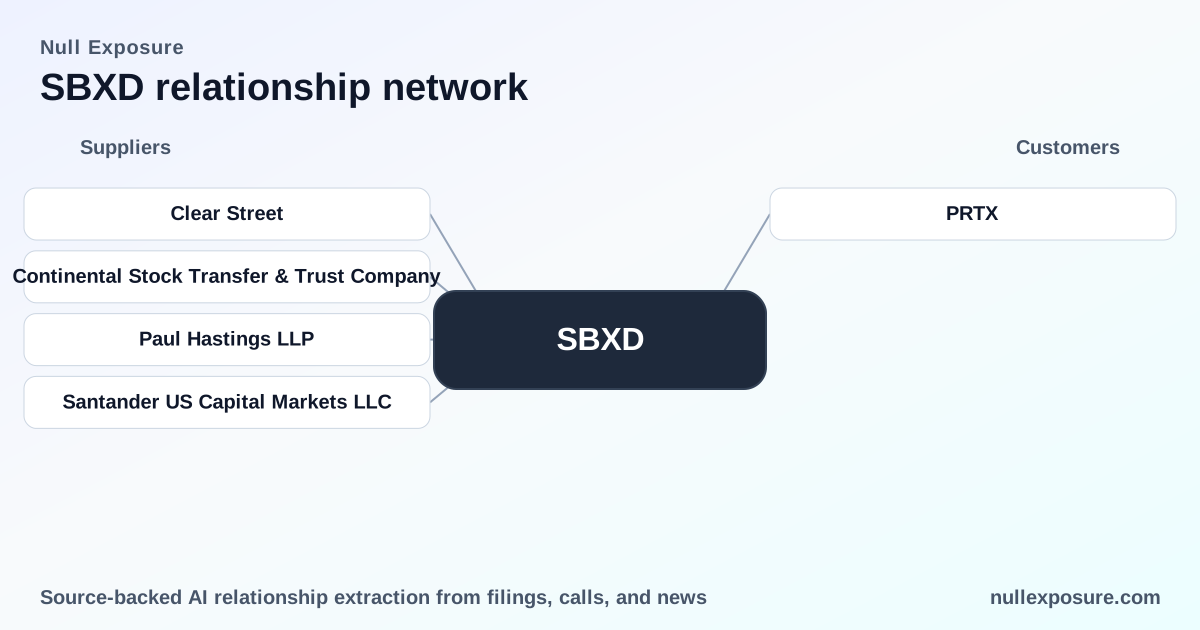
SilverBox Corp IV (SBXD): SPAC economics under the Parataxis funding lens — an investor briefing
SilverBox Corp IV operates as a special purpose acquisition company (SPAC): it holds cash raised in an IPO trust and seeks a business combination, generating value for public investors by completing a merger and unlocking sponsor and PIPE economics post-closing. Monetization for public holders and sponsors is entirely transaction-driven — success depends on consummating a deal that survives shareholder redemptions and delivers operational cash flow or market re-rating. For investors tracking counterparty exposure and deal risk, the near-term story for SBXD is singularly about the funding commitments tied to its announced business combination with Parataxis and the conditionality embedded in those commitments.
Read more at https://nullexposure.com/.
The headline deal: Parataxis brings conditional capital to the merger
Parataxis Holdings is the announced counterparty for SBXD’s business combination and brings the bulk of the committed capital that will seed the post-merger enterprise. Public reporting states the transaction delivers approximately $240 million to Parataxis, but that funding is explicitly subject to SBXD shareholder redemptions, which makes actual delivered capital a function of investor opt-outs. According to Cryptopolitan covering the March 2026 announcement, the Parataxis–SBXD union provides approx. $240 million to the business combination contingent on redemptions. (Cryptopolitan, March 10, 2026.)
The Block’s coverage emphasizes the strategic aim behind the deal: Parataxis intends to form a bitcoin treasury company with combined equity value targets reported in press coverage, and the same $240 million financing is the fulcrum for that plan—again contingent on how many SPAC shareholders redeem. (The Block, May 3, 2026.)
Every relationship found in the search results
-
Parataxis Holdings LLC / inferred ticker PRTX — Cryptopolitan reported that the union between Parataxis and SBXD “provides approximately $240 million to the merger, subject to the redemption of SilverBox Corp IV (SBXD) shareholders,” a contractual condition with direct implications for the deal’s financing profile. (Cryptopolitan, March 10, 2026.)
-
PRTX (duplicate inference) — the same Cryptopolitan notice appears again in the collected results and reiterates that the funding commitment is conditioned on redemption behavior by SBXD shareholders, reinforcing that funding is pledged but not unconditional. (Cryptopolitan, March 10, 2026.)
-
Parataxis Holdings (The Block coverage) — The Block reported the business combination will deliver up to approximately $240 million to Parataxis, and framed the tie-up as the foundation for creating a bitcoin treasury vehicle with larger enterprise ambitions. This source reinforces the size and purpose of the committed capital. (The Block, May 3, 2026.)
How the relationship changes SBXD’s operating and contracting posture
With the Parataxis transaction as the central commercial relationship, SBXD’s operating posture is that of a deal-centric shell: capital availability, not operating revenue, governs valuation and execution risk. Key structural implications:
-
Contracting posture: the merger agreement includes conditional financing language — the $240 million commitment is explicitly subject to shareholder redemptions, which converts investor choices into a direct counterparty risk to Parataxis and a funding risk to the combined entity (this condition is stated in public reporting on the deal).
-
Concentration: funding for the post-merger company is highly concentrated; a single counterparty (Parataxis and the associated financing package) supplies the bulk of near-term capital. That concentration creates single-point failure potential if redemption or financing terms change.
-
Criticality: completion of the business combination is critical to SBXD’s transition from a holding vehicle with cash-in-trust to an operating public company; absent completion, SPAC economics generally return trust assets to redeeming investors and leave sponsors with diluted or forfeited upside.
-
Maturity: SBXD is pre-operational by design (a shell); the company reports no revenue and zero operating profit on its public profile, so maturity is tied to transaction closing, not organic growth.
Read more context on cross-counterparty exposures and SPAC mechanics at https://nullexposure.com/.
Operational signals and a succinct risk checklist
SBXD’s public metrics and corporate description underline the deal-centric nature of the instrument rather than an operating business model:
- Company type: Listed as a shell/SPAC (industry: SHELL COMPANIES), headquartered in Austin, Texas; fiscal year end December.
- Financial posture: Market capitalization ~$273 million and publicly reported EPS of $0.22 with a trailing P/E of 48.82, but revenue TTM is reported as zero — valuations here reflect deal expectations, not recurring cash flow.
- Balance and returns: Book value is negative on reported figures and return metrics are effectively non-operational, reinforcing the SPAC-as-vehicle profile rather than an operating enterprise.
- Counterparty conditionality: The Parataxis funding is conditioned on SBXD shareholder redemptions — this is a structural constraint embedded in the deal and the single most material near-term risk driver for investors.
Operationally, the checklist for investors and operators includes monitoring (1) actual shareholder redemption rates at the vote, (2) any augmenting PIPE or sponsor backstops that reduce single-counterparty concentration, and (3) disclosure updates from SBXD and Parataxis about definitive financing and post-close capitalization.
What this means for investors and operators
-
For investors: SBXD’s public equity is a ticket on transaction execution and redemption dynamics; returns will be realized or lost based on closing mechanics and how much of the advertised $240 million actually reaches the combined entity. The balance sheet and listed metrics do not reflect an independent operating franchise.
-
For operators and potential counterparties: negotiating protections against redemption-driven funding shortfalls is essential. Contract terms that include sponsor backstops, alternative PIPE commitments, or contingent financing tranches materially affect execution risk and the stability of any post-merger plan (for example, Parataxis’ bitcoin-treasury thesis).
Bottom line: a funding story, not an operating story
SBXD is a classic SPAC vehicle where the equity is a function of deal closure rather than operating performance. The Parataxis relationship provides the critical funding pathway — approximately $240 million — but that pathway is conditional on shareholder redemptions, which converts retail and institutional opt-outs into real capital risk. Investors should value SBXD with the discipline used for contingent financing vehicles: price the probability of full funding and successful integration, monitor redemption tallies closely, and treat sponsor/PIPE support as the decisive variable for downside protection and upside capture.
For a practical tracker of SPAC counterparties, financing conditionality, and concentrated capital commitments, visit https://nullexposure.com/ for ongoing briefings and deal monitoring.