SCHW-P-D Customer Relationships: Custody Wins and Migration Exposure
Charles Schwab operates as a full-service custodian and broker-dealer, monetizing through custody and clearing fees, interest on client cash and margin, transaction-related revenue, and asset-servicing economics such as securities lending and recordkeeping. For investors assessing SCHW-P-D customer exposure, the current public coverage highlights Schwab’s role as a primary custodian for advisory networks and its operational gravity in broker-dealer consolidations.
If you want a concise feed of relationship-level intelligence for due diligence or portfolio risk monitoring, visit https://nullexposure.com/ for an integrated view of these customer signals.
Quick take: what the relationship feed highlights
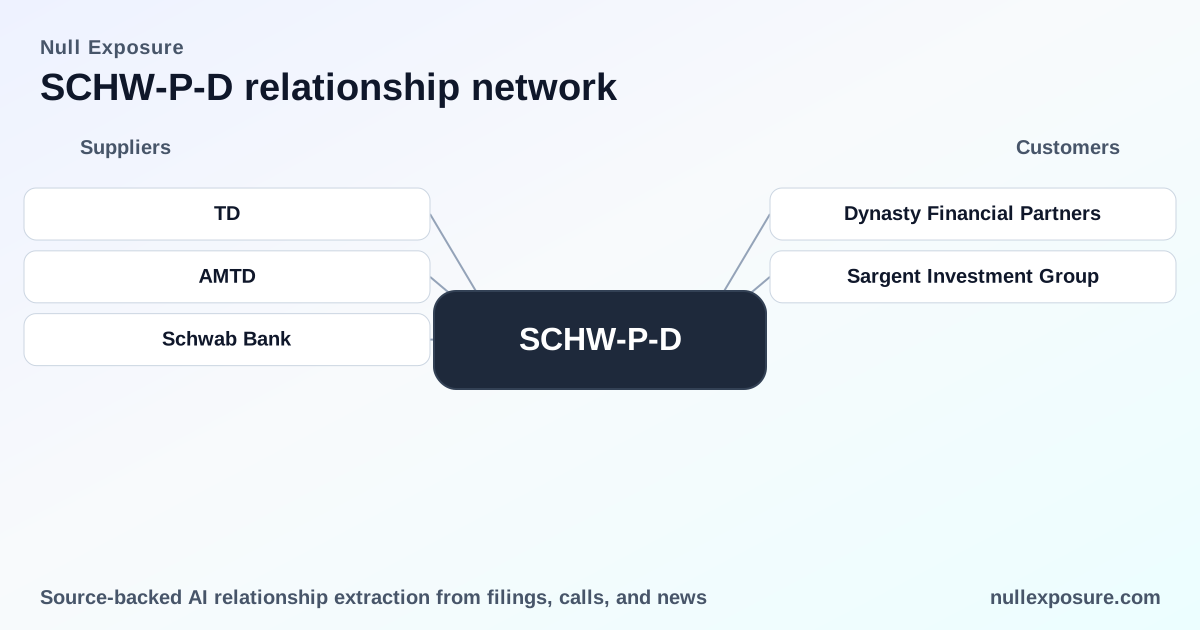
The public results for SCHW-P-D document two customer relationships focused on custody and migration dynamics. Both entries emphasize Schwab’s core competency as a custodian — one showing deep penetration in an advisory network and the other reflecting migration pressure tied to another broker-dealer integration. These are direct customer-level signals that map to revenue stability on custody flows and operational exposure during integrations.
Dynasty Financial Partners — custodian for the bulk of Dynasty AUA
Schwab serves as the custodian for over half of the $72 billion in assets under advisement in the Dynasty network, signaling a materially entrenched custody position within that advisor ecosystem. According to an InvestmentNews article dated March 10, 2026 (reporting on FY2022 figures), this scale of custody represents meaningful asset custody economics and distribution leverage for Schwab. https://www.investmentnews.com/independent-broker-dealers/dynasty-ipo-is-still-in-the-cards-shirl-penney-says/230495
Sargent Investment Group — migration point during a TD integration
As TD Ameritrade integrates, Sargent Investment Group indicated it would have needed to migrate client accounts to Schwab during the final stages of the TD integration over Labor Day weekend, underscoring Schwab’s operational role in takedown and migration workstreams tied to broker-dealer consolidations. This detail was reported by AdvisorHub in a March 2026 note referencing FY2023 operational timing. https://www.advisorhub.com/maryland-ria-managing-1-billion-adds-goldman-sachs-as-custodian/
What the feed did not capture — constraint signals (company-level)
The relationship-level constraint extract contains no recorded contractual constraints, exclusivity clauses, migration deadlines, or formal risk flags. This absence is itself a signal: there are no captured legal or contractual red flags in the feed for SCHW-P-D. Treat this as a neutral company-level position rather than evidence of guaranteed stability — normal commercial terms, service-level agreements, and integration playbooks remain off-record in this feed.
If you want continuous monitoring of changes to these signals and immediate alerts when constraints or new relationships surface, explore the monitoring options at https://nullexposure.com/.
Operating-model characteristics investors should internalize
- Contracting posture: Enterprise-grade custody contracts dominate Schwab’s customer relationships. The firm structures long-term custody and clearing agreements with advisory platforms and RIAs that emphasize settlement reliability, data connectivity, and operational SLAs rather than purely transactional terms.
- Concentration dynamics: The feed shows meaningful concentration within specific advisory networks, evidenced by Schwab’s custody of over half of Dynasty’s AUA. Concentration like this amplifies custody economics but elevates client-specific risk if an advisory network were to replatform.
- Criticality of service: Custody and migration services are mission-critical to clients’ day-to-day operations; a custodian’s reliability directly affects adviser continuity and client experience, making operational outages or migration errors high-impact events.
- Maturity and market positioning: Schwab’s role in broker-dealer integrations and as a default custodian for migration scenarios reflects a mature, dominant market posture in clearing and custody services among RIAs and independent platforms.
Strategic and risk takeaways for investors
- Revenue stability from custody flows is a core strength. Large custody relationships like the one with Dynasty produce recurring fee and interest income and create stickiness through operational integration and data flows.
- Concentration creates optionality and risk at the same time. Deep penetration into an advisory network supports higher revenue per relationship but raises the stakes if competitive replatforming occurs.
- Integration events are both opportunity and hazard. The Sargent Investment Group note underscores that merger-and-integration windows generate transactional revenue (migration fees, onboarding) but also present execution risk that can affect client retention and reputation if handled poorly.
- Absence of recorded contractual constraints reduces headline risk in the feed but does not eliminate commercial complexity. Investors should interpret the empty constraints list as a lack of captured public contract anomalies, not a substitute for legal diligence on major custody contracts.
Bottom line for portfolio managers and operators
The public relationship signals for SCHW-P-D point to custody-led revenue durability coupled with exposure to concentrated advisory networks and migration-driven operational cycles. These are classic characteristics of a market-leading custodian: steady recurring economics, episodic integration-driven revenue, and concentrated pockets of client dependency.
For ongoing tracking and deeper relationship mapping that ties custody exposure to counterparty events and integration calendars, visit https://nullexposure.com/ to subscribe to continuous monitoring and alerts.