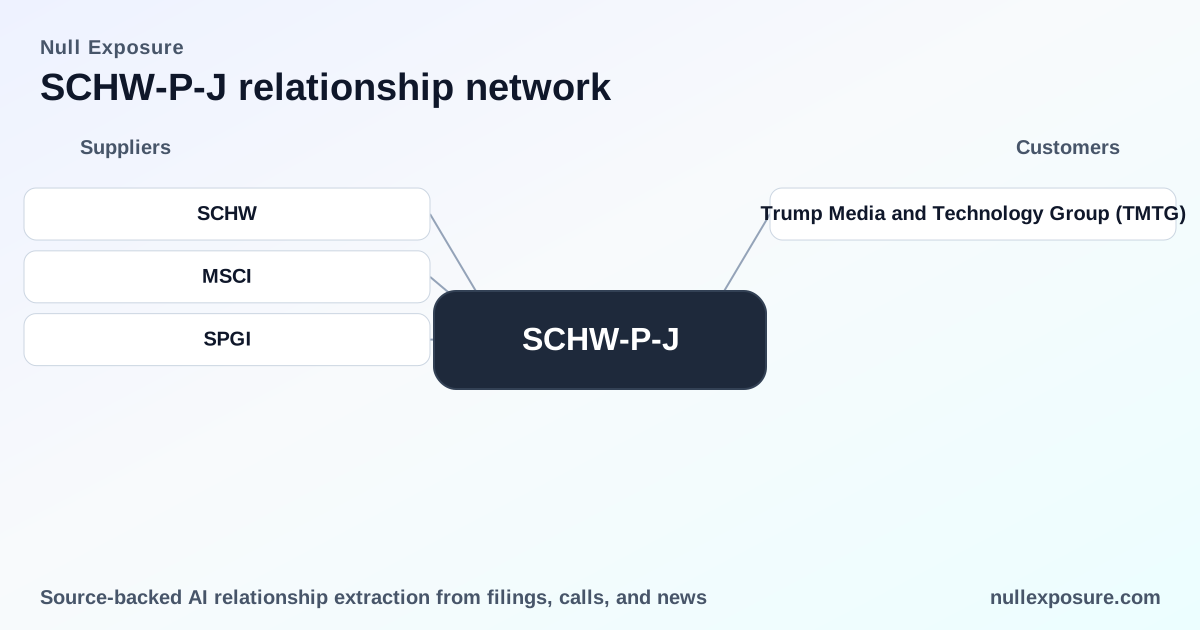
SCHW‑P‑J: Customer Relationships That Signal Strategic Product Extensions
Charles Schwab operates and monetizes as a diversified financial services platform: a custody and brokerage franchise that earns through trading spreads and commissions, asset management and advisory fees, interest on client balances and margin loans, and fee‑based product packaging such as ETFs and crypto trading services. The company leverages scale and product depth to cross‑sell higher‑margin solutions to institutional and retail clients while capturing recurring fee streams from custody, advisory, and exchange services. For maps of corporate customer linkages and relationship intelligence, visit https://nullexposure.com/.
Why a single customer mention matters for operators and investors
The recent customer mention under SCHW‑P‑J is small in count but strategic in content: it documents Schwab’s role as a provider of customized ETFs and cryptocurrency services to a high‑profile, politically exposed platform. That positioning is relevant to revenue mix, regulatory exposure, and brand risk. Investors should read this as evidence that Schwab executes product partnerships that extend beyond classic custody and trading toward bespoke product engineering for third‑party platforms.
The relationship in plain English
Trump Media and Technology Group (TMTG)
Charles Schwab partnered with Trump Media and Technology Group in January 2025 to provide customized exchange‑traded funds and cryptocurrency services for the “Truth.Fi” platform, according to media coverage. This represents a commercial arrangement where Schwab supplies product execution and custody-like services to a nonbank platform seeking investment and crypto functionality. (TradingView coverage of a Cointelegraph report, March 2026)
What this single relationship implies for the operating model
- Contracting posture (company‑level signal): The lack of multiple disclosed constraints in the customer results signals that Charles Schwab routinely executes commercial partnership agreements with third parties under standard industry terms; these agreements are likely modular and product‑specific rather than enterprise‑wide master contracts requiring public disclosure. This operational posture supports rapid product deployment for clients that need ETF listing, custody, or exchange access.
- Concentration: A single high‑profile partnership does not create material customer concentration for Schwab, given its large retail and institutional base; however, targeted bespoke arrangements can concentrate revenue within niche product teams, creating small but profitably concentrated revenue pools tied to specific partners.
- Criticality: Bespoke ETF and crypto services are operationally critical to product teams because they require integration with trading, custody, and compliance functions; failure or regulatory intervention in these services would have outsized reputational consequences despite modest absolute revenue.
- Maturity: The engagement model—delivering white‑label ETFs and crypto execution to third parties—reflects a mature product capability that Schwab has scaled across institutional and retail channels, enabling faster commercial rollouts.
Commercial and strategic implications for investors
Investors should track three vectors from this relationship:
- Revenue diversification and cross‑sell: Customized ETF and crypto work leverages Schwab’s core custody and execution capabilities into higher‑margin product creation, supporting revenue per client uplift without large incremental acquisition cost.
- Regulatory and reputational exposure: Providing services to politically exposed or controversial platforms concentrates compliance and reputational risk inside product teams even if absolute revenue is small; investors must factor potential headline risk into valuation multiples.
- Product moat reinforcement: Delivering turnkey ETFs and crypto infrastructure to third parties strengthens Schwab’s competitive position versus pure‑play asset managers and crypto exchanges by offering an integrated stack of distribution, custody, and product manufacturing.
Relationship-by-relationship review (complete)
- Trump Media and Technology Group (TMTG): In January 2025, Schwab agreed to provide custom ETFs and cryptocurrency services for the Truth.Fi platform, signaling a direct vendor relationship where Schwab supplies financial product architecture and execution to a third‑party media/tech operator. (TradingView/Cointelegraph coverage, reported March 2026)
Risk profile distilled
- Regulatory risk is elevated when Schwab supplies crypto custody or trading services to politically exposed entities; these services attract closer scrutiny from regulators and can require enhanced compliance resources.
- Reputational risk is concentrated in a narrow operational corridor—product issuance and third‑party integrations—where an adverse event would generate outsized media attention relative to the revenue involved.
- Commercial upside is real: bespoke product arrangements scale Schwab’s fee base and lock in distribution relationships that competitors cannot easily replicate without comparable custody and compliance scale.
Practical takeaways for portfolio managers and operators
- Monitor headline customers that are politically or culturally high profile; small deals can have asymmetric reputational effects.
- Treat Schwab’s third‑party product services as strategic leverage—they expand the firm’s addressable market beyond retail and institutional clients into platforms that require embedded finance.
- Assess compliance spending trajectory: growth in bespoke crypto and ETF relationships should be matched by visible investment in compliance and operational controls.
For a more systematic view of Schwab’s counterparty relationships and customer‑level exposure analysis, explore the company mapping tools at https://nullexposure.com/.
Final judgment
Charles Schwab is executing a deliberate product extension strategy: using custody, execution, and product engineering capabilities to monetize third‑party distribution through bespoke ETF and crypto services. That strategy enhances revenue diversification and reinforces Schwab’s settlement and custody moat, while concentrating regulatory and reputational risk into a narrow set of product integrations. Investors should value the revenue upside alongside the incremental compliance costs and headline risk exposure.