Service Corporation International (SCI): customer relationships, divestitures, and what they signal for investors
Service Corporation International operates and monetizes by selling funeral and cemetery merchandise and services both at the time of need and through price‑guaranteed preneed contracts, while also owning and operating a geographically diversified network of funeral homes and cemeteries across North America. The company generates recurring and service revenue from individual consumers, converts preneed liabilities into future service delivery, and supplements cash flow through opportunistic asset sales and localized consolidation. For a portfolio or operations investor, the business combines stable, cash‑backed revenue from a $17.0 billion preneed backlog with active portfolio management through asset dispositions.
If you want a concise dashboard view for due diligence, start at Null Exposure’s homepage for structured coverage: https://nullexposure.com/.
One‑line investor thesis
SCI’s scale and preneed inventory provide predictable revenue and margin leverage, while selective asset sales and a service‑provider posture compress exposure to macro cyclicality; investors should value SCI as a cash‑flow business with embedded long‑dated service obligations and active balance‑sheet management.
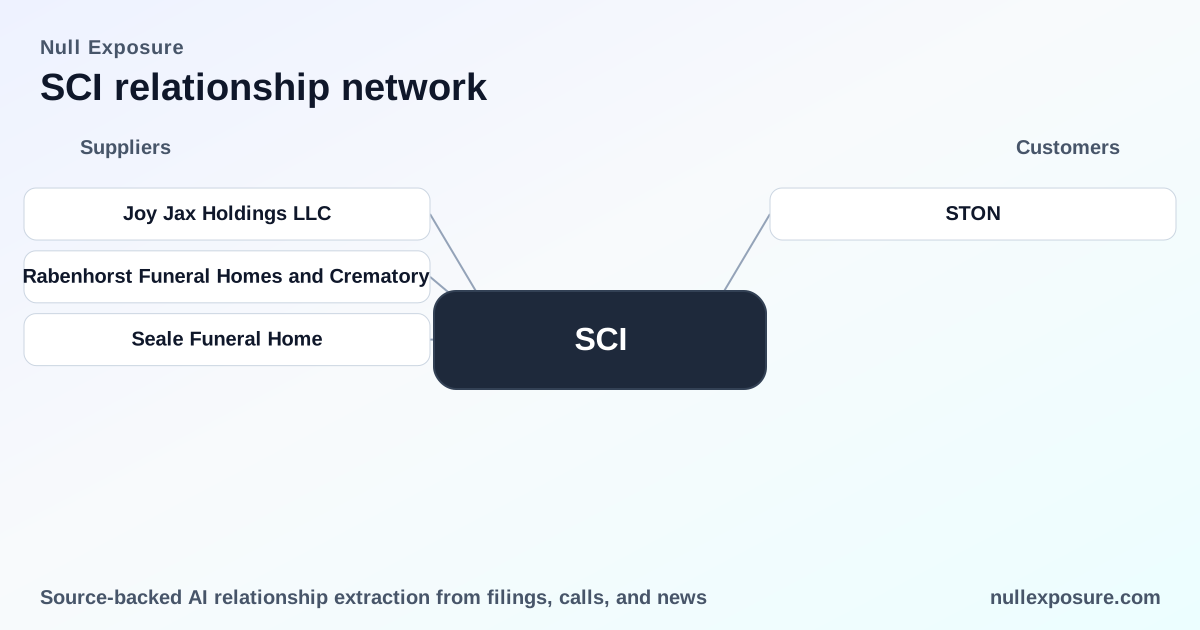
Recorded customer relationships — complete list
The dataset returned two relationship records, both referencing the same historical divestiture. I list both entries below to reflect the source-level granularity.
StoneMor Partners L.P. (STON) — FY2014 disposition
Service Corporation International sold a package of nine funeral homes, 12 cemeteries and two crematories to StoneMor Partners for $53.8 million in cash in a transaction disclosed in 2014. The move represents an example of SCI’s active local portfolio rationalization and monetization of non‑core or overlapping assets. (Source: Philadelphia Inquirer report, April 2014.)
STON (ticker inference STON) — same FY2014 transaction
The second record mirrors the same 2014 transaction to StoneMor Partners L.P., identifying the counterparty with the inferred ticker STON and documenting the $53.8 million cash sale of funeral and cemetery assets. This duplicate entry reiterates the company’s historical practice of selling localized operations to sector peers. (Source: Philadelphia Inquirer report, April 2014.)
Takeaway: both entries document the same material divestiture to StoneMor; SCI executes asset sales as a component of portfolio optimization and cash generation.
How SCI’s customer relationships and contracts shape the operating model
SCI’s public disclosures and financials describe a mix of contract types and clear counterparty concentration on individuals — these characteristics define contracting posture, concentration, criticality, and maturity.
-
Contracting posture — hybrid of long‑term and spot revenue. SCI sells services at time of need (spot) while also entering price‑guaranteed preneed contracts that lock in future merchandise and service prices. This dual posture supports revenue predictability from preneed while retaining transactional upside and pricing control at death‑time service delivery. (Source: SCI filing, year ended December 31, 2025.)
-
Counterparty concentration — individual consumers across North America. The company serves approximately 700,000 families per year through its Dignity Memorial® brand and similar operations, signaling a high‑volume, low‑ticket per‑counterparty profile with broad geographic diversification across 44 U.S. states, eight Canadian provinces, D.C., and Puerto Rico. This reduces single‑counterparty concentration risk but increases operational complexity. (Source: SCI filing, Dec 31, 2025.)
-
Criticality and materiality — services are core revenue drivers. For the year ended December 31, 2025, SCI reported $4.3 billion in consolidated revenue, with the majority derived from funeral and cemetery merchandise and services, making customer relationships both revenue‑critical and highly material to enterprise value. (Source: SCI filing, FY2025 results.)
-
Maturity and lifecycle — active preneed backlog indicates multi‑year fulfillment horizon. A preneed backlog of $17.0 billion at Dec 31, 2025 (up from $16.0 billion in 2024) shows an active pipeline of contracted future service obligations that convert into revenue over long horizons, requiring careful reserves and trust management. (Source: SCI filing, Dec 31, 2025.)
Collectively, these contract and counterparty signals create a business that is service‑centric, highly recurring, and capital‑light on some lines but capital‑intensive on cemetery land and property.
What the StoneMor transaction reveals about portfolio management
The FY2014 sale to StoneMor is a concrete example of SCI’s pragmatic approach to asset ownership: rather than hold every local footprint, SCI monetizes non‑strategic or redundant properties to free up capital and focus operating resources. The relatively modest size of the transaction ($53.8 million) versus SCI’s multi‑billion revenue base highlights that divestitures are tactical and localized rather than wholesale exits. (Source: Philadelphia Inquirer, April 2014.)
Financial context and market positioning
SCI’s public market profile supports the operating observations:
- Market capitalization roughly $10.85 billion and TTM revenue $4.33 billion, implying a scale that justifies national platform economics. (Source: company market data as of latest quarter 2026‑03‑31.)
- EBITDA is reported at $1.318 billion, giving an EV/EBITDA ~12x, consistent with a mature, cash‑generative services company in a defensive industry. (Source: company financials.)
- Analyst coverage is positive: consensus target $96.33 and ratings skewed to Buy/Strong Buy among professional analysts. (Source: sell‑side summary.)
Key investment signal: SCI trades as a large, stable consumer‑services operator with predictable margins, a history of localized portfolio sales, and solid analyst sentiment.
Risks and operational frictions investors must weigh
- Preneed obligations create long‑dated liabilities. The $17.0 billion backlog is an asset for future revenue but requires robust trust accounting and reserve adequacy; mispricing or investment shortfalls in trusts would stress cash flow timing. (Source: SCI filing, Dec 31, 2025.)
- Regulatory and reputation risk is persistent. Death‑care services are tightly regulated at state and provincial levels and sensitive to reputational issues, which can translate quickly into local demand shocks.
- Asset mix includes real estate exposure. Cemetery land and buildings create capital intensity and potential regional concentration risk despite broad geographic coverage.
- Operational scale demands execution on a decentralized platform. Managing 1,485 funeral service locations and 500 cemeteries across jurisdictions introduces operational complexity and integration risk for acquisitions and dispositions. (Source: SCI filing, Dec 31, 2025.)
Conclusion: what investors should watch next
SCI’s business model balances a durable preneed base with active local portfolio management, as evidenced by historical divestitures like the StoneMor sale. Monitor quarterly conversion rates of preneed backlog, trust performance and reserve adequacy, and the cadence of asset sales—each will drive near‑term cash flow and longer‑term valuation. For focused coverage and transaction‑level intelligence, see Null Exposure’s hub for operator and investor research: https://nullexposure.com/.
Bold final takeaway: SCI’s value proposition is predictable, service‑driven cash flow paired with disciplined asset monetization — investors should underwrite both the preneed conversion mechanics and the company’s execution on localized portfolio optimization.