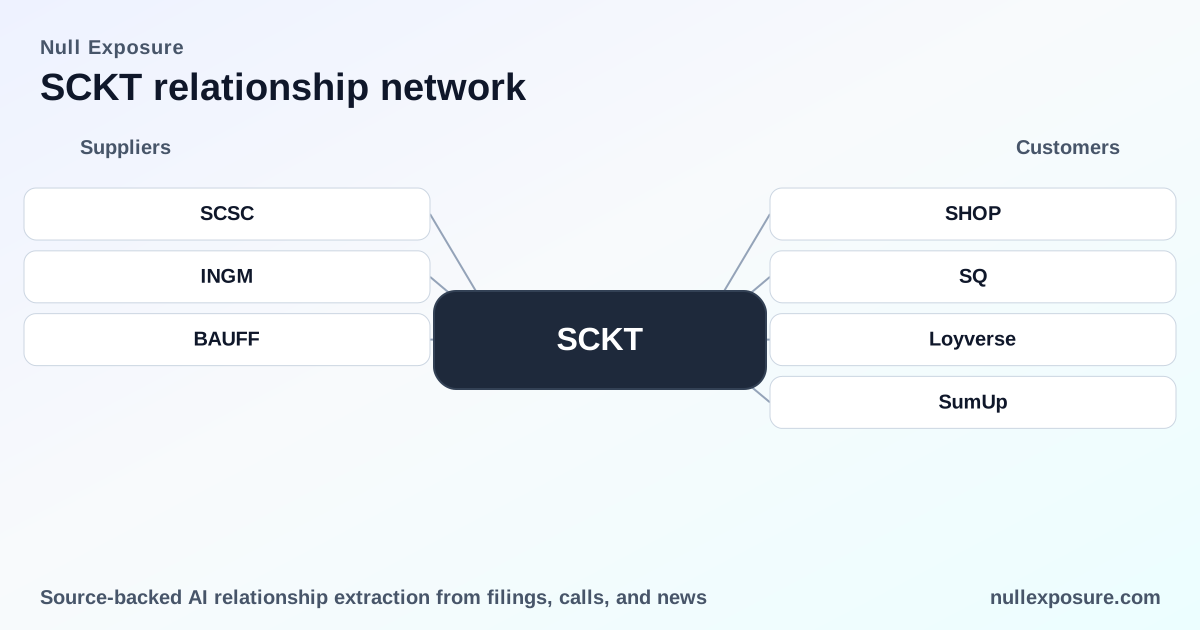
SCKT: How Socket Mobile converts ecosystem integrations into repeatable revenue
Socket Mobile sells Bluetooth data-capture hardware and a developer-facing CaptureSDK that embeds barcode scanning into third-party point-of-sale and mobile applications. The company monetizes through device sales, multi-year extended-warranty services (SocketCare) recognized ratably, and recurring channel throughput enabled by app integrations and distributor/reseller relationships — a hybrid product-plus-services model that trades high gross margin potential on software enablement for concentration and channel risk on hardware revenue.
For primary research on these customer relationships and how they drive go-to-market execution, see Null Exposure’s platform: https://nullexposure.com/
How the business actually works in the field
Socket Mobile’s commercial model is straightforward: sell hardware to app providers and their end customers, and lock in after-sale service and channel flows via distributors and SDK integrations. The CaptureSDK reduces friction for app developers to adopt Socket Mobile’s barcode scanners, which in turn channels device volume through widely used POS applications. SocketCare warranty contracts (three- and five-year terms) convert one-time hardware sales into time‑bound service revenue recognized over contract life. This structure amplifies the importance of a small set of channel relationships and app partners to ongoing topline stability.
Key operational characteristics: long-term service contracts on the installed base, concentrated distributor/reseller channels, mixed geography with U.S. domestic profitability and global distribution, and a business that combines a mature hardware line with growing software enablement.
Customer relationships that matter today — the practical read-throughs
Below I walk through every customer relationship surfaced in recent market coverage and company releases and what each implies for execution and revenue flows.
Shopify — integration expands addressable merchant base
Socket Mobile announced that Shopify’s platform (version 11.0.0) now supports the SocketScan S721 and S741, enabling merchants that run Shopify’s POS and mobile workflows to use Socket Mobile scanners for point-of-sale, inventory, and ID verification use cases. This integration broadens Socket Mobile’s reach into Shopify’s merchant ecosystem and directly supports hardware adoption through a major commerce platform. (Source: Yahoo Finance / related press coverage, May 2026 — see PR release and syndications.)
Square — direct compatibility with Square’s iOS applications
Socket Mobile’s S721 was launched with explicit compatibility for Square iOS applications (Square Point of Sale, Square Retail, Square Restaurants, Square Appointments v6.86+), positioning the scanner as a drop‑in peripheral for Square merchants using iOS devices. This is a meaningful channel because Square’s ecosystem is both large and transaction-focused, which converts device compatibility into steady replacement and accessory sales. (Source: PR Newswire press release announcing the S721, March 2026.)
Loyverse — POS app compatibility widens SMB penetration
Socket Mobile lists Loyverse among other leading point‑of‑sale applications compatible with the S721, which extends the company’s penetration into small-business and independent retail operators that adopt Loyverse for cost-effective POS solutions. Compatibility with Loyverse supports Socket Mobile’s strategy to target smaller merchants through low-friction app integrations. (Source: PR Newswire S721 product announcement, March 2026.)
SumUp — alternative payments POS channel adds distribution breadth
The S721’s stated compatibility with SumUp brings Socket Mobile into another payments-centric POS ecosystem popular with small merchants in multiple markets, increasing the company’s access to incremental device installs through SumUp’s merchant base. This contributes to distribution breadth beyond the larger platforms like Square and Shopify. (Source: PR Newswire S721 product announcement, March 2026.)
What these relationships collectively signal about SCKT’s model
- Channel-led sales: Socket Mobile’s primary commercial lever is integration with app providers and resellers that bundle hardware with their POS solutions, rather than direct merchant sales. The CaptureSDK is the instrument that makes those integrations effective.
- Concentration risk: The company acknowledges dependence on a limited number of distributors and app partners for a significant portion of sales, which makes platform compatibility wins (Shopify, Square) highly material to near-term volume.
- Contracting posture and revenue profile: The existence of three- and five-year SocketCare contracts moves a portion of revenue recognition from one-time hardware sales to ratable service revenue, improving predictability but increasing the company’s obligations over the installed base.
- Customer mix and criticality: The go-to-market targets include both small-business merchants (via Loyverse, SumUp, Square) and larger digital commerce platforms (Shopify), which creates a two-tier exposure: broad SMB volume but concentrated dependency on a few platform partners.
- Geography and maturity: Socket Mobile reports U.S. operations as the source of pretax income in recent years while maintaining a global distribution network, indicating a domestic profitability center with international reach through resellers and distributors.
Constraints investors should treat as company-level signals
- Long-term service contracts (SocketCare: three- and five-year terms) convert hardware sales into multi-year revenue streams and ongoing service obligations; revenue is recognized ratably over contract durations.
- The customer base is weighted toward small-business-focused app providers and their merchant end-users, consistent with the company’s emphasis on mPOS and tablet-based cash registers.
- Socket Mobile operates with global distribution, but reported pretax income recently derived from U.S. domestic operations, indicating geographic concentration of profitability despite worldwide sales channels.
- The company explicitly expects material reliance on a limited number of distributors, which is a concentration risk for sales and working capital.
- Distribution through resellers and app providers is core to the model; relationships act as both marketing channels and credit shields in certain territories.
- The installed-app provider base is ramping, with registered app providers increasing, which supports long-term SDK-driven adoption but also implies varying maturity across partner relationships.
- Product mix is hardware-first with software enablement: cordless barcode and NFC readers form the majority of product revenue while CaptureSDK provides stickiness and integration value.
If you want a deeper crawler view of these integrations and their commercial timing, visit Null Exposure’s research hub: https://nullexposure.com/
Investment implications and tactical view
Positive read: Compatibility with high-traffic POS platforms (Shopify, Square) is the fastest path to incremental device volume; CaptureSDK lowers switching costs for app partners and creates recurring service possibilities through SocketCare.
Risks: Heavy dependence on a small set of distributors and platform partners concentrates execution risk; hardware margins remain sensitive to volume and component inflation. The company’s small market capitalization and negative trailing profitability mean that platform wins must scale to materially change the financial picture.
Actionable takeaway: Monitor merchant adoption metrics inside Shopify and Square channels and quarterly disclosure on distributor concentration and SocketCare uptake; those variables will drive revenue visibility and valuation re-rating potential.
For ongoing signals, research feeds, and relationship monitoring on SCKT, see Null Exposure’s platform for institutional-grade coverage: https://nullexposure.com/