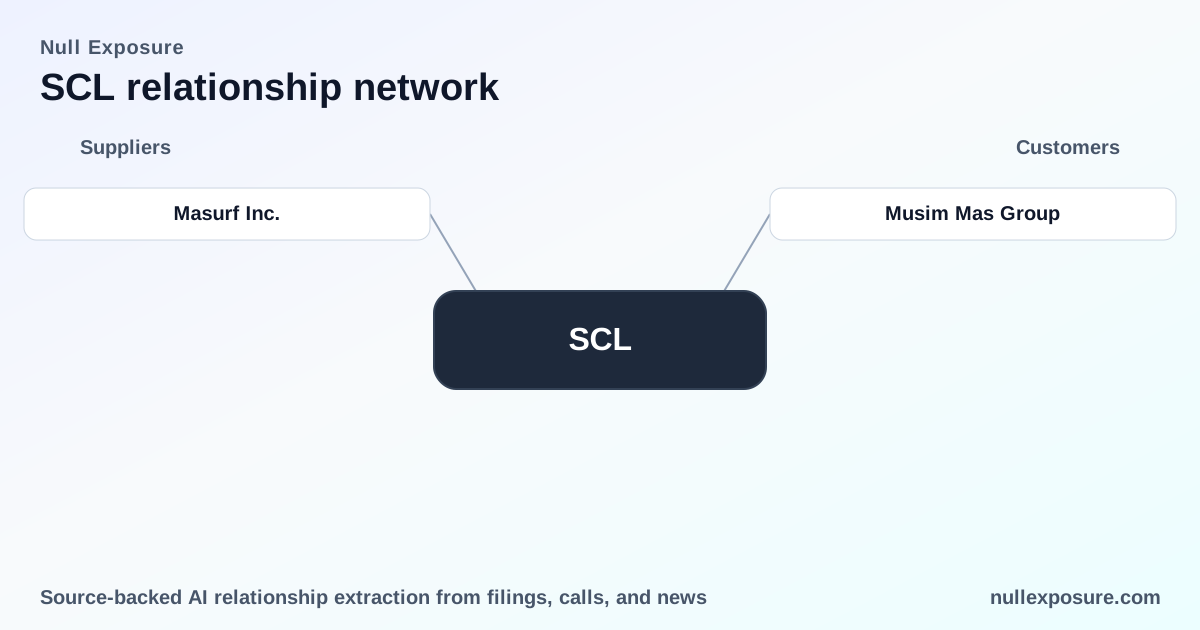
Stepan Company (SCL): Commercial footprint, contract posture, and a notable APAC divestiture
Stepan Company produces and sells specialty and intermediate chemicals—chiefly surfactants, which account for approximately 70% of consolidated net sales—to manufacturers worldwide and monetizes through B2B product sales from a geographically distributed manufacturing base. The company sells under a mix of spot shipments and contractual arrangements, collects trade receivables with standard credit processes, and recognizes occasional long-term deferred revenue tied to customer-funded capital projects. For investors, Stepan is a manufacturing-centric specialty-chemicals operator with broad geographic exposure, low single-customer concentration, and a commercial model that blends recurring framework agreements with transactional flows. For deeper counterparty context and customer-level signals, see Null Exposure’s coverage: https://nullexposure.com/.
How the business actually generates cash and economic exposure
Stepan’s revenue engine is straightforward: manufacture surfactants and intermediate chemicals at multiple sites across North America, Europe, Latin America and Asia, then sell those products to other manufacturers in cleaning, personal care, paints, food, and industrial segments. The company’s publicly disclosed regional sales mix for 2024 highlights a North American revenue base of roughly $894,105 (reported figure), with Europe and Latin America contributing material shares and Asia a smaller but strategic slice; surfactants are made at multiple global sites including a Philippines facility and a Singapore site. According to the company’s 2024 disclosures, no single customer exceeded 10% of consolidated net sales, which limits customer-concentration risk but leaves the firm exposed to commodity and regional demand cycles.
Contracting posture: a pragmatic hybrid of long-term and spot economics
Stepan’s commercial arrangements combine several contract archetypes that shape revenue visibility and working capital:
- Long-term customer-funded capex arrangements exist: the company recorded $10,709,000 in long-term deferred revenue associated with a customer payment to defray capital expenditures; as of December 31, 2024, $4,431,000 of that balance was classified as long-term and $2,216,000 as short-term, with $4,062,000 already recognized from that agreement. These balances give Stepan multi-year revenue recognition tied to customer commitments (company filing, Dec 31, 2024).
- Short-term commercial flows remain common: payment terms typically range 30–60 days, and much of Stepan’s revenue derives from shipments where control transfers at delivery, producing spot-like revenue recognition (company disclosure).
- Framework manufacturing/supply agreements are used, not volume-locks: in many cases Stepan has supply agreements that do not oblige customers to purchase minimum volumes; contractual obligations arise when customers submit purchase orders (company filing).
Combined, these elements create a predictable but not fully captive revenue base—some revenue is secured through long-dated funding arrangements, but much sales activity remains transactional and demand-sensitive.
Where customers and counterparties sit on the maturity and concentration spectrum
Company disclosures position Stepan’s customer book toward large-enterprise buyers across industry verticals and geographies; the firm evaluates creditworthiness using external ratings and financial condition as part of its receivables process. That profile produces two important investor signals:
- Low single-customer concentration: management reports that no customer represented more than 10% of consolidated net sales in 2024, 2023, or 2022, reducing counterparty concentration risk (company filing).
- Global exposure with regional manufacturing footprint: sites in North America, Europe (UK and France), Latin America (Mexico, Brazil, Colombia), and Asia (Philippines and Singapore) map to revenue pools in North America, Europe, Latin America and Asia, so demand, commodity prices, and regional regulation drive differentiated risk/return by geography (company filing).
These characteristics make Stepan a diversified supplier with exposure to global manufacturing cycles rather than a company dependent on a few captive buyers.
Customer relationship: Musim Mas Group (what happened and why it matters)
A March 10, 2026 report in OFI Magazine noted that Indonesia’s Musim Mas Group agreed to acquire a surfactants manufacturing facility in the Philippines from Stepan Company. This transaction transfers ownership of at least one APAC surfactants site out of Stepan’s asset base, and will materially alter the company's operational footprint in the Philippines region (OFI Magazine, March 10, 2026). Investors should treat the sale as a strategic reallocation of regional manufacturing capacity that will influence APAC segment volumes and local cost structures in the near to medium term.
Operational constraints and what they signal about Stepan’s business model
Using the company’s own disclosures, several persistent constraints define Stepan’s operational profile:
- Contract mix: the coexistence of long-term deferred revenue and short-term payment terms means revenue visibility is partially protected by customer-funded capex arrangements while the bulk of demand remains transactional.
- Commercial maturity: many supply relationships are framework-style, with actual obligations created on issuance of purchase orders—this structure reduces guaranteed off-take but preserves commercial flexibility for both parties.
- Counterparty quality: sales skew toward large, diversified manufacturers, lowering credit risk on average but leaving Stepan exposed to cyclical end-market demand across consumer and industrial sectors.
- Geographic diversification: material sales across North America, EMEA, LATAM and APAC distribute market risk but require managing a multi-jurisdictional manufacturing and regulatory footprint.
- Materiality profile: the absence of any single dominant customer (>10% sales) is a corporate-level signal of low customer concentration, though product concentration in surfactants (~70% of net sales) is a separate concentration risk.
These constraints make Stepan operationally resilient but cyclically exposed—it is not dependent on a single buyer, but surfactant demand and regional supply changes (including asset sales) will be the principal drivers of near-term performance.
What investors should monitor next
- Impact of the Philippines facility sale: track the deal’s closing terms, any transitional supply agreements, and the capacity/time-to-market implications for APAC surfactant volumes (OFI Magazine, March 2026).
- Deferred-revenue developments: monitor the balance and recognition schedule of customer-funded capex amounts to assess multi-year revenue visibility (company filing, Dec 31, 2024).
- Regional demand and margin dispersion: with surfactants concentrated in the product mix, regional feedstock costs, shipping dynamics, and local pricing will drive margins.
- Receivables and credit exposure: ongoing evaluation of counterparty credit quality and days sales outstanding will indicate whether short-term working-capital dynamics are stabilizing.
For a concise, customer-centered view across counterparties and to explore relationship-level signals for portfolio due diligence, visit Null Exposure: https://nullexposure.com/.
Bold takeaways: Stepan is a global, surfactant-focused manufacturer with low customer concentration but material product concentration; it operates a hybrid contract stack that affords some revenue visibility while leaving significant exposure to cyclical demand and regional strategic moves such as the Philippines facility sale.