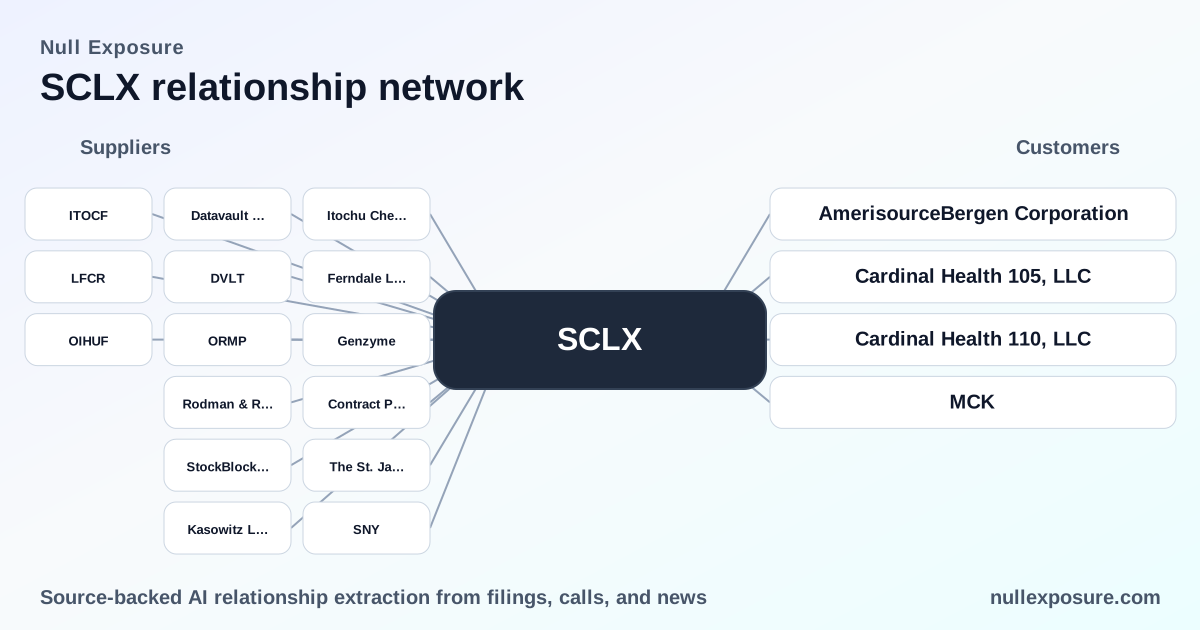
Scilex Holding Company (SCLX): Distribution-heavy commercial model with concentrated customer exposure and a new non-core investment
Scilex commercializes non-opioid pain therapies and monetizes through product sales to U.S. pharmacies, wholesalers and physician “buy-and-bill” channels; the company recognizes revenue from ZTlido, ELYXYB and GLOPERBA and fulfills orders via national pharmaceutical distributors and a dedicated U.S. salesforce. The business model is revenue-generating but materially concentrated: a small number of distribution customers account for the vast majority of sales while the company controls commercial reach through direct distribution agreements and an exclusive third‑party logistics partner. Visit https://nullexposure.com/ for background intelligence on supplier and customer risk if you want a deeper counterparty map.
What investors need to know in one line
Scilex runs a classic small-cap commercial pharma playbook — product-led revenue, centralized wholesale distribution, and high customer concentration, now combined with a sizeable strategic cash commitment into Datavault AI that diversifies cash exposure but does not alter core operating dependencies.
How Scilex monetizes and the structural constraints that shape risk
Scilex sells finished pharmaceutical products in the United States and collects revenue when wholesalers and pharmacies purchase therapy inventory. The company’s operating model is concentrated geographically (U.S.-focused), distributionally (relies on national/regional wholesalers), and commercially (three customers generated ~86% of 2024 revenue). Those facts create four practical constraints for investors:
- Contracting posture: Scilex contracts directly with major pharmaceutical distributors and uses an exclusive third‑party logistics provider for temperature‑controlled shipping, indicating centralized contracting with a small set of downstream partners.
- Concentration and criticality: Three customers accounted for 86% of 2024 revenue, making counterparty performance and pricing negotiations materially critical to cash flow.
- Product and go‑to‑market maturity: Scilex is revenue-generating with multiple launched products (first commercial launch in 2018; ELYXYB launched April 2023; GLOPERBA launched June 2024), implying an operationally mature commercial infrastructure but limited product breadth.
- Geographic focus: Net revenue derives from U.S. product sales, concentrating regulatory, reimbursement and reimbursement timing risk in a single region.
These constraints are company‑level signals drawn from Scilex’s 2024 disclosures and product launch history.
Contracting and distribution posture: who moves the product
Scilex uses national distributors and an exclusive logistics partner for domestic shipments, which lowers per‑unit logistics complexity but increases counterparty concentration risk. The company’s commercial reach depends on a short list of wholesale partners that can materially influence fulfillment speed and working capital. For direct contractual references see Scilex’s FY2024 filing.
Visit https://nullexposure.com/ to see how distribution concentration affects premium finance and counterparty exposure profiles.
Counterparties and what they mean for investors
Below I cover every relationship listed in the available results and the investor implications, with a concise source note for each.
-
Cardinal Health 105, LLC — logistics provider: Scilex uses Cardinal Health 105 as an exclusive third‑party logistics distributor for temperature‑controlled shipments, which delivers finished product to customer distribution centers the same day or within 24 hours. According to Scilex’s 2024 Form 10‑K (FY2024), Cardinal Health 105 handles the company’s U.S. commercial product shipments.
-
AmerisourceBergen Corporation — national pharmaceutical distributor: Scilex contracts with AmerisourceBergen as one of multiple U.S. pharmaceutical distributors used to reach wholesalers and pharmacies. This relationship is documented in Scilex’s FY2024 Form 10‑K (FY2024).
-
Cardinal Health 110, LLC — wholesale distributor channel: Cardinal Health 110 is named alongside other national distributors as a contracted partner for U.S. commercial distribution, per Scilex’s FY2024 Form 10‑K (FY2024).
-
McKesson Corporation (MCK) — national pharmaceutical distributor: Scilex lists McKesson as a contracted distributor used to distribute product throughout the United States. This is disclosed in Scilex’s FY2024 Form 10‑K (FY2024).
-
MCK (duplicate reference) — same contractual mention: The filing also references the ticker MCK as the same McKesson contractual relationship; the duplicate entry in the FY2024 10‑K reiterates that McKesson is a core distributor for Scilex’s U.S. shipments.
-
Datavault AI Inc. — strategic cash contribution and revenue-sharing arrangement (press release): Scilex agreed to contribute $120 million in upfront cash to Datavault AI in exchange for structured revenue participation tied to Datavault’s quantum‑ready, zero‑trust edge network, receiving staged percentages of network revenues until contractual caps are reached. This was announced in a Datavault AI press release and reported in May 2026 (FY2026).
-
DVLT (Intellectia.ai report) — market commentary on the same Datavault deal: Independent coverage noted the $120 million agreement and framed it as supporting Datavault’s GPU edge network expansion and competitive positioning; this was reported by Intellectia.ai in May 2026 (FY2026).
-
Datavault AI Inc. (MEXC news) — exchange/newswire synopsis: MEXC published a summary of the binding term sheet between Scilex and Datavault AI on May 3, 2026, describing the $120 million upfront support for Datavault’s network deployment (FY2026).
What the relationship map says about financial and operational risk
- Distribution dependency is a strategic lever and a source of risk. Using a small set of national distributors and an exclusive 3PL reduces logistics variance and improves speed to pharmacy, but also concentrates negotiation leverage and settlement timing with those partners. The FY2024 disclosure of national distributors and a named exclusive logistics provider confirms a centralized U.S. distribution posture.
- Revenue concentration is a material credit risk. With three customers contributing 86% of revenue in 2024, a disruption or adverse pricing change with any major distributor or large buyer would have immediate P&L and cash‑flow consequences.
- The Datavault AI investment is a non‑operational diversification move. The $120 million cash contribution converts some of Scilex’s balance sheet into a revenue participation vehicle tied to a tech deployment; this is material for cash allocation but does not reduce distribution or customer concentration in core pharmaceutical sales.
Investment implications and final takeaways
- Positive: Scilex has an established U.S. commercial engine with product launches and a direct salesforce; logistics are centralized and professionalized through named partners.
- Negative: High customer concentration and U.S.-only commercialization create critical counterparty and regional risk. Any distributor disruption or reimbursement shift will be amplified given the concentrated revenue base.
- Capital allocation note: The Datavault AI arrangement materially commits cash to a non‑pharma revenue stream; investors should treat this as a diversification bet on future cash flows rather than an improvement to pharmaceutical distribution resilience.
For a tailored counterparty risk profile or to map how these distribution relationships affect premium finance exposures, visit https://nullexposure.com/ and request the Scilex counterparty briefing.