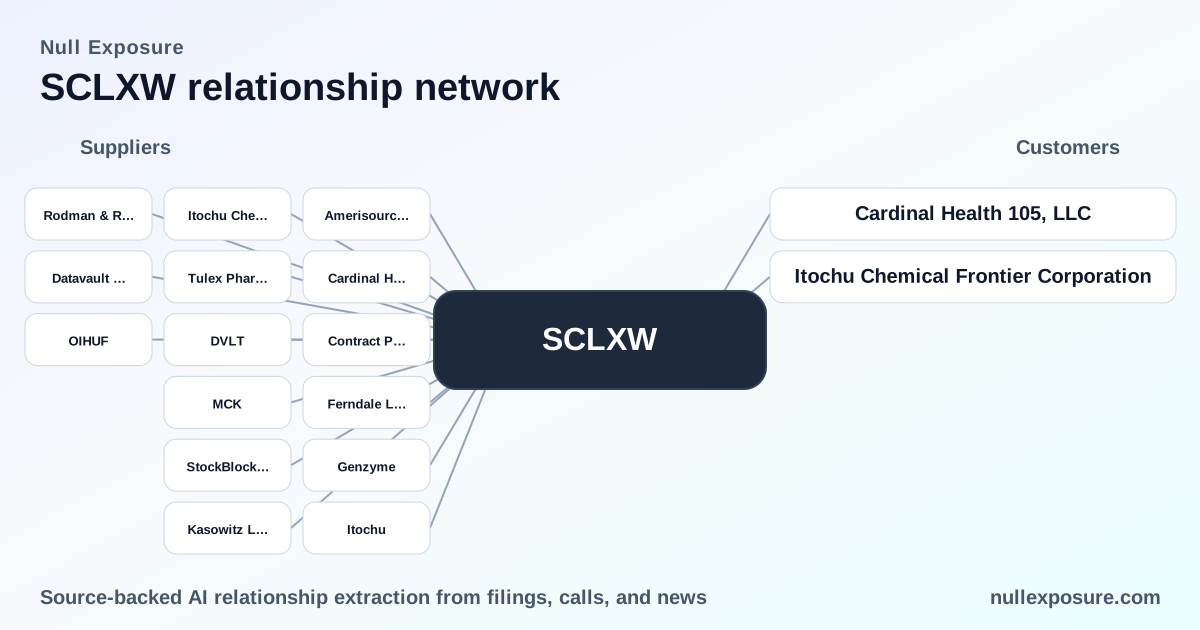
Scilex Holding (SCLXW): Customer Map and Commercial Risk — what investors should know
Scilex monetizes by developing and commercializing non‑opioid pain therapies — primarily through product sales of ZTlido, ELYXYB and GLOPERBA in the United States — and distributes those products through a mix of wholesalers and direct sales into physician channels. The company’s revenue base is concentrated and transactional: point‑in‑time sales recognized on delivery, heavy reliance on a handful of customers and U.S. commercialization, and inventory flows that depend on at least one designated supplier. For a deeper commercial diligence view, visit https://nullexposure.com/.
Market context and a compact revenue profile: Scilex reports TTM revenue of roughly $30.3 million and gross profit of $19.65 million, while operating results remain negative, reflecting an early commercial-stage biopharma business model and concentrated customer relationships (Scilex 10‑K and company financial summary).
Why the customer relationships define the investment thesis
Scilex’s commercial model is transactional and distribution‑centric. Revenue is recognized at delivery with invoicing at shipment, which produces short receivable cycles and limited long‑dated contractual revenue commitments. The company relies on distributors and a small set of customers for the bulk of sales, which creates high customer concentration and operational leverage — positive for margin upside if volumes scale, but a clear single‑counterparty and channel risk for downside.
- Contracting posture: Sales are point‑in‑time; invoicing occurs on shipment and payment terms are short, indicating spot, transactional contracts rather than long‑term take‑or‑pay deals (Scilex 2024 Form 10‑K).
- Concentration: Three customers accounted for 86% of revenue in FY2024, each representing between 23%–34% of total revenue, reflecting material dependence on a handful of counterparties (FY2024 10‑K).
- Geography and go‑to‑market: Commercial activity and revenue generation are U.S.‑focused, with product launches and distribution concentrated in the U.S. market (FY2024 10‑K).
Cardinal Health 105, LLC — the historical dependency that matters
Cardinal Health 105 was the company’s sole customer in 2020 and 2021 and for the first quarter of 2022, with sales to Cardinal Health 105 representing all net revenue for those periods. This historical single‑counterparty dependence is explicitly disclosed in the company’s fiscal 2024 10‑K and is recorded as a critical material relationship. According to Scilex’s 2024 Form 10‑K, Cardinal Health 105 generated the entire revenue stream for those earlier periods, establishing a legacy concentration risk that investors must track when assessing counterparty transition and diversification trends.
Itochu Chemical Frontier Corporation — the supplier behind ZTlido inventory
Scilex purchased ZTlido inventory from its sole supplier, Itochu Chemical Frontier Corporation, per the 2024 Form 10‑K. While not a customer in the classic sense, Itochu’s role as the exclusive supplier for ZTlido inventory constitutes a critical supply‑chain counterpart that affects product availability and cost of goods sold (Scilex 2024 10‑K).
Constraints that shape day‑to‑day operations and downside scenarios
The 10‑K language and disclosures convey several company‑level signals that define operational constraints and credit/partner risk:
- Spot, point‑in‑time contracts: Revenue recognition is tied to delivery and legal title transfer; invoicing typically occurs on shipment with short payment windows. This produces limited revenue visibility beyond near‑term orders and exposes cash flow to demand volatility (FY2024 10‑K).
- Government rebate exposure: Scilex pays rebates under government programs (state Medicaid, Medicare coverage gap discounts, TRICARE), which increases reimbursement complexity and adds cashflow and pricing pressure in certain payer segments (FY2024 10‑K).
- Direct physician targeting: The company operates a dedicated sales force (70+ reps) targeting primary care, pain specialists and other clinicians, signaling a go‑to‑market that blends distributor reach with field sales to drive prescribing behavior (FY2024 10‑K).
- U.S. concentration: Commercial rights and revenue are U.S.‑centric, including the U.S. commercialization of GLOPERBA launched in June 2024, which narrows exposure to U.S. reimbursement, pricing and distribution dynamics (FY2024 10‑K).
- Customer concentration remains material: In FY2024 three customers produced 86% of revenue, a durable concentration signal that amplifies counterparty risk and negotiating leverage for large distributors (FY2024 10‑K).
- Distribution channels are active and core: Scilex contracts with large pharmaceutical distributors (e.g., McKesson, Cardinal Health 110, AmerisourceBergen) to reach major retail chains and independents; these partnerships indicate the company’s reliance on established wholesale channels to achieve scale (FY2024 10‑K).
Collectively, those constraints mean Scilex is operating a classic early‑stage specialty pharma commercial model: transactional revenue, concentrated counterparties, reliance on wholesale partners and a proprietary salesforce to seed physician adoption. That configuration delivers rapid scaling ability when demand materializes, but it also concentrates counterparty, supply and reimbursement risk.
Key investment takeaways
- Concentration is the headline risk. Three customers accounted for the majority of revenue in FY2024, and historical dependence on Cardinal Health 105 underscores the need to monitor customer diversification progress (10‑K FY2024).
- Revenue recognition is transactional. Short invoicing/payment cycles reduce receivable risk length but limit forward revenue visibility; commercial upside requires volume growth, not contract renegotiation (10‑K FY2024).
- Supply chain is single‑sourced for ZTlido. Itochu’s role as sole supplier is a material operational dependency for that product line (10‑K FY2024).
- U.S. reimbursement dynamics matter. Government rebate obligations and U.S. commercialization focus make pricing and payer coverage the dominant macro levers on revenue outcomes (10‑K FY2024).
For investors and operators conducting commercial diligence, prioritize: (1) customer concentration trends quarter‑over‑quarter, (2) distributor throughput and contract terms with major wholesalers, (3) supplier continuity for key products, and (4) trajectory of physician adoption from the direct sales force.
If you want a tailored summary of counterparty concentration and distribution risk for small‑cap biopharma portfolios, explore additional intelligence at https://nullexposure.com/.
What to monitor next quarter
- Disclosure of customer revenue percentages by counterparty and any shift away from top‑three concentration.
- Any changes to supplier arrangements for ZTlido inventory or second‑source qualification.
- Distributor sales velocity into major retail chains and any changes in trade terms or rebate accruals.
- Commercial KPIs from the field force (new prescribers, prescription volume trends) that underpin durable revenue growth.
Taken together, the Scilex customer map is a tradeoff: a scalable transactional commercial model with concentrated counterparty exposure and a single‑sourced supply line that define both upside on successful adoption and downside if distributor or supplier dynamics change (Scilex 2024 Form 10‑K).