Scinai Immunotherapeutics (SCNI): CDMO push offers early revenue runway but concentration and capital structure shape risk
Scinai Immunotherapeutics runs a dual strategy: it develops immunotherapies for inflammation and oncology while monetizing near-term through Scinai Bioservices, a CDMO unit that sells early-stage development and clinical manufacturing services. Investors should assess SCNI as a hybrid biopharma where service revenue from a small number of strategic customers provides immediate cash flow, and longer‑term upside depends on advancing proprietary assets and managing dilution from financing agreements. For a concise vendor and customer intelligence view, see NullExposure’s portal: https://nullexposure.com/.
How Scinai is turning scientific IP into commercial receipts
Scinai’s operating model blends product development with contract manufacturing revenue. The company’s public statements and filings highlight two commercial levers: (1) ongoing development programs in immunology and oncology, and (2) revenue from CDMO services provided by Scinai Bioservices. This mixed model reduces pure‑research cash burn by selling technical services, but it also introduces a set of commercial dynamics that investors must price: contracting posture, concentration risk, criticality of services to customers, and the early maturity of commercial activity.
- Contracting posture: Scinai positions itself as a preferred early‑stage development partner for at least one large CDMO, indicating negotiated, relationship-driven contracts rather than ad hoc spot work.
- Concentration: Public disclosures name a small set of customers and partners—evidence of client concentration that amplifies single‑counterparty risk.
- Criticality: For identified customers Scinai provides clinical manufacturing and liposomal formulation capabilities, services that are operationally critical to their customers’ trial timelines.
- Maturity: Commercial traction is nascent—first U.S. clinical manufacturing contract announced and partnerships to scale CDMO capacity indicate early commercial maturity rather than an established recurring revenue base.
Customer and partner relationships that drive near‑term revenue
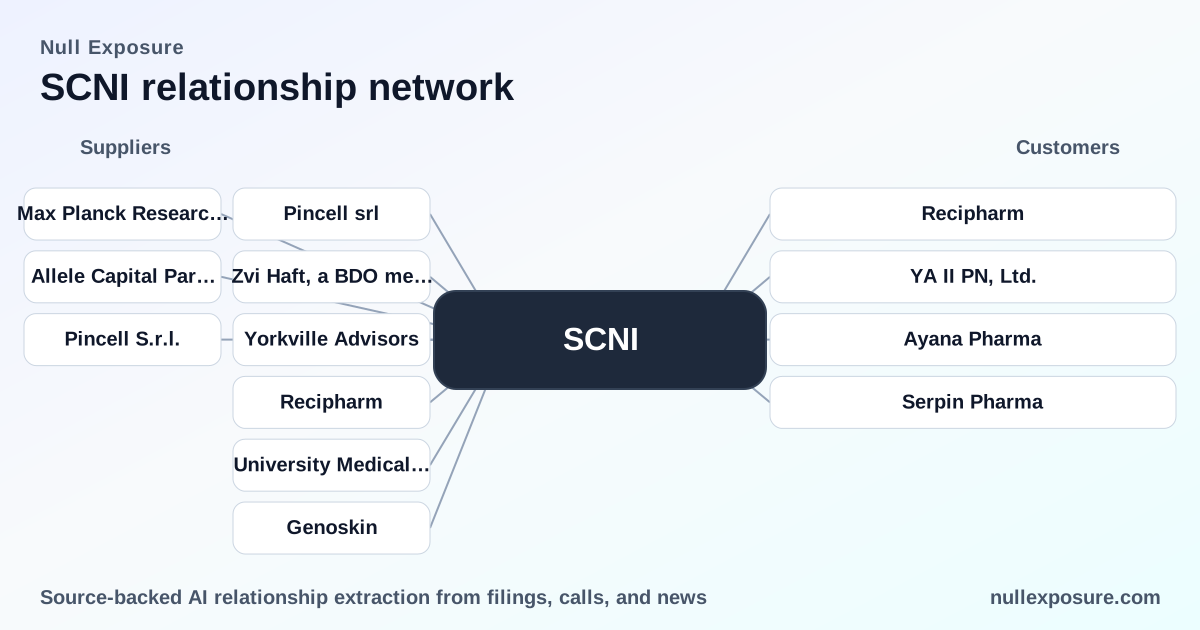
Below are the relationships disclosed in public reporting and news coverage. Each entry is a concise, plain‑English description with a source reference.
Recipharm — preferred early‑stage development partner
Scinai was named Recipharm’s go‑to partner for early‑stage biologics development, positioning Scinai Bioservices as a preferred provider for early development work. This relationship signals strategic alignment with an established CDMO, which could feed a pipeline of development projects to Scinai. (European Pharmaceutical Review, March 10, 2026; see coverage at https://www.europeanpharmaceuticalreview.com/news/271473/recipharm-scinai-immunotherapeutics-biologics-collaboration/.) Additional reporting tied this relationship to Scinai’s broader CDMO expansion narrative in May 2026. (TS2.Tech, May 3, 2026; https://ts2.tech/en/scinai-stock-surges-on-2-61-million-private-placement-as-scni-bets-on-cdmo-expansion/.)
YA II PN, Ltd. (Yorkville) — standby equity purchase agreement
Scinai entered a Standby Equity Purchase Agreement (SEPA) with YA II PN, Ltd., providing committed financing capacity of up to $10 million; this is a liquidity and capital structure instrument rather than a commercial customer relationship, but it materially affects funding for the CDMO expansion and R&D. The company disclosed the SEPA in March 2026. (PR Newswire, March 2026; https://www.prnewswire.com/il/news-releases/scinai-immunotherapeutics-announces-10-million-standby-equity-purchase-agreement-302393060.html.)
Ayana Pharma — liposomal encapsulation services partnership
Scinai announced a collaboration with Ayana Pharma to provide liposomal encapsulated drug development services, indicating specialized formulation capabilities in Scinai Bioservices that address a growing demand in I&I and oncology programs. This partnership supports the unit’s technical breadth as Scinai expands into U.S. commercial activity. (PR Newswire, March 2026; https://www.prnewswire.com/il/news-releases/scinai-immunotherapeutics-establishes-us-subsidiary-for-cdmo-business-unit-scinai-bioservices-inc-302332614.html.)
Serpin Pharma — first U.S. commercial contract for clinical manufacturing
Scinai signed its first U.S. customer contract with Serpin Pharma to support clinical manufacturing, representing proof of commercial market entry for Scinai Bioservices in the U.S. market and a concrete revenue source tied to clinical trials. This agreement underscores the shift from capability building to client delivery. (PR Newswire, March 2026; https://www.prnewswire.com/il/news-releases/scinai-immunotherapeutics-establishes-us-subsidiary-for-cdmo-business-unit-scinai-bioservices-inc-302332614.html.)
Financial and operational context that shapes these relationships
Scinai’s financials show modest revenue but persistent losses: revenue TTM of about $1.31 million, negative gross profit and operating margin reflecting R&D and scale‑up costs (latest reported operating margin TTM -7.02). Market capitalization is very small relative to biotech peers. These facts create three practical implications for customers and investors:
- Commercial reliance on a handful of partners: With named customers limited to a few firms, each new contract materially affects revenue growth and visibility.
- Revenue is delivery‑dependent: Clinical manufacturing and early‑stage development contracts convert to cash only as milestones are achieved and manufacturing runs are completed.
- Capital structure matters: The SEPA with Yorkville provides a financing backstop but introduces dilution risk; investors must balance near‑term liquidity against long‑term shareholder dilution.
The relationship data set contains no explicit operating or contractual constraints flagged by the sources; as a company‑level signal, this absence indicates disclosures so far focus on partnerships and financing rather than restrictive covenants or litigation disclosures in the customer context.
For deeper coverage of how these customer links translate into revenue and risk, explore NullExposure’s company profiles: https://nullexposure.com/.
Investment implications and a focused risk checklist
Scinai’s pattern of named contracts and partnerships gives a clear roadmap for growth, but investors need to underwrite specific execution and financing risks.
- Positive: CDMO revenues create a nearer‑term monetization path while the therapeutic pipeline preserves upside if clinical programs progress.
- Negative: High customer concentration and early commercial stage produce volatility in quarterly revenue and cash flow.
- Capital risk: The SEPA and small market cap imply sensitivity to financing terms and potential dilution.
- Operational risk: Scaling CDMO capacity and meeting clinical manufacturing quality standards are execution items that directly affect customer retention and referrals.
Bottom line: small cap CDMO plus pipeline equals asymmetric but binary return profile
Scinai presents a classic early‑stage biotech risk/reward tradeoff: service contracts provide immediate revenue and validation, while proprietary programs offer meaningful upside if clinical progress occurs. The named relationships—Recipharm, Ayana Pharma, Serpin Pharma—and the Yorkville financing arrangement create a connective tissue that supports Scinai’s growth plan, but revenue concentration and capital dependency are the dominant risks investors must price into any valuation.
For a structured read on customer‑level exposure and next catalysts, visit NullExposure’s analyst hub: https://nullexposure.com/.