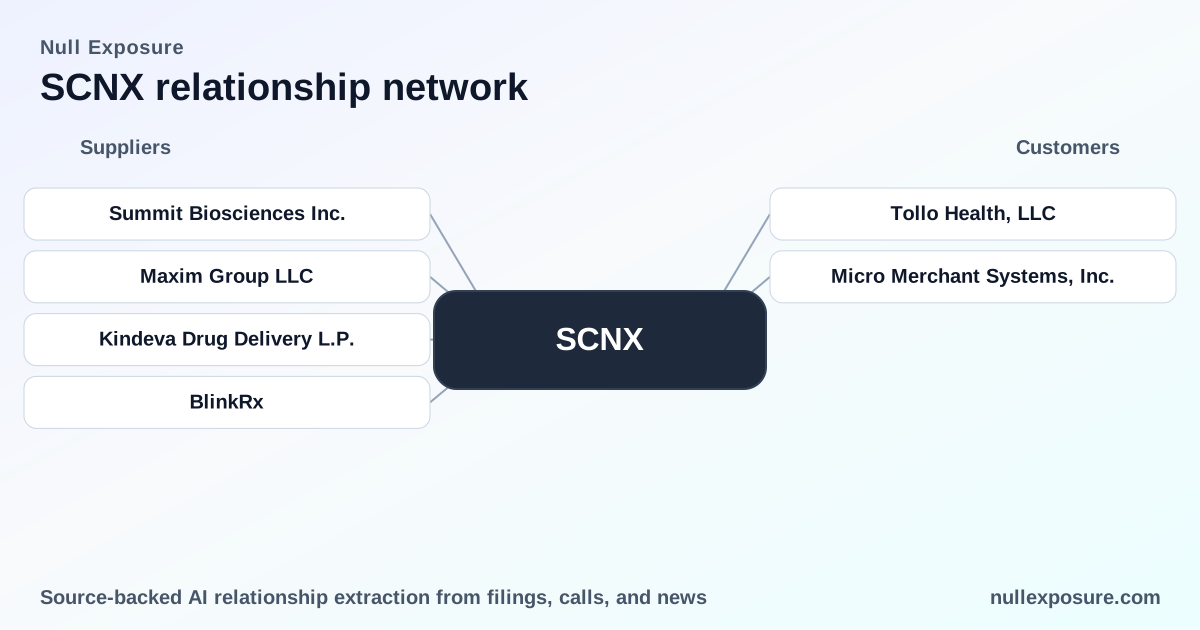
Scienture Holdings (SCNX) — customer relationships and commercial posture
Scienture Holdings develops neurological therapies and monetizes through a hybrid model of product commercialization, distribution services, and licensing: the company sells pharmaceutical products through wholesale and distribution channels, licenses clinical-stage assets to third parties for U.S. commercialization, and has executed recent asset sales that reconfigure its distribution footprint. For investors evaluating customer relationships, the most salient facts are a U.S.-centric distribution reach, explicit B2B wholesaler/seller activity, and active licensing agreements that shift commercialization risk to partners. For a deeper view of how these customer linkages affect commercial scale and counterparty risk, see NullExposure’s customer intelligence hub: https://nullexposure.com/
How Scienture makes money — a concise commercial thesis
Scienture operates at the intersection of drug development and specialty pharmaceutical distribution. Revenue today is modest and derives from distribution and product sales through licensed wholesalers and clinics, while longer-term value is tied to licensed clinical candidates (SCN-102, SCN-104) where the company has granted exclusive U.S. commercialization rights to a partner. The company also actively repositions non-core assets via sales to third parties, converting operating burden into cash and sharpening focus on specialty product development. Financials reflect an early-stage commercial profile: low trailing revenue (roughly $432k TTM) and negative EBITDA, which underscores that customer relationships are both strategic levers and short-term revenue drivers rather than large, recurring cash engines.
Snapshot: the named customer/partner relationships
Below I cover every named relationship in available reporting. Each relationship summary is concise and sourced to the public mention.
Tollo Health, LLC
- Scienture completed a sale of subsidiaries — explicitly including IPS, Softell, and Bonum Health, Inc. — to Tollo Health as part of a strategic realignment in FY2025. This transaction transfers those operational businesses and associated customer flows to Tollo. (TradingView coverage of the company 10‑Q, March 10, 2026: https://www.tradingview.com/news/tradingview:8a1835f7321db:0-scienture-holdings-inc-sec-10-q-report/)
Micro Merchant Systems, Inc.
- In 2024 Scienture sold its web-based market platform to Micro Merchant Systems and completed a reverse merger that repositioned the company toward specialty pharmaceutical product development and commercialization, indicating a deliberate move away from marketplace operations and toward product-led revenue. (CityBiz report on executive appointments, citing the 2024 sale and corporate repositioning, published March 2026: https://www.citybiz.co/article/697839/scienture-appoint-dr-shankar-hariharan-and-dr-narasimhan-mani-as-co-ceos/)
What these relationships imply for commercial strategy
- Asset monetization and focus: The sale of platform and subsidiary operations signals that Scienture is monetizing non-core assets to concentrate resources on drug development and the commercialization pathway for its clinical candidates. The Tollo and Micro Merchant transactions remove operational complexity and redirect capital toward core R&D and licensing activities.
- Channel reconfiguration: Divestitures that include distribution/logistics businesses (e.g., IPS) change where and how product flows reach customers; downstream customer relationships tied to those businesses now sit with new owners. This reduces Scienture's direct channel control but converts operating liabilities into near-term liquidity.
- Licensing as de‑risking: Separately, Scienture’s exclusive U.S. license agreements for SCN-102 and SCN-104 (with Kesin Pharma Corporation per company disclosures) position the company as a licensor that captures royalties or milestone payments rather than taking full commercialization risk.
If you want ongoing tracking of how these counterparty changes alter revenue funnels and concentration risk, visit our coverage at https://nullexposure.com/
Constraints and company-level signals that shape customer risk
Several recurring signals in Scienture’s public filings and reporting define the structure and quality of customer relationships:
- U.S.-centric geography: Scienture’s operations and reported segments run in one geography — the United States — and distribution historically reached over 1,600 pharmacies and clinics across 38 states. That concentrates counterparty and regulatory exposure domestically and requires U.S. payer and provider access to scale sales.
- Government as an end-customer channel: Public excerpts indicate that customers for some of Scienture’s distribution lines include government organizations, hospitals, clinics and independent pharmacies. That introduces procurement, contracting and compliance complexities, but also suggests access to larger volume buyers when products are approved.
- Seller and distribution posture: Disclosures describe IPS as a licensed pharmaceutical wholesaler and the company’s intention to serve logistics and distribution roles, framing Scienture’s commercial posture historically as B2B seller and distributor, not direct-to-consumer. This affects revenue stickiness and dependence on wholesaler margins.
- Licensor role for pipeline assets: Scienture has executed exclusive license and commercial agreements (notably with Kesin Pharma Corporation for SCN-102 and SCN-104) that transfer commercialization responsibility for candidate drugs in the U.S., converting development risk into license-derived economics.
- Early maturity and concentration: Company financials show modest revenue, negative EBITDA, high insider ownership (~21.9%), and low institutional ownership (~3.7%), which together indicate an early-stage commercial profile with concentration of control and limited institutional shareholder validation.
Collectively, these characteristics produce a company that is operationally focused on U.S. distribution pathways and licensing, but which is currently small-scale and reshaping how it reaches customers through asset sales and third-party commercialization.
Investment implications — what investors should watch next
- Revenue conversion from licensing: Monitor milestone and royalty schedules from existing license deals (Kesin) and any new agreements; these will materially influence the transition from operating losses to recurring, less cap‑intensive revenue.
- Counterparty concentration after divestitures: With logistics and platform assets sold, customer access depends on partners and wholesalers; investors should track whether those partners preserve incumbent customer lists and volume (especially institutional and government buyers).
- Regulatory and contracting exposure: Given the U.S.-only operational footprint and reported government customers, successful product approvals and contracting wins with wholesalers, hospitals, and federal/state purchasers are critical to commercial scaling.
- Balance sheet runway and cash deployment: Asset sales reduce operating burden but do not replace the capital needs of late-stage development; monitor cash from divestitures versus R&D spending cadence.
Bottom line
Scienture is pivoting from mixed operations toward a product-licensing and specialty commercialization model, using asset sales to streamline operations and prioritize pipeline value realization. That strategy reduces direct distribution overhead but shifts commercial execution and revenue realization to partners — a trade-off investors must value by tracking license economics, partner performance, and U.S. channel access.
For continued monitoring of customer-level changes and how counterparty shifts affect valuation, see the company intelligence coverage at https://nullexposure.com/