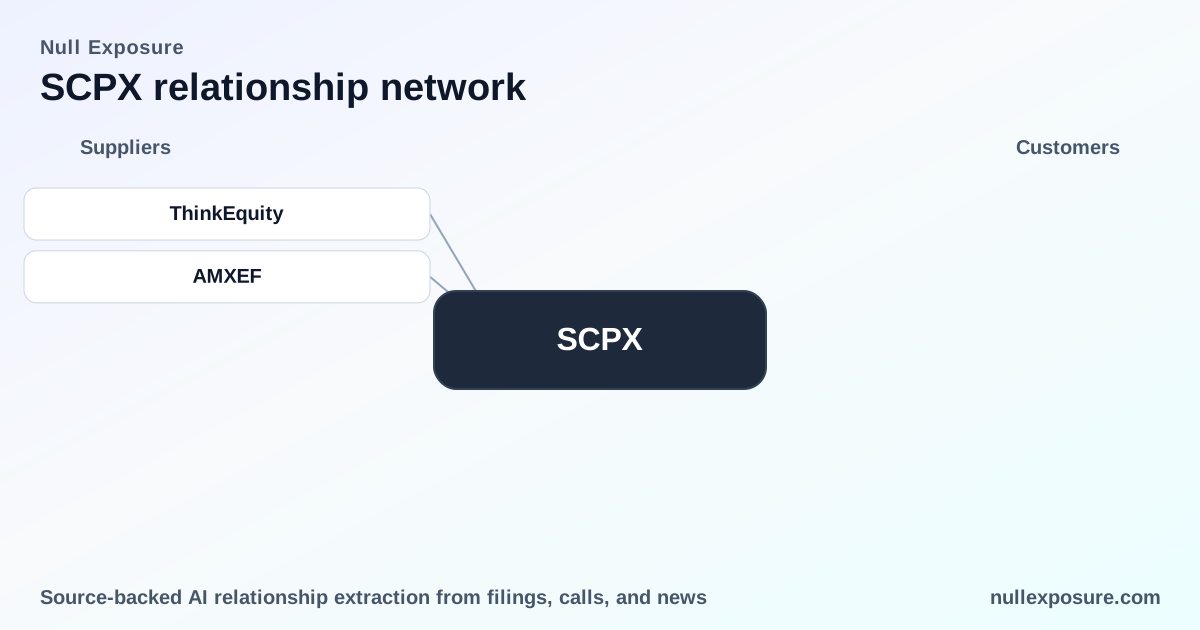
SCPX customer relationships: concentrated CDMO revenues, active clinical manufacturing engagements
SCPX operates as a small-cap Contract Development and Manufacturing Organization (CDMO) through its Scorpius Biomanufacturing subsidiary, monetizing by providing process development and CGMP clinical and commercial biologics manufacturing to biotech customers. Revenue is generated primarily from short-term CDMO contracts and customer deposits that convert into recognized revenue as performance obligations are fulfilled. Investor focus should be on customer concentration, single-facility exposure, and the pipeline of GMP validation engagements that can convert to near‑term revenue. Learn more at https://nullexposure.com/.
What the customer list tells investors about SCPX right now
SCPX’s publicly visible customer relationships point to a company executing classical CDMO work for pre‑commercial and government‑oriented programs, while undergoing transactional change in its corporate assets. The universe of relationships in public reports is small but material: there are active GMP validation engagements and a recent asset acquisition involving Scorpius Holdings that alters the underlying business footprint. Below I cover each named counterparty cited in public news for SCPX/Scorpius.
Tivic Health Systems, Inc.
Tivic contracted Scorpius BioManufacturing to complete GMP manufacturing validation of Entolimod in support of a Biological License Application for Acute Radiation Syndrome, representing an active, clinically significant CDMO engagement that converts to revenue as validation activities are performed. According to a BioSpace press release (May 3, 2026), the agreement is definitive and targeted at final GMP validation ahead of an FDA BLA filing; an investing.com notice the same period reiterated the engagement in FY2026.
Velocity Bioworks, Inc.
Velocity Bioworks acquired all personal property and assets of Scorpius Holdings for $16.3 million, a transaction that effectively transfers Scorpius’s asset base and changes the counterparty landscape for SCPX’s historical CDMO operations. MarketScreener reported the acquisition (listed as Dec. 10 in the transaction notices covering FY2025/FY2026), and multiple MarketScreener items associated with FY2025–FY2026 document the same asset purchase and related corporate changes.
Elusys Therapeutics
Elusys was divested from Scorpius in December 2023, and public filings clarified that the divested business did not contribute to the revenue line presented for the 2023 year-end results. The company’s 2023 year‑end update noted the exclusion of Elusys‑derived revenue from reported figures (GlobeNewswire, April 29, 2024), signaling that historical revenue streams have been re‑scoped after the divestiture.
How SCPX’s operating model shapes relationship risk and opportunity
The public constraints and company disclosures form a coherent operating profile that investors must use to judge stability and upside.
- Contracting posture: short-term CDMO engagements. SCPX emphasizes that it generally does not hold long‑term CDMO customer contracts and that its customer base is small with primarily short‑term agreements, producing revenue volatility tied to program timing and validation milestones.
- Geographic concentration: U.S.-centric operations and single‑site risk. The company derives virtually all revenue from the United States and conducts manufacturing at a single San Antonio, Texas facility, creating operational concentration risk from regional disruption.
- Customer concentration: material single-customer exposure. One customer represented 37% of revenue in 2024 and 70% in 2023, making SCPX’s top-line highly sensitive to client retention and customer-scale decisions.
- Role profile: SCPX is primarily a seller/service provider. Public disclosures frame SCPX as a CDMO that provides process development through CGMP manufacturing, recognizing product sales when customers accept delivery; this positions the company as both a service provider and seller of manufactured product, with customization and ownership of product details resting with customers under ASC 606.
- Relationship stage: active project execution and deposits. The company reports active CDMO revenue and deferred revenue from customer deposits that will convert to revenue as obligations are performed, signaling an active commercial pipeline subject to milestone timing.
- Segment focus: manufacturing and services. Process development and CGMP manufacturing comprise the majority of CDMO revenue, underscoring that SCPX’s economic model is heavily weighted to manufacturing services rather than licensing or recurring product sales.
Those characteristics combine into a classic small‑CDMO profile: high operational leverage to a few clients, concentrated geography, and revenue timing linked to discrete validation and production milestones.
Investment implications and risk-adjusted outlook
SCPX’s value drivers are straightforward: convert active GMP validation contracts into near‑term revenue, secure follow‑on commercial manufacturing from current customers, and diversify the customer base to reduce concentration risk. The Tivic engagement is a high‑value example of this model in action — a successful GMP validation and subsequent BLA filing support can produce predictable revenue runs for a CDMO. Conversely, the asset acquisition by Velocity Bioworks for $16.3 million signals corporate transition and potential dislocation in SCPX’s asset and revenue base; investors should track integration and contract novation outcomes post‑transaction.
Key risk factors for valuation and operational forecasting:
- Revenue volatility from short‑term contracts and milestone timing.
- Concentration exposure to a single large customer that materially influences year‑to‑year results.
- Single‑site operations that amplify the impact of physical disruption or regulatory inspection findings.
- Corporate restructuring following the asset sale to Velocity that could change service capacity or contract continuity.
Monitor forthcoming disclosures on customer contract lengths, any new long‑term manufacturing agreements, and commentary on the Velocity asset transfer and its effect on Scorpius’s CDMO capabilities. For a concise view of SCPX’s customer signals and how they translate to credit and revenue risk, visit https://nullexposure.com/.
Bottom line: where the facts point
- Active, revenue‑generating CDMO engagements are present (e.g., Tivic GMP validation).
- A recent asset transfer to Velocity materially alters the company’s asset footprint.
- High customer and geographic concentration create meaningful downside sensitivity without faster diversification or longer‑term contract signings.
For research teams modeling SCPX, stress test scenarios for loss of the top customer and delayed validation milestones, and prioritize updates around contract novation and facility control following the Velocity transaction.