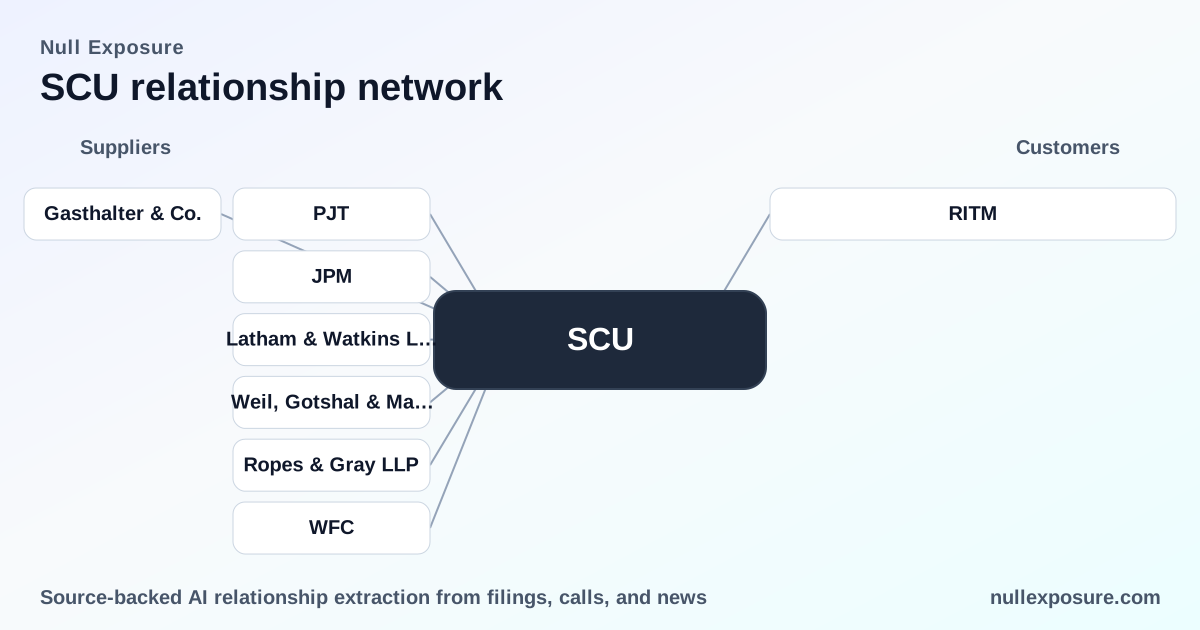
Sculptor Capital (SCU) — Customer Relationship Briefing: Rithm Capital Acquisition and What It Means for Investors
Sculptor Capital Management operates as a global alternative asset manager that monetizes through recurring management fees, performance-related incentive fees, and fee-bearing capital solutions tied to assets under management and realized investment performance. For investors evaluating SCU’s customer relationships, the dominant near-term headline is corporate-control risk and transition: Rithm Capital’s acquisition of Sculptor changes the counterparty and governance dynamics that matter to SCU’s clients, fee streams, and distribution agreements. For a concise company-comparative view, visit https://nullexposure.com/ for platform-level analytics and relationship mapping.
What happened and why it matters to SCU’s commercial profile
Rithm Capital Corp. announced and then completed a transaction to acquire Sculptor (SCU) in early 2026. The public reporting around that deal provides two different valuation framings — both are material to assessing buyer economics and the strategic posture that now governs SCU’s customer relationships. A change in ownership of this scale alters incentive alignment with limited partners and third‑party distributors, and compresses the informational symmetry investors rely on when assessing future fee capture and retention.
A completed control transaction is not just a headline; it is an operational inflection that affects contracting posture, client continuity, and the predictability of fee income over the next several quarters. For governance-sensitive investors, the ownership transfer creates a fresh counterparty (Rithm) whose priorities will determine whether existing commercial arrangements are renewed, re-priced, or restructured.
Relationship coverage: reported items you need to know
Below are the three relationship entries returned in the review dataset; each entry is described in plain English with its sourcing.
-
Latham & Watkins reported that Rithm Capital completed the acquisition of Sculptor, with a per‑share consideration of US$12.70 and an aggregate transaction value reported at approximately US$719.8 million. This filing documents deal completion and the final ownership transfer timeline (Latham & Watkins advisory note, May 3, 2026 — https://www.lw.com/en/news/latham-watkins-advises-on-sculptor-capital-management-completed-acquisition-by-rithm-capital-corp).
-
CityBiz reported on March 10, 2026 that Rithm Capital entered a definitive agreement to acquire Sculptor, citing Sculptor’s standing as a global alternative asset manager with ~$34 billion in AUM and referencing an offer of US$11.15 per Class A share and an implied transaction value of approximately US$639 million. This article covers the announcement of the deal terms that preceded the later completion filing (CityBiz, March 10, 2026 — https://www.citybiz.co/article/444576/rithm-capital-to-acquire-sculptor-capital-management/).
-
The dataset also includes a duplicate CityBiz entry reflecting the same March 10, 2026 announcement, reinforcing that the transaction terms and positioning were publicly communicated at that time and carried in trade press coverage ahead of the closing (CityBiz, March 10, 2026 — https://www.citybiz.co/article/444576/rithm-capital-to-acquire-sculptor-capital-management/).
Interpreting the reporting differences — a clear investor takeaway
The market record contains different reported per‑share and aggregate valuation figures between the announcement and the completion notices: CityBiz recorded an announced term, while the Latham & Watkins completion notice reported the closing consideration. Investors should treat both figures as part of the transaction narrative: the announced offer set market expectations; the completion filing confirms what ultimately transferred hands. The practical implication for revenue forecasting is that realized investor outcomes — particularly incentive fees tied to realized asset sales or fund wind-downs — are governed by the closing mechanics and the acquirer’s post‑close strategy.
Operating model constraints and company-level signals
Evaluate Sculptor not just as an AUM line item but as a commercial counterparty with these operating-model characteristics:
-
Contracting posture: Sculptor’s revenue mix historically links to multi-year limited partnership agreements and contractual management fees, creating a mix of sticky recurring revenue and event-driven incentive fees. Contracts can be renegotiated or terminated at the direction of LPs and, now, the new parent company, which shifts bargaining power.
-
Concentration: Alternative asset managers commonly have concentration risk across flagship funds and large institutional investors; this relationship set is sensitive to single‑client withdrawals or non‑renewal of large mandates and therefore amplifies counterparty risk.
-
Criticality: For institutional customers, Sculptor functions as a specialized service provider (portfolio manager and investment advisor), making continuity and performance continuity critical; any perceived disruption in portfolio management under new ownership will trigger re-allocation risk.
-
Maturity and liquidity posture: As an established manager that executed an M&A outcome, Sculptor is in a transitional maturity phase where capital structure decisions by the acquirer will determine reinvestment, asset realization priorities, and the pace of fee monetization.
These signals are company-level and should guide due diligence on counterparty renewals, fee stability, and client retention metrics.
Investment implications and risk checklist
- Governance reset risk: Ownership transfer to Rithm creates an immediate governance reset; investors must monitor early Board and senior management changes that affect strategy and client retention.
- Fee-runway visibility: Expect near-term uncertainty in incentive fee realization as new owner priorities reshape asset disposition and fundraising activity.
- Customer continuity priority: Large institutional clients will test continuity clauses and service-level commitments; track retention announcements and any early contract amendments.
- Valuation and reporting divergence: Public reporting showed different headline figures between announcement and close; use completed‑deal filings as the definitive accounting of proceeds and contractual obligations.
- Concentration vigilance: Examine top-10 client exposures and flagship fund concentration as part of counterparty risk assessment.
Action for investors: prioritize monitoring client retention notices, LP meeting minutes where available, and the acquirer’s integration updates. For structured access to relationship intelligence, see https://nullexposure.com/ for consolidated reports and event-tracking tools.
Bottom line for business and research users
Rithm’s acquisition of Sculptor is the central customer-relationship event in the dataset and it recalibrates the commercial and contractual landscape that underpins SCU’s fee flows. Investors and operators must shift focus from standalone fund performance to the integration and post‑close strategy executed by Rithm, because that strategy will determine retention, fee realization, and the timing of any asset realizations. Monitor governance actions and client‑level communications closely — they are the leading indicators of whether the transaction preserves, dilutes, or accelerates Sculptor’s historical revenue profile.