374Water (SCWO): Customer relationships as the revenue runway and operational proving ground
Thesis: 374Water monetizes through the sale of its AirSCWO hardware and by delivering Waste Destruction Services (WDS) contracts—a hybrid capital-equipment plus recurring services model selling systems and operating destruction hubs or short-term deployments for municipal and industrial customers. Investors should view 374Water as an early commercializing industrial environmental technology company where pilot demonstrations convert into multi-year service contracts and occasional capital sales, and where near-term revenue growth depends on a small number of municipal wins and select contractor channels. Learn more at https://nullexposure.com/.
How 374Water actually makes money and why that matters to investors
374Water sells proprietary AirSCWO systems (hardware) and sells treatability studies, demos, and ongoing WDS as fee-for-service work. The company recognizes AirSCWO revenue over the life of long‑term fixed-price contracts, and it routes municipal engagement through a combination of capital sales, leases and waste destruction services. This commercial posture creates two clear commercial dynamics:
- Revenue concentration and seasonality risk: company disclosures show two customers accounted for roughly 72% of revenue in 2024, reflecting high customer concentration and near-term sensitivity to contract timing.
- Transition from pilot to scale: many deployments are still at a demonstration or pilot stage (demo contracts and mobile systems), which positions the company for larger multi‑year WDS contracts but keeps FY revenue low today (Revenue TTM: $215,040; EBITDA negative).
Operationally, 374Water targets municipal, federal and industrial counterparties and sells both hardware and services—an approach that supports recurring cashflow when WDS contracts scale but requires execution across procurement channels and contractor partners. These are firm-level signals drawn from company filings and recent press coverage; investors should treat them as structural features of 374Water’s business model rather than one-off observations.
Customer relationships and what each means for commercial traction
Below are every customer or partner mentioned in public coverage to date, with a concise plain-English summary and source note for each.
-
City of St. Cloud, Minnesota — 374Water was awarded a Waste Destruction Services project to remove PFAS from biosolids and water treatment residuals and is preparing a mobile AirSCWO deployment there as part of remediation work. This is a demo-to-service engagement that illustrates the company’s mobile offering and municipal sales motion. (Proactive Investors, May 3, 2026; The Globe and Mail press release, May 3, 2026)
-
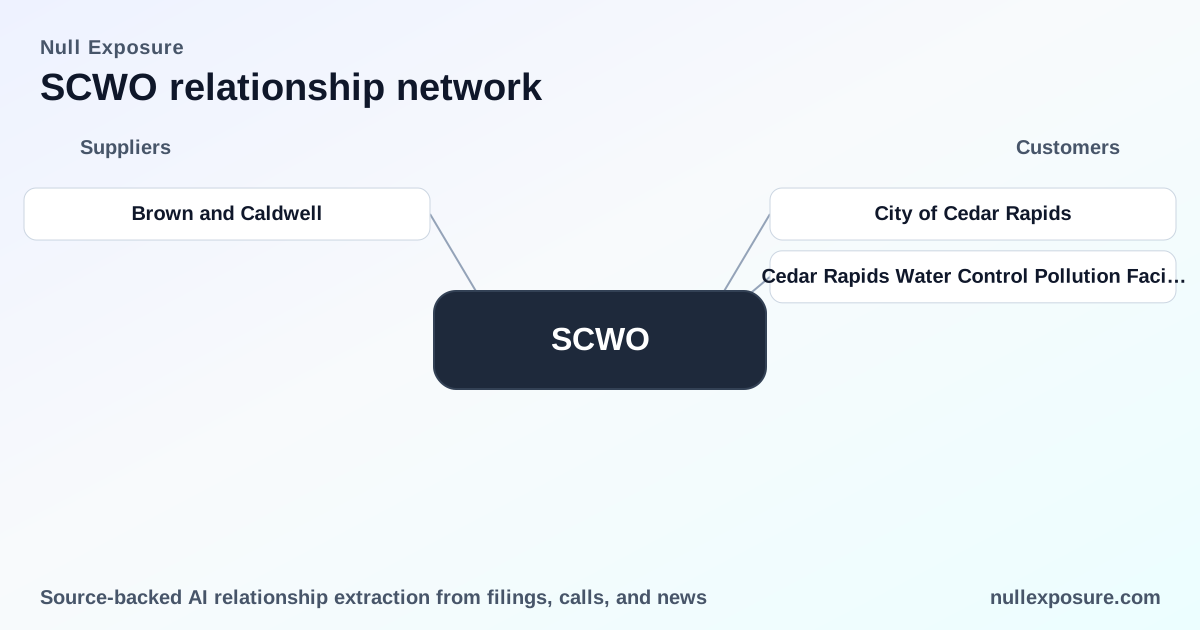
City of Cedar Rapids, Iowa — Cedar Rapids selected 374Water to perform a project to destroy PFAS in municipal biosolids, illustrating uptake by mid‑sized municipal wastewater authorities. This project is being executed in partnership with local process operators. (Proactive Investors, March 10, 2026; GlobeNewswire/Manila Times press release, Dec 26, 2025)
-
Cedar Rapids Water Control Pollution Facility (CRWPCF) — The Cedar Rapids Water Control Pollution Facility is named as the operational partner on the Cedar Rapids project and will work with 374Water and Brown and Caldwell on execution, signaling municipal operator buy‑in and an engineering partner layer. (Proactive Investors, March 10, 2026)
-
Garney Construction — Garney issued a purchase order to 374Water tied to a municipal PFAS biosolids destruction project in Olathe, Kansas; this shows 374Water is starting to engage through contractor channels that handle municipal capital projects. (Proactive Investors, May 3, 2026)
-
City of Olathe, Kansas — 374Water signed an agreement to supply a system to Olathe, representing a direct municipal capital sale or equipment supply arrangement and an incremental commercial reference for the company’s system. (Proactive Investors UK, May 3, 2026)
-
Orange County Sanitation District (California) — 374Water plans to deploy its latest‑generation system to the Orange County Sanitation District in 2026, indicating engagement with a large regional utility and a meaningful reference if delivered. (Proactive Investors UK, May 3, 2026)
-
City of Orlando (Iron Bridge Regional Water Reclamation Facility) — Orlando is a critical commercial milestone: 374Water executed a five‑year Waste Destruction Services license with the City of Orlando and previously ran a full‑scale demo there, showcasing the conversion of demonstration work into a multi‑year municipal services contract. (The Globe and Mail press release, May 3, 2026; company disclosures, Dec 2024 demo contract)
-
Crystal Clean — 374Water lists engagement with Crystal Clean as a contractor partner to accelerate exposure and adoption, suggesting the company is building commercial channels through specialty waste contractors. (Quantisnow investor presentation, May 2026)
-
Clean Earth — Clean Earth is also named among contractor partners engaged to expand access to federal and municipal opportunities, indicating 374Water’s strategy to leverage established waste management firms for business development and site work. (Quantisnow investor presentation, May 2026)
What the relationship map implies about business constraints and runway
374Water’s customer list reveals a clear set of operating constraints and characteristics that should drive investor diligence:
-
Contracting posture: the company recognizes revenue over time under long‑term fixed‑price AirSCWO contracts, which supports multi‑year visibility when contracts are signed but delays cash realization until performance milestones are met. (Company disclosures)
-
Counterparty type: a heavy tilt to government and municipal customers requires competence in public procurement and long sales cycles, but yields higher contract stickiness when awarded. (Company disclosure)
-
Geographic footprint: commercial activity is concentrated in North America while the company describes itself as a global technology provider—expect initial scale to depend on NA municipal rollouts with later international expansion. (Company disclosure)
-
Concentration and materiality: recent years show high customer concentration (two customers ≈72% of 2024 revenue), so near‑term revenue variability will be driven by a few municipal projects. (Company disclosure)
-
Product and go‑to‑market: 374Water operates as both hardware seller and service provider; core product is AirSCWO systems, and WDS is positioned to generate recurring service revenue and hub throughput economics. (Company disclosure)
-
Maturity stage: several named projects are pilot or demo stage, with Orlando moving to a licensed five‑year WDS agreement—investors should track pilot-to-contract conversion rates as the key operational KPI.
Risk / reward and what to watch next
374Water trades as an early revenue company (Revenue TTM: $215k) with negative EBITDA and concentrated customers. The reward is meaningful if the company converts municipal pilots into recurring WDS hubs and expands through contractor partners (Garney, Crystal Clean, Clean Earth). The risk is concentrated execution: missed conversions, delayed system deliveries, or procurement setbacks at two or three municipal customers will have outsized impact on financials.
Key monitoring items:
- Signed WDS contracts and published throughput or processing volumes at Orlando and the Orlando hub expansion.
- Purchase order fulfillment and installation progress for Olathe (Garney) and Orange County deployments.
- Any disclosure of broadened contractor pipeline or federal/DoD contract awards that reduce customer concentration.
Explore detailed coverage and alerts at https://nullexposure.com/ for timely updates and document links.
Bottom line
374Water’s customer relationships show clear commercial traction in municipal PFAS destruction, driven by a hybrid hardware + services model and partnerships with established contractors. The path to scalable revenue runs through converting demos (Orlando, St. Cloud, Cedar Rapids) into multi‑year WDS contracts and proving throughput economics at waste destruction hubs. Investors should price in execution risk and concentration, while recognizing that each municipal win serves as a high-value reference that materially de‑risks the company’s go‑to‑market if replicated.