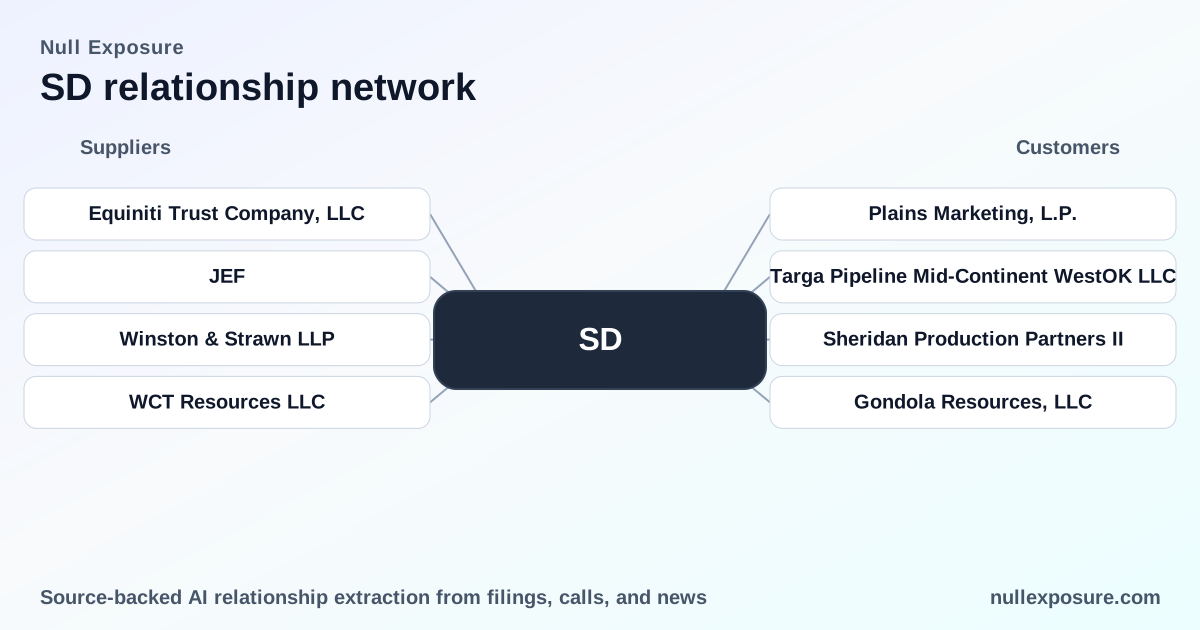
SandRidge Energy (SD): Customer Relationships and Commercial Risk Profile
SandRidge Energy generates cash flow by acquiring, developing and producing oil, natural gas and NGLs in the U.S. Mid‑Continent and monetizes through direct sales to marketers, large energy companies and pipeline operators; its commercial model is commodity sales with concentrated counterparty exposure, where a small set of purchasers account for a large share of receivables. For investors, the critical questions are counterparty credit, concentration risk, and exposure to regional basis movements that compress realizations. Learn more at https://nullexposure.com/.
How SandRidge sells product and how that translates into revenue
SandRidge is a pure upstream operator: it produces hydrocarbons and sells them into nearby markets and pipeline systems, rather than operating midstream infrastructure or downstream retail. Its customers include independent marketers, large oil and natural gas companies and gas pipeline companies, which positions SandRidge between commodity price realization and the logistics offered by buyers. According to company disclosures, purchasers are primarily large enterprises and pipeline companies, which supports reliable offtake but does not eliminate price and basis risk.
- Concentration is material. SandRidge disclosed that three purchasers represented roughly 70.9% of revenues receivable as of December 31, 2024, and two purchasers each exceeded 10% of total revenue during 2024.
- Geographic focus reduces breadth but supports logistical simplicity. The company operates primarily in the U.S. Mid‑Continent, which reduces the universe of buyers but gives access to established regional markets and pipelines.
- Commercial posture is transactional and active. Sales are ongoing, recurring and tied to production volumes and market spreads rather than long-term supply contracts.
Recorded customer relationships and what they tell investors
Plains Marketing, L.P.
Plains Marketing is listed in SandRidge’s FY2024 10‑K as a customer, indicating an active commercial relationship in the year ended December 31, 2024. According to the FY2024 Form 10‑K filing, Plains Marketing, L.P. is identified among purchasers that concentrate SandRidge’s revenue. (Source: SandRidge FY2024 10‑K)
Targa Pipeline Mid‑Continent WestOK LLC
Targa Pipeline Mid‑Continent WestOK LLC also appears in the FY2024 10‑K as a named customer, reflecting SandRidge’s reliance on pipeline counterparties for physical offtake and transportation of hydrocarbons in the mid‑continent. This underlines the company’s use of pipeline networks to access markets. (Source: SandRidge FY2024 10‑K)
Sheridan Production Partners II
In a historical transaction, SandRidge sold Permian Basin assets to Sheridan Production Partners II for $2.6 billion in cash, a major divestiture reported in 2012; this is a legacy buyer/partner in asset sales rather than a routine product purchaser today. The deal materially reshaped SandRidge’s asset footprint at the time. (Source: RTT News, 2012)
Gondola Resources, LLC
SandRidge announced the sale of North Park Basin assets in Colorado to Gondola Resources, LLC for $47 million in 2020, confirming that the company periodically monetizes non‑core assets to refocus operations or shore up liquidity. This is an example of transactional counterparties used for asset disposition. (Source: OK Energy Today, 2020)
Panhandle Eastern
Management commentary during the Q4 2025 earnings call notes that a significant portion of SandRidge’s gas volumes are sold through Panhandle Eastern and NGL markets, illustrating active commercial flows through regional pipeline markets that affect realized prices and basis exposure. (Source: Q4 2025 earnings call transcript, InsiderMonkey)
Explore the full customer intelligence offering on the platform at https://nullexposure.com/ — the insight framework above is built from public filings and market reports.
What the relationships and constraints imply for operations and risk
The evidence set yields a clear commercial portrait:
- Contracting posture — transactional and production‑tied. SandRidge sells product into spot and market-based arrangements with marketers and pipelines; there is no public indication of long‑term fixed‑price contracts dominating revenue.
- Concentration and criticality — high and material. With roughly 70.9% of receivables concentrated among three purchasers, loss or downgrade of a top counterparty would be immediately material to cash flow and could force price concessions or accelerate asset sales.
- Geography — concentrated in the Mid‑Continent. This limits diversification of buyers but simplifies logistics; regional basis dynamics and local gas differentials therefore materially affect realized revenue.
- Counterparty profile — large enterprises and pipeline operators. That profile reduces counterparty credit risk relative to a book dominated by small retailers, but it raises counterparty bargaining power on logistics and basis.
- Relationship maturity and stage — active and operational. These are ongoing, production‑linked relationships rather than one‑off transactions, apart from the historical asset sales noted above.
Investment implications: what to watch and portfolio levers
For investors evaluating SD as a customer‑exposure story, prioritize monitoring three levers:
- Receivable concentration trends. If the top three purchasers’ share drops materially, that would reduce single‑counterparty risk; a stable or rising share increases vulnerability.
- Regional basis and pipeline flows. Management commentary linking sales channels (for example, Panhandle Eastern) to widening regional spreads is a direct inflow risk to EBITDA and free cash flow.
- Balance sheet resilience and liquidity. With a market capitalization around $587 million and trailing EBITDA near $101 million, SandRidge trades with modest valuation multiples (trailing P/E ~8x, EV/EBITDA ~4.2x) that reflect commodity exposure and concentration risk; management’s ability to convert sales into free cash flow determines the company’s capacity to withstand counterparty stress.
Bottom line: concentrated customers are both a stabilizer and a vulnerability
SandRidge’s business model—production monetized through large marketers and pipelines concentrated in the Mid‑Continent—delivers economies of scale and operational simplicity, but the material concentration of receivables and reliance on regional pipeline markets are clear sources of downside volatility. Investors should treat top‑customer composition and regional basis trends as leading indicators for revenue and coverage risk.
For further intelligence on counterparty concentration and to compare SD’s buyer profile versus peers, visit https://nullexposure.com/.