Schrödinger (SDGR): Customer Relationships Drive Platform Monetization and Milestone Optionality
Schrödinger operates a dual business model: a software licensing/subscription platform that sells computational chemistry and informatics tools to large enterprises, governments, and academia, paired with collaborative drug-discovery partnerships that deliver milestone and royalty upside. Revenue comes primarily from software sales and annual contracts, while large multi-year pharma collaborations create episodic, high-margin milestone potential. Learn more about how these customer dynamics translate to risk and optionality at https://nullexposure.com/.
How Schrödinger sells value and converts clients into revenue
Schrödinger’s go-to-market centers on licensing and subscription delivery of physics-based modeling and LiveDesign informatics, sold to well-established life sciences companies and institutions. The company runs a high-touch enterprise sales motion: many customers have annual contracts (typical term = one year), a meaningful cohort have ACVs > $100k, and a smaller but significant set of customers generate seven-figure ACVs. These structural elements produce a predictable but concentrated revenue base, while collaborative drug discovery deals layer in milestone timing risk and asymmetric upside.
- Licensing and subscription are both core: Schrödinger distributes on-premise licensed software and cloud-access subscriptions, which preserves recurring revenue while supporting larger one-time license deals. This is a deliberate commercial posture that balances retention with scalable seat-based and compute-based pricing.
- Enterprise concentration and material customers: The company reports customers across North America, EMEA and APAC, and one customer represented roughly 10% of revenue in the most recent fiscal year — a clear concentration signal that amplifies downside if a large partner shifts spending.
- Short-term contract cadence: Many software agreements run on annual terms, increasing the importance of renewal execution and account management versus long multi-year lock-ins.
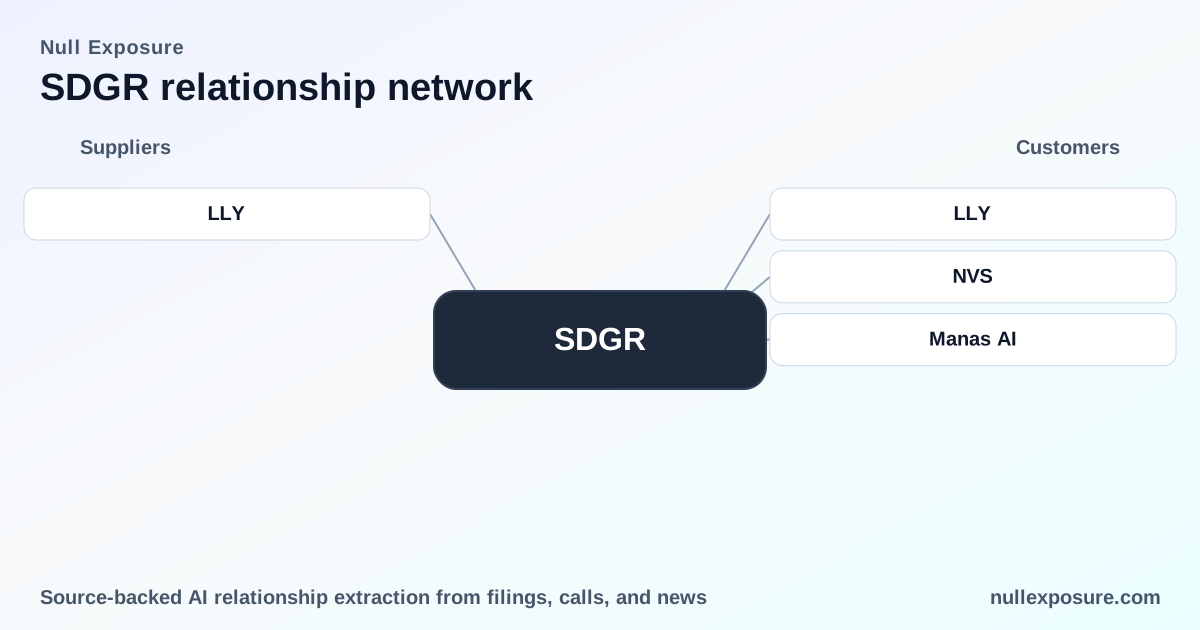
Customer roster: who Schrödinger is working with now
Below I cover every counterparty reported in the available results and the public reference for that relationship.
GPCR (partnering for computational chemistry support)
Schrödinger provides computational chemistry support under an established collaboration with GPCR, supporting drug discovery efforts through its modeling platform. This relationship was referenced in a TradingView summary of a 10‑K disclosure in March 2026. (TradingView, March 2026)
Novartis (large multi‑year collaboration with significant upfront and milestone potential)
Novartis committed US$150 million upfront with up to US$2.272 billion in potential milestones under a multi-year collaboration, a contract that signals big‑pharma adoption of Schrödinger’s platform and the company’s ability to secure materially sized deals. Reports emphasizing the scale and milestone structure appeared in industry coverage in March 2026. (Simply Wall St, March 2026)
Eli Lilly / TuneLab (LiveDesign integration; federated AI workflows)
Schrödinger announced a January 9, 2026 collaboration integrating Eli Lilly’s TuneLab AI-driven discovery workflows into Schrödinger’s LiveDesign informatics via a privacy-preserving federated learning framework, positioning LiveDesign as a priority interface for TuneLab participants. The announcement was highlighted across analyst and press pieces in March 2026 and reiterated in Schrödinger’s own Q4/FY2025 release. (Simply Wall St and BioSpace press releases, January–March 2026)
Manas AI (strategic agreement for ultra‑large scale access and algorithm integration)
Schrödinger entered a strategic agreement with Manas AI granting Manas access to Schrödinger’s computational platform at ultra-large scale and integrating physics-based modeling with Manas AI algorithms to improve predictive accuracy and speed. This partnership was disclosed in Schrödinger’s corporate press material and results commentary in March 2026. (BioSpace press releases, March 2026)
What the relationship map implies for business operations and risk
The public evidence supports a clear operating profile for Schrödinger:
- Contracting posture: The company mixes short-term, annual software agreements with multi-year, milestone‑driven collaborations. This creates a blended revenue stream: recurring, predictable license/subscription income and episodic milestone receipts that drive large step-ups. The mixed model amplifies upside when drug-discovery partnerships succeed and increases earnings volatility from milestone timing.
- Customer concentration and criticality: Large-enterprise customers dominate the revenue mix; one customer accounted for ~10% of revenue. This concentration makes high-value contract retention critical to financial stability and increases negotiation leverage for buyers of enterprise software.
- Commercial maturity and product positioning: Schrödinger is positioned as a licensor and seller of specialized software for discovery, supported by professional services and integrated collaborations. The company’s platform is now accepted by major pharma (Novartis, Eli Lilly) and newer AI partners (Manas AI), indicating commercial maturation beyond early adopters.
- Geographic diversification with material international exposure: Sales are global, with nearly half of revenues from outside the U.S., and formal sales operations in the EU, U.K., Japan, India and South Korea. Geographic breadth reduces country-specific concentration risk but requires consistent international go-to-market investment.
- Spend profile and account tiers: Schrödinger reports several hundred customers with ACVs ≥ $100k and dozens with ACVs ≥ $1m, signalling a meaningful installed base of high-value enterprise accounts that underpin recurring revenue.
Investment implications — where the upside and risk live
- Upside: Large pharma collaborations (Novartis capex/milestone structure, Lilly TuneLab integration) validate Schrödinger as a platform standard and deliver substantial optional milestone and royalty upside when programs advance. AI partnerships like Manas AI expand the addressable market for physics‑informed modeling at scale.
- Risk: Revenue concentration, short-term contract cadence, and milestone timing are the principal levers of downside. A lost renewal from a top-ten account or delayed milestones creates outsized P&L sensitivity given current scale.
- Operational focus for investors: Monitor renewal rates for customers with ACV > $100k, the timing and probability of milestone payments from large pharma deals, and expansion of LiveDesign as a preferred interface for third‑party AI workflows.
If you want a concise scoring of how partner concentration and contract structure affect valuation, see our portfolio research hub at https://nullexposure.com/.
Bottom line
Schrödinger is a software-first commercial enterprise with meaningful, high-upside partnership optionality. The firm’s enterprise licensing and subscription sales provide recurring baseline revenue while major pharma and AI collaborations create the potential for outsized milestone-driven earnings. Investors should value the stock on a dual axis: steady subscription growth and the binary timing/value of collaboration milestones. Monitoring renewal health among the mid- and large‑ACV cohorts and milestone realization from partners like Novartis and Lilly is essential to any investment thesis.