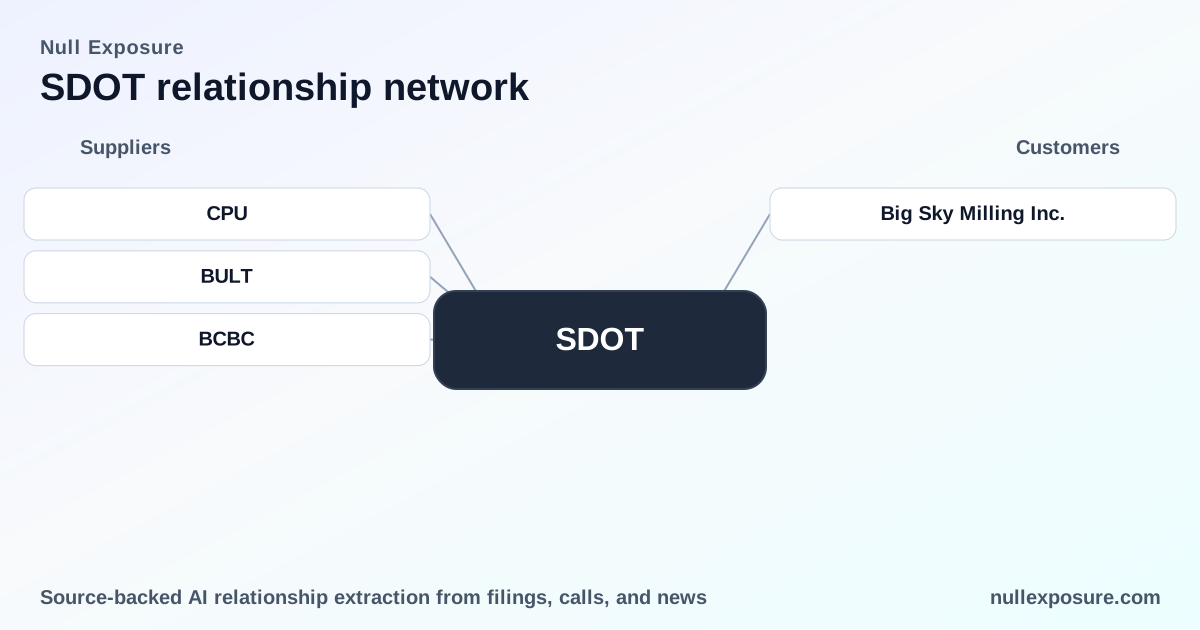
Sadot Group (SDOT) — Customer and Partner Map for Investors
Sadot Group Inc. operates as an integrated agricultural commodities trader and foodservice franchisor, generating revenue through commodity trading and distribution, franchise and licensing fees, and operating and management services across multiple geographies. The company monetizes by capturing margins on bulk imports/exports and distribution, licensing foodservice brands (franchise fees and development payments), and selling direct services through subsidiary-managed operations. For investors, the key value drivers are global distribution reach, franchise/licensing scalability, and control of commodity flows, balanced against thin margins and operating losses that require careful counterparty and capital monitoring. Explore Nillexposure research for deeper signals.
How Sadot monetizes in practice: an investor lens
Sadot’s business model combines merchant trading economics with a services-led franchising arm. In trading, the company purchases agricultural commodities and hedges exposure to deliver to customers — revenue is volumetric and margin-driven, with material counterparty and commodity-price risk. On the foodservice side, Sadot acts as both licensor (franchisor) and service provider, collecting initial franchise fees, multi-unit development payments, and management fees while offering pre-opening and operational support. The firm has also operated subscription-based consumer offerings historically, adding recurring revenue elements to the mix.
Operating constraints and what they signal about risk and scalability
- Contracting posture: Sadot runs a mix of licensing and service agreements (evidence shows franchise agreements and management services), indicating a hybrid model where predictable fee streams coexist with volatile trading margins. This implies contractual diversity but also complexity in execution.
- Concentration and criticality: The company’s SEC disclosures warn that counterparty or customer defaults can materially impact results, signaling that trading counterparties and large customers are economically critical.
- Geographic footprint: Sadot operates globally — subsidiaries span the United States, Brazil, Canada, Colombia, India, Israel, Singapore, Ukraine, UAE and Zambia — which diversifies market exposure but raises logistics, FX, and regulatory complexity.
- Relationship roles: Corporate documents and filings show Sadot acting as buyer, seller, licensor, licensee, and service provider, underlining an integrated position across the value chain from commodity procurement to retail franchising.
- Segment focus: The firm emphasizes distribution as a strategic segment alongside trading and franchising; distribution is a core, recurring commercial engine for revenue.
These signals frame Sadot as a growth-oriented, operationally intensive company whose upside depends on scaling fee-bearing franchise and management services while stabilizing commodity-trading margins and counterparty risk.
Customer and partner roster: the evidence from recent filings and press
Below is a concise, source-backed read of every counterparty and investor relationship captured in the recent results.
Big Sky Milling Inc.
Sadot Canada entered a formal management services agreement to provide full-scale operational and growth support to Big Sky Milling, positioning Sadot as the active operator and manager for that business unit (FY2025). Source: The Globe and Mail / AccessWire news release announcing the management services agreement (March 10, 2026) — https://www.theglobeandmail.com/investing/markets/markets-news/ACCESS%20Newswire/32032173/sadot-group-inc-announces-management-services-agreement-between-subsidiary-sadot-canada-inc-and-big-sky-milling-inc/.
MARV Brands Inc. and MARV Brands of America LLC
Sadot completed the sale of certain franchise assets to MARV Brands Inc. and MARV Brands of America LLC for a combined purchase price of $2.9 million, indicating a disposition of legacy franchise interests and a shift toward management and licensing models (FY2025). Source: Investing.com SEC filing summary of the Form 8‑K disclosure (May 3, 2026) — https://ng.investing.com/news/sec-filings/sadot-group-appoints-new-cfo-and-completes-sale-of-franchise-assets-93CH-2245418 and related Investing.com items (May 3, 2026) — https://in.investing.com/news/sec-filings/sadot-group-appoints-new-cfo-and-completes-sale-of-franchise-assets-93CH-5144247.
Sixth Borough Capital Fund
Sixth Borough Capital Fund participated in Sadot’s public offering, reflecting capital market support for near-term financing and potential dilution dynamics for shareholders (FY2025 offering). Source: AccessNewswire press release covering the public offering (May 3, 2026) — https://www.accessnewswire.com/newsroom/en/business-and-professional-services/sadot-group-inc.-announces-pricing-of-public-offering-1087315.
Stanley Hills, LLC
Sadot raised capital via a private placement of newly designated Series A Preferred Stock to Stanley Hills, LLC for gross proceeds of approximately $145,244, and subsequently amended the stock purchase agreement to reduce the preferred voting rights per share — a governance-sensitive financing event that directly affected Nasdaq compliance remediation (FY2026). Source: TipRanks and Investing.com coverage of the securities purchase agreement and amendment (February–March 2026) — https://www.theglobeandmail.com/investing/markets/markets-news/Tipranks/217296/sadot-group-raises-capital-via-series-a-preferred-stock/ and https://uk.investing.com/news/sec-filings/sadot-group-regains-nasdaq-compliance-after-amending-preferred-stock-voting-rights-93CH-4559045; summary reporting (March 2026) — https://minichart.com.sg/2026/03/14/sadot-group-inc-sdot-files-form-8-k-notice-of-nasdaq-delisting-and-company-information/.
What these relationships imply for investors
- Capital and governance pressures are front-and-center. The Stanley Hills preferred issuance and subsequent amendment to voting rights reflect urgent capital needs coupled with governance restructuring to maintain listing compliance. That dynamic has direct implications for shareholder dilution and control.
- Franchise strategy is shifting from ownership to services and licensing. The sale of franchise assets to MARV Brands and the management engagement with Big Sky Milling show a pivot toward fee-based services and outsourcing of physical franchise ownership, which reduces capital intensity but transfers execution risk to partners.
- Counterparty credit risk is material. Company disclosures explicitly flag that customer or counterparty default can materially affect results, a critical consideration given Sadot’s negative operating margins and reliance on hedging in commodity flows.
Investment takeaways
- Bull case: Sadot’s global distribution network and expanding management/licensing footprint convert capital-intensive franchise assets into scalable, fee-bearing services while commodity trading revenue recovers with improved margins.
- Risk case: Persistent operating losses, counterparty concentration, and recent governance changes tied to preferred equity issuance create near-term downside and execution risk until profitability and balance-sheet stability improve.
For a concise map of Sadot’s commercial relationships and governance events, Nillexposure compiles these signals daily; revisit for updates as filings and market notices arrive. Visit Nillexposure for ongoing coverage.
Overall, Sadot is an operationally complex, globally exposed agri-trader with mixed profitability; investor returns will hinge on management converting franchise and service contracts into reliable, low-capital revenue while reducing counterparty and commodity exposure.