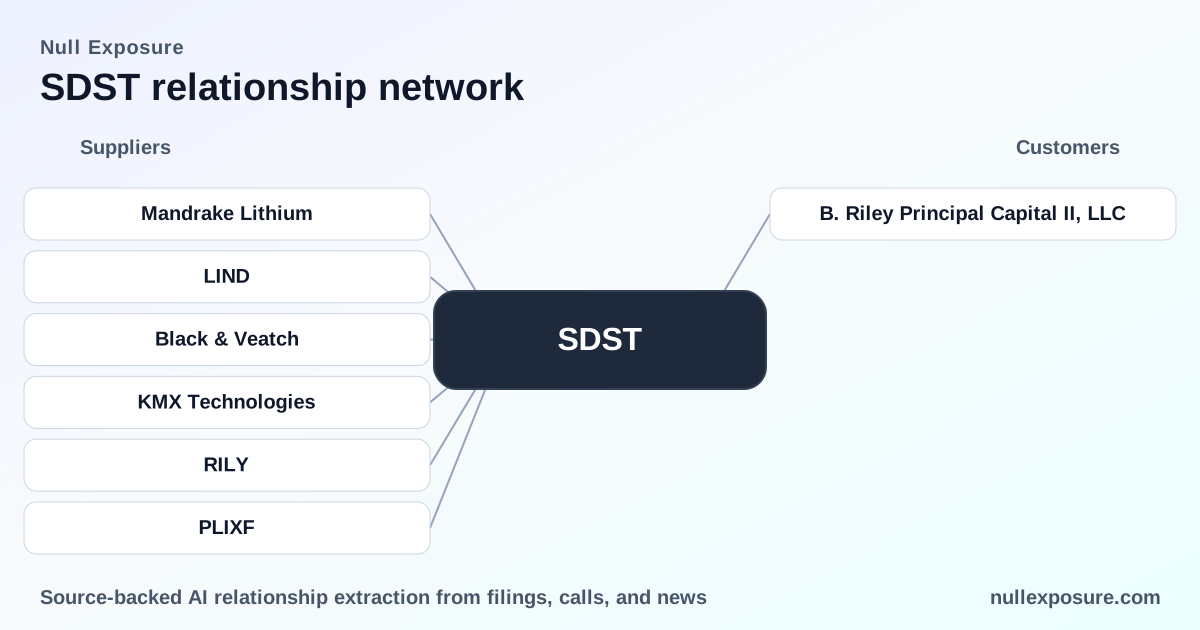
Stardust Power (SDST): Customer Relationships and Commercial Positioning
Thesis: Stardust Power is a vertically integrated lithium refiner that plans to monetize by selling battery‑grade lithium carbonate to large industrial customers while funding operations through equity facilities; its commercial picture today is built on non‑binding long‑term offtake intent with strategic buyers and a short‑term equity funding line, which together define revenue visibility, dilution risk, and execution leverage for investors.
Learn more or track relationship signals at https://nullexposure.com/
How Stardust plans to sell lithium and fund growth
Stardust Power operates as a seller of refined lithium carbonate targeted at battery manufacturers and EV supply chains, with go‑to‑market anchored on commercial offtake agreements and strategic supply letters. The company has not yet commenced production and generates no revenue; therefore, economic value today is driven by contract optionality (offtake letters) and financing capacity to reach commercial qualification, not by recurring cash flows.
What investors should know about the contracting posture
Stardust’s customer relationships are predominantly non‑binding and at the prospect stage, with at least one counterparty contemplating a multi‑year binding relationship once product qualification is complete. This posture delivers potential long‑dated revenue upside (if qualification succeeds) but leaves short‑term cashflow uncertain, so financing arrangements become critical to sustain development and commercial qualification activities.
Customer relationships (each reported relationship covered)
B. Riley Principal Capital II, LLC — equity facility to bridge development
Stardust secured a common stock purchase agreement that gives it the right, over a three‑year period, to sell up to $10 million of common stock to B. Riley Principal Capital II, LLC; the arrangement is structured as an equity facility rather than a revenue or offtake commitment. According to multiple news reports in FY2026, this facility provides immediate liquidity optionality and a predictable capital channel during the pre‑revenue phase (QuiverQuant, March 2026; Bitget, May 2026; Investing.com, May 2026).
Why this matters: the equity facility is a liquidity backstop that reduces immediate funding risk but increases potential dilution if fully drawn.
Sources: QuiverQuant (March 10, 2026) reporting the up‑to‑$10M common equity financing; Bitget and Investing.com (May 3, 2026) summarizing the three‑year equity facility terms.
Sumitomo — large offtake intent with long initial term
Stardust disclosed a non‑binding letter agreement with Sumitomo (Sumitomo Corporation of Americas) dated January 28, 2025, contemplating a long‑term commercial offtake for 20,000 metric tons per year of lithium carbonate from Stardust’s first production line, with potential to increase to 25,000 tpa and an initial commercial term of 10 years plus a five‑year renewal option contingent on qualification. News coverage in FY2026 repeats these supply partnership terms as the key anchor for future feedstock and product placement (TradingView coverage referencing the filing, FY2026).
Why this matters: the contemplated Sumitomo offtake represents a high‑criticality, long‑dated demand anchor that, if converted to a definitive contract after qualification, materially de‑risks commercial sales and enables scale economics.
Source: Company disclosure dated January 28, 2025 (non‑binding letter agreement) as summarized in media coverage (TradingView, FY2026).
Company‑level operating signals and what they imply for investors
Use the following constraints and disclosures to read between the lines of Stardust’s commercial profile:
- Contracting posture: non‑binding, long‑term intent. The primary commercial evidence consists of letters of intent and non‑binding supply letters that contemplate 10‑year initial terms for major counterparties; this is a signal that Stardust’s go‑to‑market strategy prioritizes securing long‑dated demand commitments prior to production qualification. This reduces post‑startup market risk but leaves execution tied to qualification milestones.
- Counterparty profile: large enterprises targeted. Management expects customers to be experienced, large lithium market participants, which supports the strategy of pursuing big offtakes (e.g., Sumitomo) and suggests low buyer count but high per‑counterparty volume.
- Geographic focus: North America (domestic market emphasis). Management frames the addressable market in U.S. lithium carbonate equivalent terms, indicating focus on domestic industrial customers and OEMs, which aligns with supply‑chain localization trends for EV batteries.
- Role dynamics: primarily a seller (with buyer targets in EV/battery OEMs). Stardust’s disclosures identify the company as the supplier; the firm’s commercial success depends on qualifying product to buyers’ technical and procurement standards.
- Relationship stage: prospect/pre‑revenue. Management acknowledges no revenue and that current customer commitments are non‑binding, so revenue realization is conditional on technical qualification and ramp.
These constraints collectively produce a clear operating model: pre‑revenue, concentrated prospective customers, long potential contract tenors, and reliance on capital markets for development cash.
Financial and governance context that colors customer risk
Stardust is a small public company with ~$25 million market capitalization and negative operating metrics; the company reported negative EBITDA and no revenue through its latest annuals (MarketCap $25,075,200; EBITDA -$16,080,040; Revenue TTM $0). Insider ownership is elevated at ~42%, while institutional ownership is low (~9%), implying founder/insider control and limited institutional scrutiny or depth in the shareholder base. These facts amplify the importance of the B. Riley equity facility as a near‑term funding mechanism and make dilution and governance outcomes material to investors.
Investment implications and risk checklist
- Catalyst: successful product qualification and conversion of the Sumitomo LOI into a definitive offtake would be transformational and provide multi‑year revenue visibility.
- Liquidity/dilution: the B. Riley equity facility reduces the probability of an immediate cash shortage but creates dilution risk if drawn in full.
- Concentration risk: a strategy built around a small number of very large counterparties concentrates execution risk—if Sumitomo does not proceed, the demand gap is large.
- Execution dependency: commercial realization depends on technical qualification, permitting, and the company’s ability to scale to address 20k+ tpa commitments.
For investors who track counterparty conversion and financing milestones, these two relationship streams—Sumitomo for demand and B. Riley for capital—are the primary value drivers to monitor.
Learn more about relationship signals and monitoring at https://nullexposure.com/
Bottom line
Stardust Power’s customer landscape is not yet revenue‑generating but is structured around large, long‑term offtake intent and short‑term equity financing. The company’s upside arises from converting non‑binding LOIs into definitive contracts and executing qualification; the downside centers on execution risk, dilution, and high customer concentration. Investors should treat progress on the Sumitomo qualification and any drawdown or amendment of the B. Riley facility as the two immediate binary drivers for SDST’s valuation trajectory.