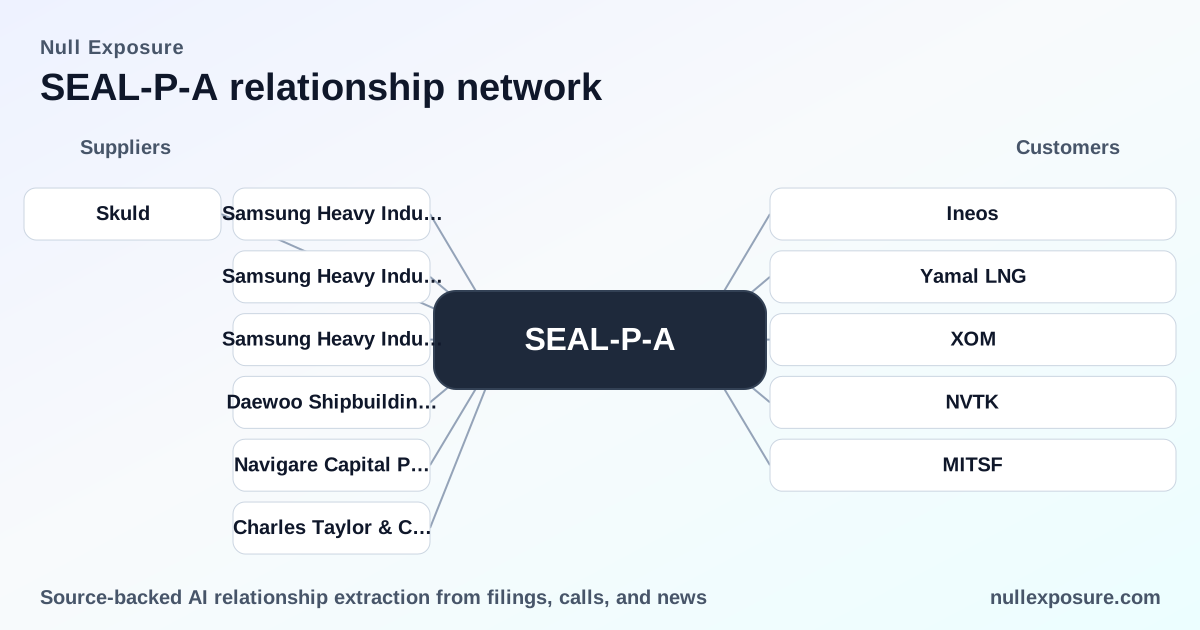
SEAL-P-A: What Seapeak’s customer map tells investors about cash visibility and contract risk
SEAL-P-A represents a preferred share exposure to a company that monetizes capital-intensive maritime assets through long-term, fixed-rate charters and selective spot employment, converting vessel ownership into predictable cash flows and asset value optionality. The customer relationships visible in public reporting show a deliberate mix of energy majors, commodity traders, and project-level counterparties that together underpin earnings stability while concentrating operational and geopolitical risk in a handful of trade lanes. For independent investors and operators assessing SEAL-P-A, the central conclusions are simple: high contract visibility, material counterparty credit quality, and concentrated trade-risk tied to Arctic and U.S. LNG offtakes. Learn more about the platform and coverage at https://nullexposure.com/.
How the customer set defines the business model in practice
Seapeak’s revenue model is built on charter economics: it sources or builds LNG carriers and then secures multi-year charters that convert capital spending into contractual cash yield. The observable customer roster confirms a bias toward long-dated, fixed-rate hires and strategic project charters rather than pure spot exposure. That underpins preferred dividends and reduces volatility, but also channels risk through a limited number of large counterparties and geopolitically sensitive trades.
Key operating-model characteristics investors should internalize:
- Contracting posture: Predominantly long-term, fixed-rate time charters that deliver predictable cash flows and support leverage capacity.
- Concentration: Revenue driven by a relatively small set of large counterparties (energy majors, trading houses, project sponsors), increasing single-counterparty importance.
- Criticality: Many charters service strategically important liquefaction projects and offtakes; loss or restriction of a single trade lane can meaningfully reduce utilization and earnings.
- Maturity profile: Contracts extend well into the early 2030s and, for some Arctic trades, into the 2040s—providing visibility but locking exposure to long-range geopolitical and regulatory shifts.
These are company-level signals that frame how investors should think about SEAL-P-A’s risk-adjusted yield and refinancing profile.
Relationship-by-relationship: what each cited report changes in the thesis
Below are concise, source-linked summaries for every customer relationship instance in the public record provided. Each item is a 1–2 sentence plain-English takeaway with the reporting source.
Mitsui & Co. — LNG carrier tied to Cameron, Louisiana offtake
Seapeak assumed a time-charter with a firm period through 2030, servicing Mitsui & Co.’s LNG offtake from Cameron, Louisiana, demonstrating a multi-year commitment to a major trading house. Source: LNG Prime (report dated 3 May 2026) — https://lngprime.com/americas/seapeak-buys-navigares-lng-carrier-for-213-million/132769/
ExxonMobil — five new 174,000-cbm carriers ordered for charter
Seapeak placed an order for five 174,000-cbm LNG carriers at Samsung Heavy for charter to ExxonMobil, signaling infrastructure-backed, large-cap counterparty demand and longer-term charter commitments. Source: LNG Prime (March 2026 coverage of Evergas transaction) — https://lngprime.com/contracts-and-tenders/seapeak-wraps-up-evergas-acquisition/69920/
Ineos — fixed-rate charters and portfolio diversification
Ineos is listed as a key customer with several vessels on fixed-rate charters, underlining Seapeak’s strategy to diversify charter counterparties beyond traditional majors. Source: Maritime Executive (March 2026) — https://maritime-executive.com/article/seapeak-completes-evergas-acquisition-in-continued-growth
Ineos — fleet capability and fuel-flexible tonnage
Reports note that vessels on charter to Ineos are capable of burning gas as fuel, enhancing operational flexibility and compliance with fuel transition requirements. Source: LNG Prime (March 2026, Evergas acquisition coverage) — https://lngprime.com/contracts-and-tenders/seapeak-wraps-up-evergas-acquisition/69920/
Yamal LNG — long-term Arctic charters through 2045
Several Arc7 vessels are under long-term charter to the Yamal LNG project with commitments extending to 2045 and beyond, anchoring very long-dated project exposure into Seapeak’s fleet. Source: High North News (March 2026) — https://en.highnorthnews.com/politics/uk-maritime-services-ban-on-russian-lng-threatens-seapeaks-arctic-yamal-fleet/1090456
ExxonMobil — confirmation of major-energy demand in fleet orders
Additional reporting reiterates that the Samsung-built carriers were ordered for charter to US energy giant ExxonMobil, reinforcing the scale and credit quality of Seapeak’s customer mix. Source: LNG Prime (March 2026) — https://lngprime.com/contracts-and-tenders/seapeak-wraps-up-evergas-acquisition/69920/
Ineos — scale of newbuilding order and customer role
MarineLog coverage describes the $1.1 billion order for five carriers and highlights Ineos as a key customer that expands Seapeak’s charter diversity. Source: MarineLog (March 2026) — https://www.marinelog.com/news/seapeak-places-1-1-billion-order-for-5-lng-carriers-at-shi/
Novatek — Arctic capacity exposure and potential disruption
High North News warned that if maritime-service bans affect operators like Seapeak, Novatek would face an immediate shortage in shipping capacity, indicating mutually critical reliance between Arctic producers and vessel operators. Source: High North News (March 2026) — https://en.highnorthnews.com/politics/uk-maritime-services-ban-on-russian-lng-threatens-seapeaks-arctic-yamal-fleet/1090456
NVTK — same Novatek exposure (alternate ticker reference)
Reporting repeats Novatek exposure under the ticker NVTK, emphasizing the same capacity risk for Russian LNG supply if vessel access is restricted. Source: High North News (March 2026) — https://en.highnorthnews.com/politics/uk-maritime-services-ban-on-russian-lng-threatens-seapeaks-arctic-yamal-fleet/1090456
Buana Lintas Lautan (BULL) — secondary-market vessel sale
Indonesian operator Buana Lintas Lautan acquired a secondhand Seapeak vessel (Seapeak Jupiter), illustrating Seapeak’s activity in the modern secondhand market and recapture of value through disposals. Source: LNG Prime coverage of Teekay/Seapeak transaction (March 2026) — https://lngprime.com/americas/teekay-lng-to-become-seapeak-after-6-2-billion-deal/39007/
Novatek — domestic capacity risk reiterated
A separate High North News article again highlights that Novatek would confront immediate shipping shortfalls if UK-linked vessels are banned from Russian LNG transport, reiterating regulatory tail risk. Source: High North News (March 2026) — https://www.highnorthnews.com/en/britain-ban-transport-russian-lng-uk-linked-vessels
NVTK — alternate listing reference to Novatek risk
The NVTK-coded instance mirrors the previous Novatek note, signaling multiple reporting lines identifying the same counterparty exposure. Source: High North News (March 2026) — https://www.highnorthnews.com/en/britain-ban-transport-russian-lng-uk-linked-vessels
Mitsui & Co. — Marvel Swan on charter to Mitsui (TradeWinds)
TradeWinds reports the Samsung-built Marvel Swan is on charter to Mitsui & Co., further confirming Seapeak’s involvement in the eight-ship series tied to Cameron LNG offtake. Source: TradeWinds (March 2026) — https://www.tradewindsnews.com/gas/seapeak-buys-navigare-capitals-three-year-old-lng-carrier/2-1-1740311
MITSF — same trade coverage under alternate symbol
TradeWinds repeats the commercial detail using the MITSF reference, underscoring multiple press outlets noting the Mitsui charter link. Source: TradeWinds (March 2026) — https://www.tradewindsnews.com/gas/seapeak-buys-navigare-capitals-three-year-old-lng-carrier/2-1-1740311
MITSF — Splash247 confirms the Cameron series charter set
Splash247 specifically notes the Marvel Swan is part of eight carriers on charter with Mitsui to serve Cameron, reinforcing the scale of that trading-house relationship. Source: Splash247 (March 2026) — https://splash247.com/seapeak-snaps-up-navigare-capitals-lng-carrier/
Mitsui & Co. — another Splash247 reference to the Cameron series
An additional Splash247 mention reiterates Mitsui’s role in the eight-ship charter series serving Cameron, consolidating evidence of multi-vessel commitments. Source: Splash247 (March 2026) — https://splash247.com/seapeak-snaps-up-navigare-capitals-lng-carrier/
Investment implications and final takeaways
- Predictable cash flow with concentrated counterparty risk. Long-term charters to ExxonMobil, Mitsui, Ineos and project sponsors like Yamal create a durable revenue base but concentrate exposure in a few major counterparties and geopolitically sensitive trades.
- Regulatory and geopolitical tail risk is material. Arctic trades linked to Novatek/Yamal LNG introduce a regulatory vulnerability that can instantaneously affect utilization and earnings.
- Optionality through newbuild and secondhand activity. Orders for newbuilds tied to majors and selective secondhand disposals (e.g., Buana Lintas Lautan purchase) show Seapeak can recycle tonnage and capture market value.
For a deeper, deal-level read of how these customer contracts translate into preferred-share coverage ratios and refinancing levers, visit https://nullexposure.com/ and review our issuer analysis and scenario modeling.
Bold, concentrated customers and long-term charters support yield—but they also concentrate political and counterparty risk. Investors in SEAL-P-A should weight the preferred yield against the operational and trade-lane concentration documented in the links above.