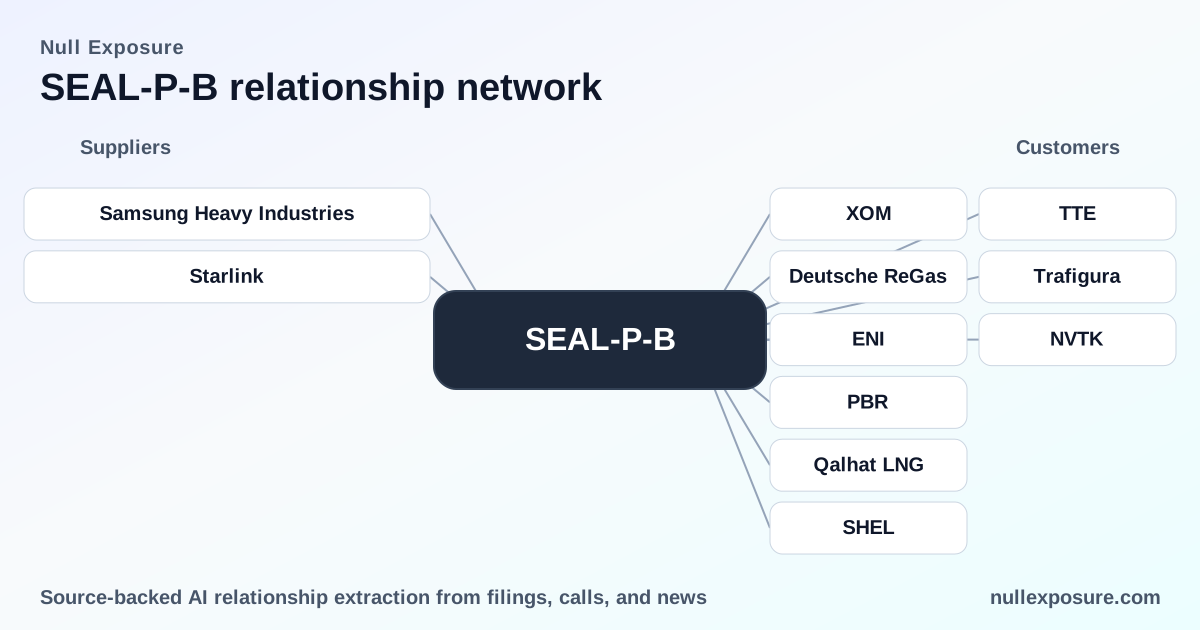
SEAL-P-B: Customer Map and Contract Risk — What investors need to know
SEAL-P-B operates as a maritime lessor and charter-manager that monetizes a fleet of LNG carriers through time charters, joint-venture arrangements and vessel sales tied to long-term energy counterparty commitments. Revenue is driven by charter contracts with large integrated and trading counterparties and by strategic fleet investments (newbuild orders and joint ventures) that lock in cash flows across multi-year terms. For a concise view of counterparties and contract timing, see NullExposure’s customer signal page: NullExposure.
Why the customer map matters for valuation and risk
Institutional investors value SEAL-P-B on the predictability and duration of charter cash flows, the credit quality of charterers, and the company’s ability to redeploy vessels when contracts roll off. The relationships in public reporting and industry press show concentration toward major energy houses and trading firms, a pattern that supports earnings visibility but also concentrates counterparty and geopolitical risk. For a deeper look at these relationships, visit NullExposure.
Direct customer relationships you must price into the model
Below I list every counterparty pulled from recent reporting, with a plain-English summary and the source for each relationship.
ExxonMobil (XOM)
Seapeak placed a five-vessel order tied to ExxonMobil charter demand, indicating a pipeline of contracted or contract-linked newbuild capacity connected to Exxon’s LNG needs (reported in March 2026). (LNG Prime, March 10, 2026: https://lngprime.com/americas/seapeak-trials-starlink-on-lng-carrier/71249/)
Deutsche ReGas
Seapeak Hispania, a 2002-built vessel, was on charter to Deutsche ReGas with the contract running through June 2024, highlighting short-to-medium-term charter business with European regasification operators. (LNG Prime, March 10, 2026: https://lngprime.com/contracts-and-tenders/seapeak-says-working-on-charter-and-other-opportunities-for-six-lng-carriers/108246/)
Eni (ENI)
Seapeak Catalunya, a 2003-built carrier, was on charter to Eni’s LNG Shipping unit until October 2024 with one option to extend for up to a year, reflecting multi-year arrangements with an integrated oil major. (LNG Prime, March 10, 2026: https://lngprime.com/contracts-and-tenders/seapeak-says-working-on-charter-and-other-opportunities-for-six-lng-carriers/108246/)
Petrobras (PBR)
Seapeak Vancouver, a 2017-built 173,400-cbm carrier, is chartered to Petrobras with the contract expiring in March 2025, showing exposure to Latin American national oil company demand. (LNG Prime, March 10, 2026: https://lngprime.com/contracts-and-tenders/seapeak-says-working-on-charter-and-other-opportunities-for-six-lng-carriers/108246/)
Qalhat LNG
Seapeak secured a new charter for a vessel in February 2024 with Qalhat LNG after a prior contract with Trafigura expired in January 2024, demonstrating active redeployment into regional LNG projects. (LNG Prime, March 10, 2026: https://lngprime.com/contracts-and-tenders/seapeak-says-working-on-charter-and-other-opportunities-for-six-lng-carriers/108246/)
Shell International Trading Middle East (SHEL)
Seapeak Madrid, built in 2004, is on charter to Shell International Trading Middle East until December 2024, signaling continued commercial ties with a major trading arm of a supermajor. (LNG Prime, March 10, 2026: https://lngprime.com/contracts-and-tenders/seapeak-says-working-on-charter-and-other-opportunities-for-six-lng-carriers/108246/)
TotalEnergies (TTE)
Seapeak has operational links to TotalEnergies through vessel operations and the MALT joint venture: Seapeak’s 52% stake in MALT led to an effective exchange of charter contracts between Seapeak Magellan and Seapeak Marib in May 2024; additionally, Seapeak Arwa hosted a carbon-capture installation while operating for TotalEnergies. These items show both strategic JV integration and participation in energy transition pilots. (LNG Prime, March 10, 2026: https://lngprime.com/contracts-and-tenders/seapeak-says-working-on-charter-and-other-opportunities-for-six-lng-carriers/108246/; Maritime Executive, March 10, 2026: https://maritime-executive.com/article/researchers-achieve-very-promising-carbon-capture-results-on-lng-carrier)
Trafigura
Trafigura was the prior charterer on a vessel that Seapeak re-chartered in February 2024 to Qalhat LNG, indicating a role for commodity trading houses in short-term demand for capacity. (LNG Prime, March 10, 2026: https://lngprime.com/contracts-and-tenders/seapeak-says-working-on-charter-and-other-opportunities-for-six-lng-carriers/108246/)
Novatek PJSC (NVTK)
Seapeak’s ownership history under private equity (Stonepeak’s 2022 purchase) left it with ice-class vessels that were used in exports from Yamal, creating an indirect linkage to Novatek operations and raising reputational and regulatory exposure questions for Western investors. (InvestmentNews, March 10, 2026: https://www.investmentnews.com/ria-news/american-pension-funds-indirectly-supporting-russian-lng-exports/255536)
What these relationships collectively reveal about SEAL-P-B’s operating model
- Contracting posture: The client list is dominated by large energy majors and trading houses that prefer time charters and JV arrangements; this signals an operational posture centered on longer-term, contract-level revenue stability with periodic redeployments when contracts expire. Evidence: multiple time-charter expiries and the MALT JV exchange reported in 2024. (LNG Prime, March 2026)
- Concentration: Cash flows are concentrated with creditworthy counterparties (ExxonMobil, TotalEnergies, Shell, Eni) but also include exposure to traders and national oil companies (Trafigura, Petrobras, Novatek-related flows), which produces a mixed counterparty risk profile.
- Criticality: Vessels are mission-critical assets for counterparties’ supply chains—charter timetables and joint-venture swaps indicate high criticality and limited redundancy for some routes, supporting bargaining leverage for charter owners.
- Maturity and flexibility: Several charters expire in 2024–2025 with options to extend; SEAL-P-B demonstrates active redeployment capability (e.g., Qalhat LNG replacement), which supports mid-cycle revenue management but leaves gap risk at rollovers.
Financial transparency and model inputs
Public fields in the available profile lack traditional financial metrics and per-share figures, which is a signal to investors that you must rely on contract disclosure, charter schedule analysis and press-reported vessel movements rather than stable reported line-item forecasts. Use the charter expiry dates and JV disclosures as primary inputs for cash-flow duration and downside scenarios.
Investment implications — key takeaways
- Positive: Counterparty quality and multi-year charters underpin visible cash flows and support valuation multiples that reward duration and low technical risk. The MALT JV and newbuild orders tied to ExxonMobil indicate strategic capacity alignment with demand.
- Risk: Concentration on a handful of large counterparties and trading firms creates single-counterparty exposure and potential geopolitically-driven disruptions; the Novatek-linked vessel activity underscores reputational/regulatory risk vectors for institutional investors.
- Actionable: Model roll-off risk around 2024–2025 expiries and stress-test redeployment assumptions against charter-rate volatility in spot and short-term markets.
For institutional-grade monitoring of counterparty contracts and to track changes to this customer map in real time, review NullExposure’s customer intelligence hub: NullExposure.
The customer relationships reported here provide a concise map for credit, strategic and operational diligence — and they should be the baseline scenario inputs for any premium finance or asset-backed lending exercise on SEAL-P-B.