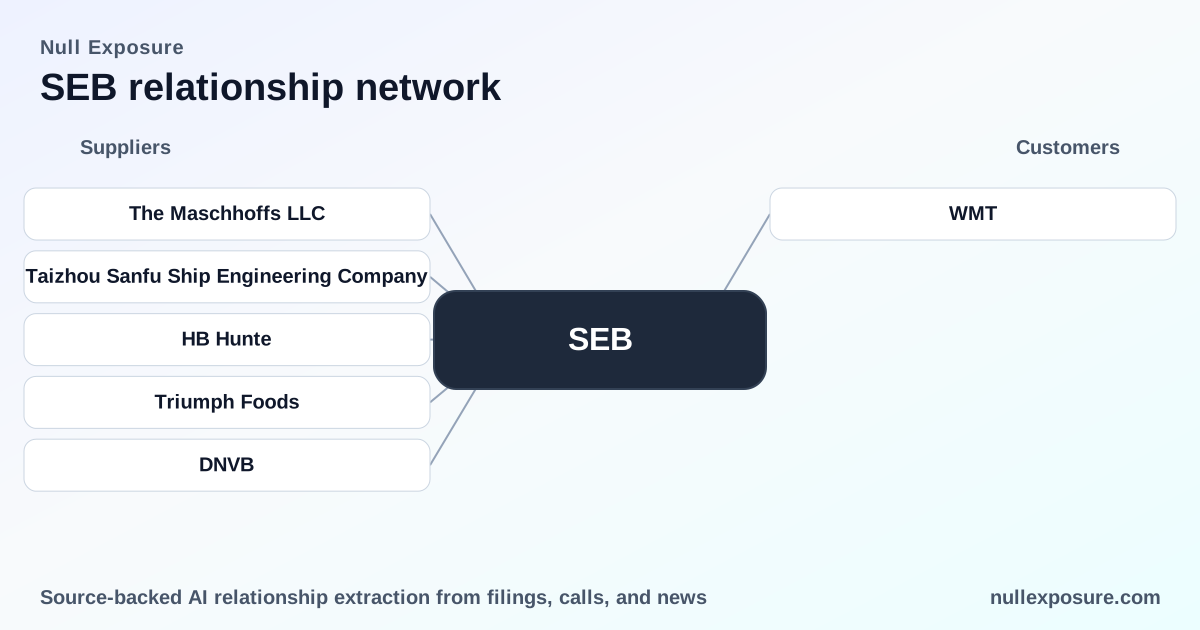
Seaboard Corporation (SEB): Customer relationships, concentration and operating constraints investors should price in
Seaboard is a diversified agribusiness and transport conglomerate that monetizes through volume-driven commodity processing, ocean freight services and regionally contracted power sales. Revenue stems from pork and poultry processing and sales, ocean carriage and logistics, commodity trading and power generation—each business characterized by high turnover, low-margin throughput and significant geographic exposure to Latin America. For investors, the thesis is clear: cash generation depends on scale, operational continuity and tight cost control rather than long-term customer contracts.
For additional context on relationship coverage, visit the NullExposure homepage: https://nullexposure.com/
Why customer relationships matter for a conglomerate like Seaboard
Seaboard’s businesses are transaction-heavy and operationally integrated. That operating model creates a distinctive set of business-model characteristics investors must weigh:
- Contracting posture: Seaboard maintains mostly short-term customer contracts (virtually all under one year), which drives nimble pricing but reduces revenue stickiness and increases exposure to spot-market cycles.
- Concentration and criticality: Sales are widely distributed—no single customer accounts for 10% or more of consolidated revenues—so counterparty concentration is low, but individual contracts can still be operationally critical in localized facilities (e.g., large plant customers or distributor relationships).
- Geographic focus and exposure: The company has meaningful Latin American exposure (notably Colombia and broader Caribbean / Central and South America routes for Seaboard Marine), which gives revenue diversity but introduces regional political, trade and FX risk.
- Role diversity and revenue recognition: Seaboard acts as distributor, service provider (ocean freight recognized over transit time) and buyer in different segments, so cash flow drivers vary by segment and are sensitive to commodity cycles, logistics capacity and counterparty credit.
- Maturity and governance signal: The company’s diversified, established businesses generate positive EBITDA and free cash flow, but the operational model rewards execution and cost control over long-term contract leverage.
These characteristics make Seaboard a cash-oriented industrial play: stable if operations run smoothly, vulnerable to short-term demand shocks or regional disruptions.
What the collected relationship evidence shows
The dataset returned two relationship hits, both pointing to the same news item describing a plant-level remediation tied to product destined for a major retailer. Both entries are included below exactly as found.
Wal‑Mart — mention in plant settlement (FY2022)
Workday Magazine reported that Seaboard was required to renovate a section of a meatpacking plant called the “single quantity SKU area,” which is where employees load boxes onto pallets with many shipments destined for Wal‑Mart. This ties an operational remediation directly to shipments that flow to a major retail customer, underlining the link between plant-level operations and large retail distribution channels. (Workday Magazine, March 10, 2026: https://workdaymagazine.org/in-rare-case-a-large-meatpacking-plant-is-being-forced-to-address-workers-repetitive-motion-injuries/)
WMT — duplicate listing of the same FY2022 mention
A second indexed result references WMT and duplicates the same passage about the “single quantity SKU area” and palletized shipments bound for Wal‑Mart, reinforcing that the retailer is an identifiable downstream destination for product leaving Seaboard’s plant. This duplicate confirms the retailer link surfaced in the reporting. (Workday Magazine, March 10, 2026: https://workdaymagazine.org/in-rare-case-a-large-meatpacking-plant-is-being-forced-to-address-workers-repetitive-motion-injuries/)
For broader customer intelligence on Seaboard, visit https://nullexposure.com/ for consolidated relationship views.
How the specific Wal‑Mart mention should influence investor thinking
The Workday Magazine item is operational rather than contractual: it documents a regulatory or settlement-driven plant renovation tied to repetitive-motion injuries in a loading area that handles pallets destined for Wal‑Mart. Two practical investor inferences follow:
- Operational dependency: Large retail buyers create throughput requirements at specific plants; interruptions or required capital works at those sites can affect short-term supply and margins even when overall customer concentration is low.
- Reputational and compliance exposure: Labor- or safety-related settlements that force plant modifications can increase near-term capex and operating disruption, and they attract attention when major retailers (like Wal‑Mart) are downstream.
Seaboard’s model—short-term contracting and high-volume distribution—means these operational shocks translate quickly into revenue and cost swings.
Putting constraints into an investment framework
The constraint signals detected across Seaboard’s customer relationships form useful strategic levers for valuation and monitoring:
- Short-term contracts (company-level signal): Expect revenue to be cyclic and sensitive to spot commodity prices and shipping demand; discount rates should reflect lower customer stickiness.
- Government counterparty in power (company-level signal): Power sales in the Dominican Republic to state-owned distributors provide stable but politically exposed cash flows; political risk premiums apply.
- LatAm concentration (company-level signal): Significant sales to Colombia and shipping routes across Central/South America increase exposure to regional macro, trade and FX volatility; stress-test scenarios should include adverse regional outcomes.
- Immaterial customer concentration (company-level signal): No single customer exceeds 10% of revenues—this reduces single-counterparty credit risk but does not eliminate localized operational concentration risk at plant level.
- Role mix (company-level signal): Acting as distributor, buyer and service provider means revenue quality differs by segment—shipping revenues are recognized ratably over transit time, processing revenues are transactional and inventory-dependent.
Each of these signals is a persistent feature of Seaboard’s operating model and should be priced into cash-flow projections and scenario analysis.
Bottom line: what investors should watch next
- Watch operational KPIs at the plant level (throughput, downtime, OSHA / regulatory items) because short-term contracts amplify the financial impact of local disruptions.
- Monitor LatAm macro and trade flows, especially Colombia and Caribbean shipping lanes, as these have outsized influence on consolidated revenue.
- Track power segment contract renewals and government counterparty performance, since those are less price-flexible and more politically exposed.
- Regularly review safety and labor disclosures—the Wal‑Mart-related plant remediation is an example of how a single facility’s issues can create both capex and reputational costs.
Key takeaway: Seaboard’s diversified revenue base reduces single-buyer concentration risk, but the company’s short-term contracting and plant-level operational criticality make it sensitive to localized disruptions and regional macro swings.
For a consolidated view of Seaboard’s customer relationships and ongoing monitoring, see the NullExposure homepage: https://nullexposure.com/