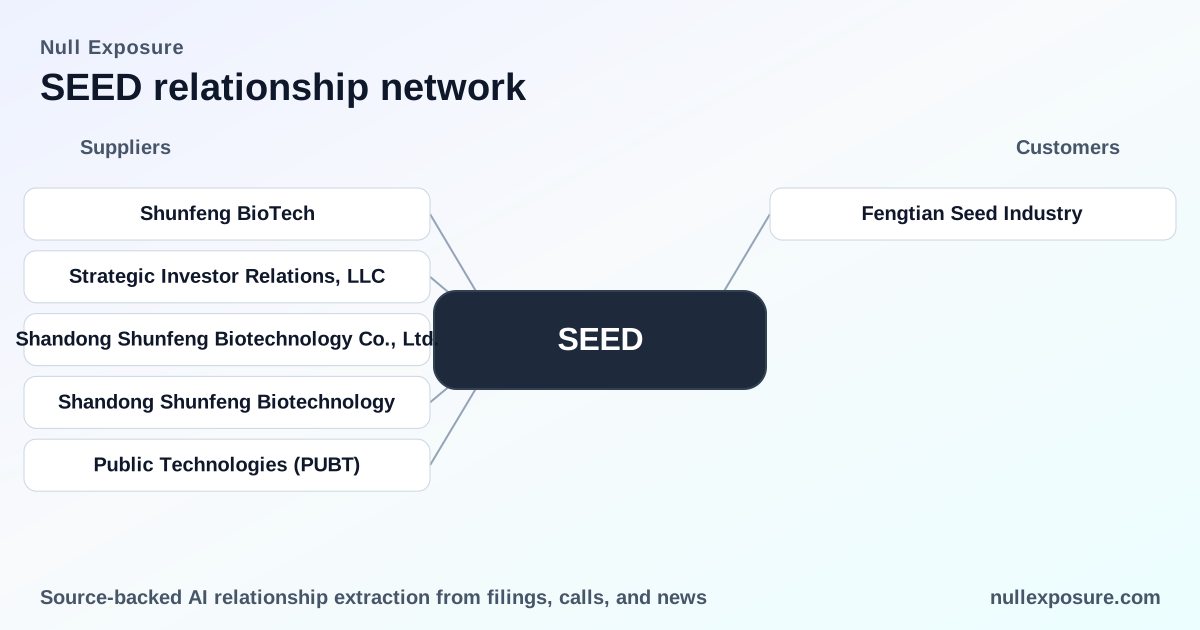
Origin Agritech (SEED): Northeast Re‑Entry and the Fengtian Seed Industry Tie‑Up
Origin Agritech operates as an agricultural biotechnology and e‑commerce company in China, monetizing through seed R&D, licensing and commercialization of proprietary corn varieties and direct product sales to regional distribution partners. The company's go‑to‑market is partnership‑driven: it develops varieties in R&D and then leverages local seed companies and distributors to scale commercial adoption, a model that converts intellectual capital into recurring seed sales and licensing revenue. For investors tracking customer relationships, the recent collaboration with Fengtian Seed Industry is the operational pivot that defines Origin’s re‑entry strategy in Northeast China.
Explore relationship intelligence and platform context at https://nullexposure.com/.
The headline relationship: Fengtian Seed Industry and premium variety commercialization
Origin executed a strategic collaboration agreement with Fengtian Seed Industry to jointly develop and commercialize premium corn varieties, including Ao Yu Feng Tian 310, 501, and 109—an explicit commercial pathway to scale product sales in the northeast market. MarketScreener reported this agreement on March 10, 2026, describing the partnership as central to Origin's market re‑entry efforts in the region.
Multiple outlets reinforced the arrangement: Investing.com covered the re‑entry and described the Fengtian tie‑up as a deliberate commercialization step on May 3, 2026.
Why this relationship matters operationally
The Fengtian arrangement is not a passive endorsement; it is a commercialization pact that assigns market access, local distribution and co‑development responsibilities to a regional seed player. For operators, that translates into a rapid route to farmer adoption without Origin shouldering the full downstream distribution network, while for investors it converts R&D potential into addressable sales more quickly.
The company signals that frame these customer ties
Origin’s relationship posture and business characteristics are visible in its public financials and ownership structure—these are company‑level signals that inform how customer deals will perform in practice rather than metrics tied to any single partner.
- Contracting posture: Partnership and co‑development agreements are the primary commercialization mechanism; Origin outsources market access and local scaling to established seed companies rather than building broad direct distribution.
- Concentration and governance: Insider ownership is high—over 54% of shares held by insiders—and institutional ownership is minimal (under 1%), which creates concentrated control and lower passive investor oversight.
- Commercial maturity and criticality: Origin reports $91.29 million in trailing revenue with gross profit of $6.393 million and negative EBITDA of $50.603 million, signaling that the firm is in a commercialization and scaling phase where partner performance is critical to margin recovery.
- Capital and operational constraints: Negative profitability and thin gross margins to date make originating and funding commercial expansion dependent on either successful monetization of partnerships or external capital.
These company‑level signals explain why strategic customers like Fengtian are critical to Origin’s path to profitability: the company’s model transforms R&D into revenue through third‑party commercialization.
Financial posture: what the numbers tell investors
Origin’s public metrics present a mixed profile: meaningful top‑line scale but persistent operating losses. Revenue of $91.29M demonstrates market traction; gross profit of $6.39M implies modest margin capture on shipped product and licensing. Operating indicators show elevated cost structure: operating margin and EBITDA are substantially negative, and EPS is negative at ‑$1.09 (TTM). Valuation metrics are bifurcated: a low Price/Sales of 0.163 contrasts with an EV/Revenue of 1.175 and EV/EBITDA of 2.648, reflecting depressed equity value and the market pricing of near‑term turnaround risk.
Investor implication: Origin’s value hinges on successful commercialization and margin expansion from partnerships such as the Fengtian collaboration; absent execution, the company will be reliant on additional financing.
Risks to monitor and near‑term catalysts
- Execution risk on commercialization: The Fengtian agreement accelerates access but requires operational execution—seed registration, distribution logistics, field trials and farmer adoption are all gating items.
- Capital intensity and margin recovery: Negative EBITDA and thin gross profits mean the company must convert volume into margin improvement or secure external capital.
- Governance and liquidity: High insider ownership concentrates decision power and low institutional ownership leaves liquidity and independent oversight limited.
- Regulatory and market risk in China: Regional approvals and seed registration processes can affect timing of commercialization.
Catalysts to watch are concrete commercialization milestones with Fengtian—registrations completed, planting area committed, and initial sales figures in the northeast—each will materially impact revenue momentum and investor sentiment.
How operators should read the Fengtian tie‑up
For supply‑chain managers and regional operators, the Fengtian deal is a pragmatic commercial arrangement: it delegates field adoption and distribution to a local seed company that already understands farmer channel dynamics in Northeast China. Operational focus for partners will be on trial conversion rates, seed multiplication timelines and logistics throughput, not on basic R&D, because Origin retains the breeding IP while Fengtian executes scale.
Bottom line for investors and business partners
Origin Agritech is a small‑cap, partnership‑centric commercializer of corn varieties whose near‑term value is tied directly to execution of customer relationships such as the Fengtian Seed Industry agreement. The Fengtian collaboration is a high‑impact commercial event: it accelerates market re‑entry and creates a measurable route to revenue, but it does not eliminate execution, capital or regulatory risk. Investors should watch operational milestones and partner throughput; operators should prioritize trial-to-adoption conversion metrics.
For a focused view on Origin’s customer relationships and commercial signals, visit https://nullexposure.com/ for additional context and relationship intelligence.