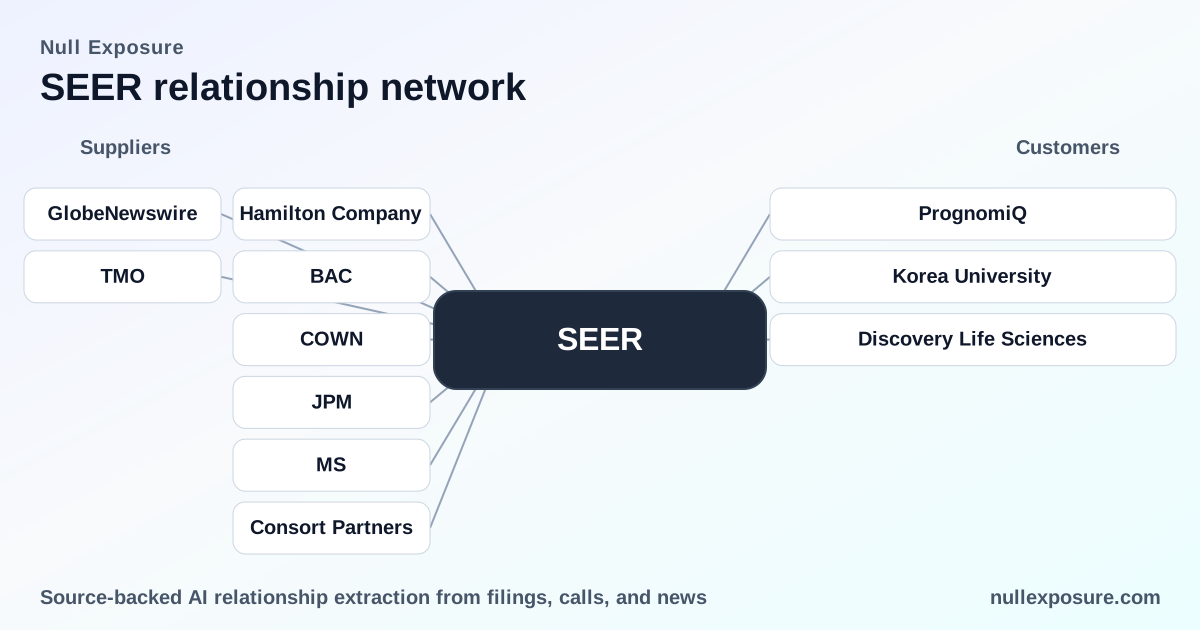
SEER Customer Map: How PrognomiQ, Korea University and Discovery Life Sciences Drive Commercial Trajectory
Seer monetizes the Proteograph Product Suite through a hybrid model: hardware and consumables sales paired with services and analytics sold primarily to academic institutions, research companies and lab operators. Revenue recognition is product-and-service driven, with short invoicing cycles and an early-stage commercial posture as the company scales international deployments and population-scale studies. For investors, the question is simple: does Seer convert marquee, concentrated customers and large-scale validation projects into durable recurring consumable and services revenue? Learn more at https://nullexposure.com/.
PrognomiQ: a material commercial customer and a product commercialization milestone
PrognomiQ accounted for 17% of Seer’s revenue in FY2024, down from 28% in FY2023, signaling both concentration and meaningful customer churn in contribution levels, per Seer’s FY2024 Form 10‑K. According to multiple earnings call transcripts and press coverage around Q4 2025, PrognomiQ commercially launched ProView/ProVue Lung, a proteomics-based laboratory-developed test for early lung cancer detection, in November — a tangible commercialization use-case for Seer’s proteomics outputs and a validation point for downstream customers. (Source: Seer 2024 10‑K; Q4 2025 earnings call transcripts reported by The Globe and Mail and Investing.com, March–May 2026.)
Why it matters: PrognomiQ is both a revenue concentration risk and a commercial reference customer whose product launch demonstrates how Seer’s technology flows into diagnostic products and lab services.
Korea University: academic validation at population scale
Korea University selected Seer’s Proteograph ONE workflow as the foundation for a large-scale, 20,000-sample study to identify early-onset cancer biomarkers, an institutional endorsement of the platform’s suitability for population research. The selection and associated quotes from Seer leadership were described in Seer’s press coverage and partner announcements in 2025/2026. (Source: Seer–Korea University announcement covered by Quiver Quant, reported March 2026.)
Why it matters: Academic-scale adoption is a credibility driver that supports consumables and service sales in APAC and signals the platform’s throughput and reproducibility for large cohorts.
Discovery Life Sciences: commercial-scale project work and service revenue
Discovery Life Sciences contracted Proteograph for a 10,000-sample project, one of several large-scale studies where the Proteograph was selected after evaluation of alternative proteomic technologies. Multiple earnings-transcript summaries and market write-ups in Q4 2025 referenced this collaboration. (Sources: Q4 2025 earnings-call coverage summarized by Investing.com, The Globe and Mail and InsiderMonkey, March–May 2026.)
Why it matters: Projects with CROs and sample-handling partners convert into service revenue and help Seer scale recurring consumable usage across commercial pipelines.
Company-level operating signals that shape customer economics
Seer’s public disclosures surface a consistent set of company-level signals that define how customer relationships behave and how revenue converts:
- Short-term contracting posture. Customers are invoiced generally upon shipment or delivery, with payment typically due within 30–60 days — a working-capital model that produces rapid cash conversion on product sales and services.
- Global commercial footprint with APAC and EMEA weight. Since launch Seer served customers in over 20 countries; about 33% of revenue in FY2024 was generated outside the U.S., driven primarily by Asia and Europe. This is a clear signal that Seer’s growth and risk profile are geographically diversified and exposed to cross-border operational and regulatory dynamics.
- Direct sales in core markets plus field support. Seer has direct sales and field teams in North America, the U.K., and parts of the EU, supporting a hybrid go-to-market that combines hardware installs with local technical support.
- Early-stage commercialization and ramping sales motion. Seer describes itself as still building commercial, marketing and distribution capabilities, consistent with a company transitioning from R&D to scale.
- Multi-segment revenue mix. Revenue streams include hardware, consumables, software, and services (notably generation and analysis of proteomic data on behalf of customers), creating multiple monetization levers but also operational complexity around manufacturing, reagent economics, and professional services delivery.
These items are company-level constraints and characteristics, stated directly in Seer’s filings and investor communications and not tied to any single customer unless the filing names one explicitly.
Concentration, growth and margin implications for investors
Seer’s financial snapshot (Revenue TTM $16.6M; Gross Profit TTM $8.5M; operating margin and EPS metrics reflect ongoing investment) combined with customer disclosures drive two central investment theses:
- Upside through scale and consumables attachment. Large academic and CRO projects (Korea University 20k, Discovery Life Sciences 10k) imply material consumable throughput potential if conversion to paid sample processing and reagent purchases is executed.
- Concentration risk and early commercialization drag. PrognomiQ’s 17% share in FY2024 (28% in FY2023) highlights customer revenue concentration and volatility as Seer adds customers; that concentration compresses predictability until a broader base of repeat consumable buyers is established.
Investors should weigh these dynamics against valuation multiples (Price/Sales ~6.5x on trailing revenue) and the company’s progress in scaling field teams and international support.
Practical takeaways for operators and allocators
- Commercial validation is real and public: institutional adoption and a commercial LDT launch by a customer provide credible go-to-market proof points.
- Operational focus should be on consumable economics and service delivery margins: hardware sales drive upfront revenue, but the durability of revenue depends on consumable repurchases and data-service engagements.
- Geographic execution is a strategic lever and a risk: APAC and EMEA contribute a meaningful share of revenue and require localized regulatory and commercial execution.
For a concise, investor-oriented breakdown of Seer’s customer relationships and how they impact revenue composition, see our full primer at https://nullexposure.com/.
Conclusion: Seer’s customer map currently balances high-impact validation projects and concentration-driven revenue volatility. The company’s trajectory will be determined by how effectively it converts large-scale academic and CRO deployments into recurring consumable and services revenue while diversifying its commercial base beyond a handful of material customers.