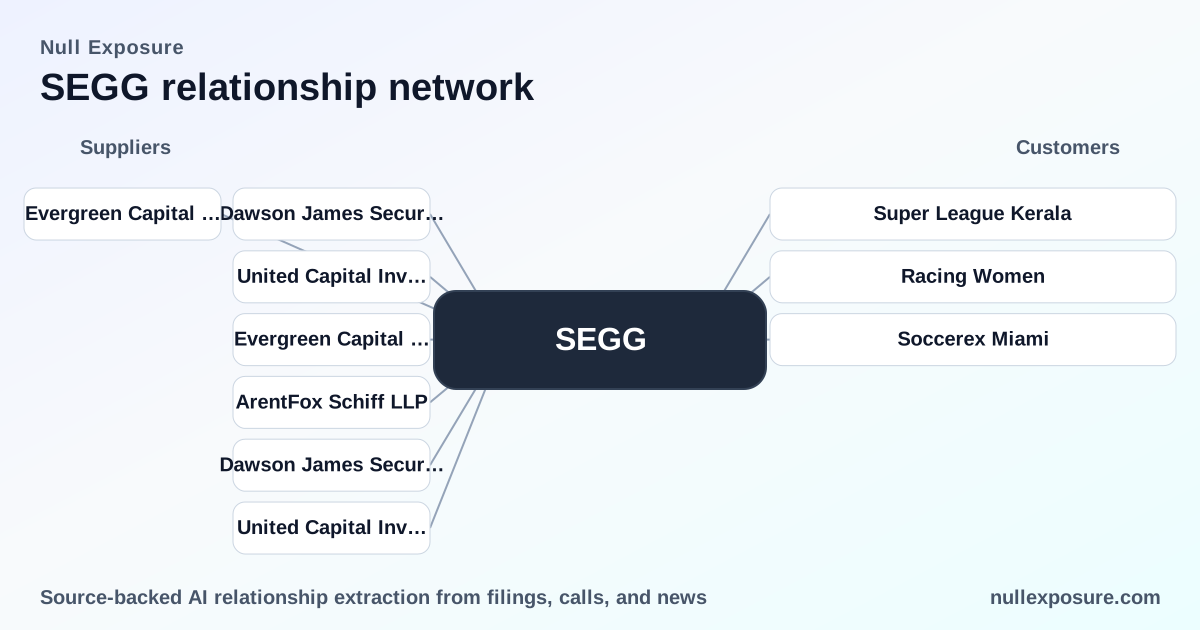
SEGG (Lottery.com Inc.): Customer relationships that move the needle
Lottery.com Inc., operating as Sports Entertainment Gaming Global Media Corporation (SEGG), monetizes a media-and-data platform by licensing content, selling subscription access to its commercial data services, and partnering to distribute live sports and lottery content to global audiences. Revenue derives from multi‑year licensing and subscription contracts, usage‑linked commercial data sales, and event sponsorships that convert audience reach into advertising and licensing fees. For a concise commercial signal set and relationship map, see https://nullexposure.com/.
Why these partnerships matter to investors
SEGG is not a traditional lottery operator — its value proposition is content distribution plus proprietary transaction and results data, packaged for commercial partners and publishers. The company’s commercial model is characterized by multi‑year contracts, mixed subscription and usage pricing, and licensing arrangements that provide upfront fees and recurring revenue. This structure creates predictable revenue when partner scale is achieved, but also concentrates execution risk in audience monetization and partner activation.
Key operating signals:
- Long‑term contracting is central. SEGG repeatedly sells anonymized transaction and results services under multi‑year agreements, which underpins recurring revenue and customer retention.
- Mixed pricing: subscription plus usage. Commercial buyers pay subscriptions for access and additional per‑record fees for large acquisitions, aligning revenue with partner scale.
- Licensing and sponsorships complement data sales. SEGG licenses its trade name and content for upfront fees and pursues event sponsorships and title partnerships that drive brand exposure.
- Global reach and publisher concentration. The company delivers results and sports content across 40+ countries and to hundreds of digital publishers, doubling as a B2B content supplier and B2C channel operator.
- Seller posture and services orientation. SEGG’s role is primarily a content and data seller — the company packages platform access, streaming rights, and proprietary results services to partners.
For institutional access to the relationship signals summarized here, visit https://nullexposure.com/ for the full relational view.
How partners are being used commercially
Super League Kerala — exclusive live‑streaming partner
SEGG, through its Sports.com brand, served as the exclusive streaming partner for Super League Kerala, live‑streaming 33 matches over a 77‑day window and claiming reach of more than 150 million viewers via app, website, and social channels. This engagement demonstrates SEGG’s capacity to secure exclusive streaming rights and to convert sports content into large audience impressions. (GlobeNewswire press release, Dec 23, 2025)
Racing Women — strategic sponsorship in female motorsport
Sports.com entered a strategic sponsorship with Racing Women to accelerate female participation and visibility in motorsport, leveraging branding and promotional inventory to build audience affinity and advertiser appeal. This sponsorship fits SEGG’s model of using targeted sports partnerships to expand reach into niche, high‑engagement verticals. (Finviz / GlobeNewswire coverage, Mar 2026)
Soccerex Miami — title sponsorship and industry positioning
SEGG positioned Sports.com as the title sponsor of Soccerex Miami 2025, using conference and event sponsorship to strengthen relationships with rights holders, advertisers, and global soccer stakeholders while amplifying its brand among commercial buyers of sports content. Event title sponsorships like this convert visibility into sales pipelines for licensing and data services. (Finviz / GlobeNewswire coverage, Mar 2026)
Orange Middle East and Africa — regional distribution partnership
In a commercial partnership, Sports.com teamed with Orange Middle East and Africa to provide sports streaming and news via the Max it app, extending SEGG’s distribution into operator platforms and telco ecosystems and creating a channel for subscription and advertising revenue outside North America. This engagement illustrates SEGG’s strategy to embed content with regional distribution partners to scale international reach. (Investing.com report summarizing filings and partnership detail, May 3, 2026)
What these relationships imply about SEGG’s commercial posture
These partnerships collectively underscore a go‑to‑market strategy that blends exclusive content rights, brand sponsorships, and distribution alliances to monetize audiences and sell data/licensing to commercial customers. Several implications for investors:
- Revenue mix will be lumpy but contractually anchored. Multi‑year licensing and subscription contracts provide a baseline, while event sponsorships and telco partnerships deliver episodic revenue and audience growth.
- Commercial scalability depends on partner distribution. The Orange MEA and Super League Kerala deals show dependency on third‑party platforms (telcos, publishers, leagues) to unlock audience scale necessary for ad and data monetization.
- Customer concentration and execution risk are material. With limited institutional ownership and thin trailing revenue (Revenue TTM ~$0.9M), the ability to convert audience reach into sustainable, recurring revenue is the principal operational risk.
- Pricing architecture supports upside but requires data integrity and compliance. Usage‑based per‑record fees and subscription licenses provide upside as partners grow, but require robust delivery and regulatory compliance across jurisdictions.
Financial and governance context investors should weigh
SEGG’s public metrics reflect an early‑stage commercial media company: Revenue TTM $902k, negative operating margins, and small market capitalization (~$19M). The company operates globally but at low scale today, with high beta and limited institutional ownership, indicating investor sensitivity to execution news. The reported multi‑year contracts and licensing do provide contract visibility, but investors should prioritize evidence of repeatable monetization and margin expansion before attributing multiple expansion.
Bottom line: partnerships are strategic, but scale is the catalyst
SEGG’s customer relationships — exclusive streaming for Super League Kerala, sponsorship of Racing Women and Soccerex Miami, and a distribution deal with Orange MEA — show a coherent commercial playbook: win rights, embed content with distributors, and monetize via subscriptions, licensing, and usage fees. For investors, the essential question is whether SEGG can translate audience claims into predictable, recurring cash flow at scale. If you want a structured, relationship‑level view to test that translation, explore the full relationship map at https://nullexposure.com/.
Key takeaway: Partnerships create a clear path to scale, but financial upside depends on consistent contract execution and conversion of large audience impressions into recurring commercial revenue.