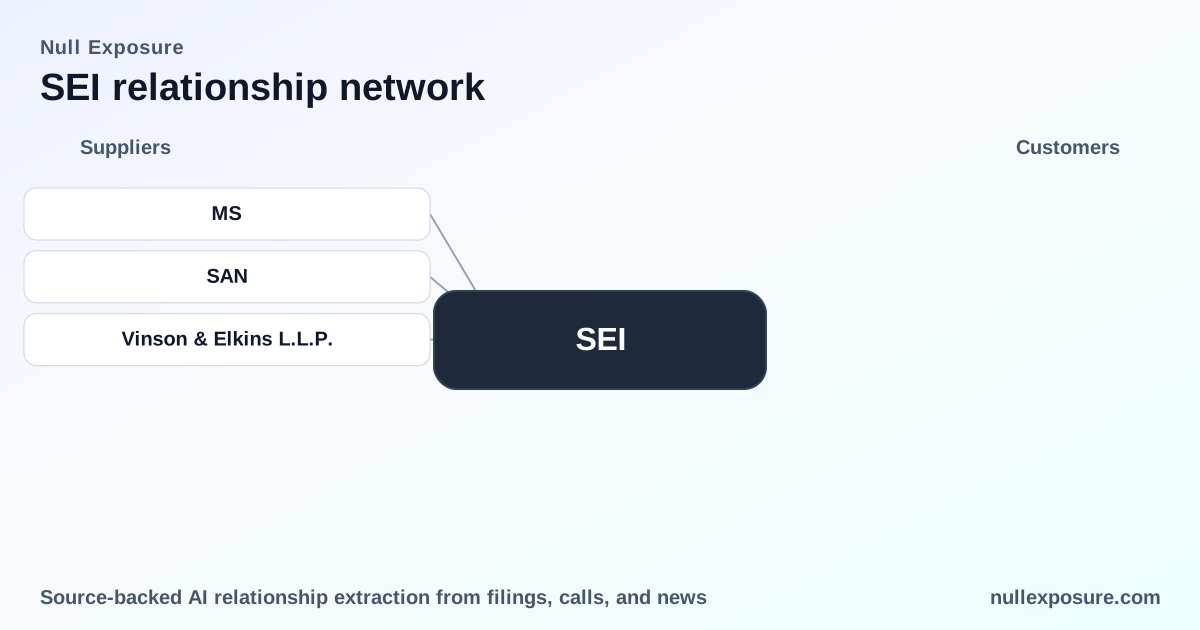
Solaris Energy Infrastructure (SEI): Customer Map and Commercial Risks
Solaris Energy Infrastructure designs, manufactures and leases specialized power and equipment to oil & gas operators, data centers and industrial customers, monetizing through a mix of equipment leasing, power solutions contracts, and multi-year service agreements that create predictable recurring revenue. With a $6.96 billion market capitalization and roughly $692 million in trailing twelve‑month revenue, Solaris’s cash flow profile is driven by a small number of large, long‑dated customers and structured Master Service Agreements that lock in capacity and margin. For a quick reference on how these customer relationships evolve, visit the Null Exposure research hub: Null Exposure.
How Solaris structures commercial exposure and what it means for investors
Solaris conducts the bulk of its business under long‑term commercial commitments and framework agreements. The company reports that roughly two‑thirds of delivered capacity is committed under agreements with tenors of two to six years, and standard customer engagement uses Master Service Agreements (MSAs) with task‑specific work orders underneath. Those contracting mechanics produce revenue visibility and asset utilization, but they also concentrate counterparty risk where a single large account controls pricing leverage and future renewal optionality. Company disclosures covering FY2024–FY2026 describe this posture explicitly in segment commentary and contract excerpts.
Contracting posture: visibility with embedded concentration
- Long tenors and framework MSAs create predictable cash flows and simplify fleet planning, because Solaris can plan capital deployment around committed capacity.
- The flip side is concentration exposure, since substantial revenue depends on a very small set of counterparties rather than broadly distributed end markets.
Customer concentration: a single data center dominates a segment
Solaris’s Power Solutions segment demonstrates acute concentration: one data‑center customer represented 96% of that segment’s revenue from the acquisition date through December 31, 2024. Across the company, filings show multiple individual customers representing double‑digit percentages of revenue (for example, three customers accounted for 17%, 12% and 12% of total revenue in 2024). This structure makes Solaris’s topline and negotiating leverage sensitive to renewal timing and individual customer demand swings, while long contracts blunt short‑term churn risk. These figures come from the company’s segment disclosures for FY2024 and related filings through FY2026.
Geography and counterparty profile
Solaris is U.S.‑centric, headquartered in Houston and serving North American energy, data center and industrial clients. The company characterizes its primary Power Solutions buyers as large enterprises—data centers and energy firms requiring power for hydrocarbon production, processing and transportation—so credit quality and contract enforcement tend to be institutional rather than retail in nature.
Relationship listing: what the public record contains
Below I cover every customer relationship identified in the searchable results provided.
- AIXC — A Bitget news release dated May 2, 2026 reports that AIXC established a strategic technology partnership with the Sei Development Foundation, with Sei providing high‑performance blockchain infrastructure support for the AIXC mobility and EAI robotics ecosystem; this item was captured under FY2026 reporting and appears in industry press. Source: Bitget news report (May 2, 2026) at bitget.com.
That single result in the record references a technology partnership between AIXC and the Sei Development Foundation; Solaris’s customer list as disclosed in filings does not name AIXC directly in the provided results. The Bitget piece is the sole external mention provided for FY2026 in the relationship search.
Operational constraints and company‑level signals
The company disclosures and extraction highlights convey several consistent operating characteristics that are material for investor due diligence:
- Long‑term contracting: Solaris reports that about two‑thirds of its fleet is committed under agreements ranging two to six years, and it disclosed specific long‑term contracts secured in late 2024 and early 2025, indicating a deliberate shift toward multi‑year revenue stability.
- Framework MSAs: Customer engagements are commonly governed by Master Service Agreements with work orders for scoped activity, which standardizes legal terms and shortens execution time on follow‑on projects.
- Large‑enterprise counterparties: The Power Solutions segment’s primary customers are large data center and energy firms, implying counterparty credit quality is enterprise grade but also concentrated.
- North American focus: Headquartered in Houston, Solaris’s served markets are predominantly U.S. energy and industrial end users, concentrating geopolitical and commodity exposure regionally.
- Critical single‑customer dependency: The 96% segment share from one data center is a critical dependency for that segment and a material commercial risk at the company level.
- Active relationship management: Solaris notes it is in active negotiations for the remaining one‑third of its fleet capacity, signaling both upside from new agreements and exposure to lease re‑pricing cycles.
These constraints are company‑level signals derived from filings and segment disclosures across FY2024–FY2026 and should be treated as structural characteristics of Solaris’s business model rather than attributes of any single named external partner unless a filing explicitly ties them to that partner.
For ongoing tracking of these evolving customer exposures and to view the primary sources at a glance, see Null Exposure.
Investment implications: risk‑reward and monitoring checklist
Solaris’s commercial model yields high revenue visibility and attractive operating leverage when large customers are contracted; yet customer concentration is the dominant idiosyncratic risk. Key items for investors and operators to monitor:
- Contract renewal timing and the terms on which the major data‑center relationship is extended—renewal economics will determine both near‑term revenue and the practical value of fleet assets.
- Utilization of uncontracted capacity (the remaining one‑third of fleet): concessions required to re‑contract that capacity will pressure margins if renewals fall at lower rates than existing contracts.
- Counterparty credit and expansion: the degree to which Solaris can diversify into multiple large enterprise customers or geographies will materially reduce single‑customer risk.
- Regulatory and energy cycle sensitivity: as a provider to energy operations and data centers, Solaris’s demand profile ties into capital spending cycles in oil & gas and hyperscale customer energy strategies.
Bottom line
Solaris delivers predictable, lease‑style revenue through long‑dated MSAs with large enterprise customers, but the company’s economics are fundamentally linked to a handful of counterparties—most notably a single data center in the Power Solutions segment. That concentration amplifies both upside on successful renewals and downside if any major counterparty reduces demand or walks away at renewal. Investors should prioritize contractual disclosure, renewal schedules, and customer diversification as primary drivers of valuation and risk.