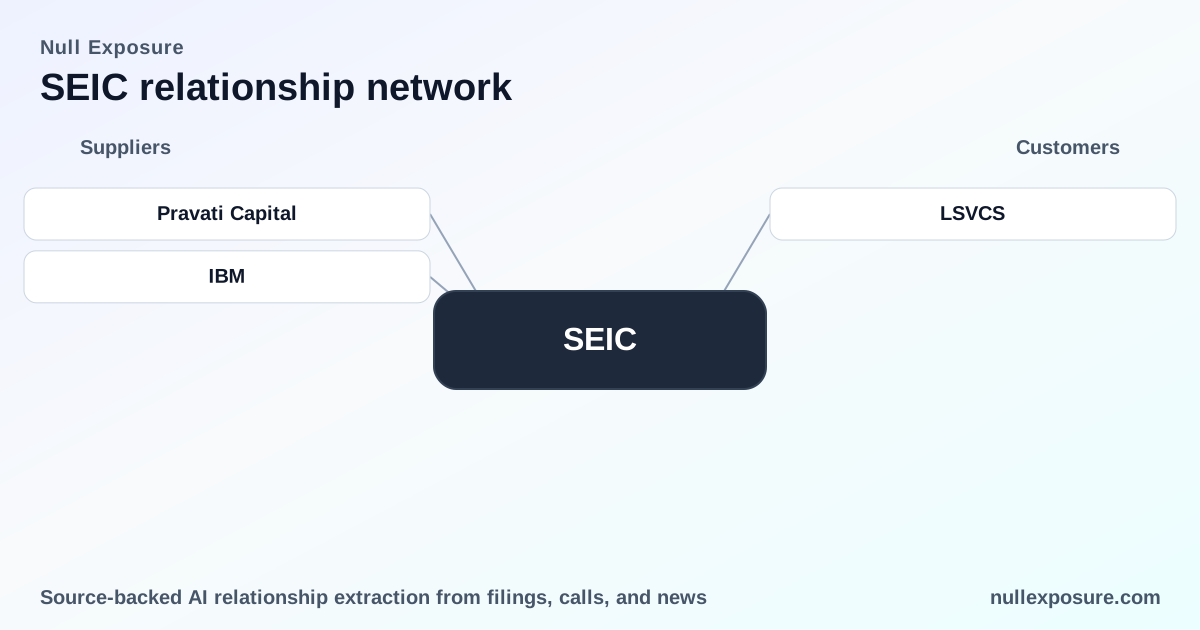
SEI Investments (SEIC) — Customer Relationships That Drive Recurring Revenue
Thesis: SEI monetizes a mix of technology subscription and outsourced services to financial institutions and asset managers, earning recurring fees tied to assets under administration, platform subscriptions, and per-account/transaction usage; its business model blends SaaS-like revenue with scale-dependent, usage-based fees, creating durable margins when client relationships expand across services.
For a quick deep dive into SEI’s client footprint and what these relationships imply for revenue durability and concentration risk, visit https://nullexposure.com/ for an expanded dataset and analysis.
How SEI wins: SEI sells core back-office processing, fund administration, distribution and digital wealth platforms to banks, ETF sponsors and alternative managers — often on multi-year contracts that combine a base monthly fee with per-account or AUM-linked charges. The result is sticky, usage-linked revenue that scales with client assets and product launches.
Operating model and business-model constraints (company-level signals)
- Contracting posture: SEI runs a mix of long-term outsourcing agreements (3–5 years) and shorter, one-year or usage-billed engagements; revenue recognition often follows invoicing or asset-based metrics rather than fixed project milestones.
- Pricing mechanics: Fees are usage-based and subscription-oriented — monthly platform fees plus per-transaction/per-account or percentage-of-AUM components are common.
- Client profile: SEI serves institutional and very large enterprise clients as well as not-for-profit sponsors; the customer mix includes banks, ETF sponsors and alternative managers, which supports cross-sell of professional services and hosted software.
- Geography and scale: SEI operates globally from multiple service centers but retains strong North American concentration in revenue.
- Role and criticality: SEI is a service provider for mission-critical back-office and distribution functions; this creates operational criticality and high switching friction as implementations mature.
- Spend buckets: SEI has numerous clients with large program sizes (multiple clients with $100m+ in customer assets), signaling material account economic potential.
Investor takeaways: SEI’s revenue durability comes from long onboarding cycles and expanding usage once clients adopt multiple services, but AUM sensitivity and concentration among large bank and asset-manager clients remain key risk vectors.
Client relationships — what matters, one by one
- KRYP (ProShares): SEI Investments Distribution Co. is named as the distributor for ProShares’ KRYP product, underlining SEI’s role in ETF distribution rather than portfolio management (ETF Trends, Mar 2026).
- URSP: TradingView notes SEI Investments Distribution Co. as the distributor for URSP, indicating SEI’s repeated use as an ETF distribution vehicle for third-party sponsors (TradingView listing, FY2025).
- LNGX (Global X US Natural Gas ETF): Global X’s press release lists SEI Investments Distribution Co. as the fund distributor for LNGX, demonstrating SEI’s distribution footprint with commodity-themed ETFs (PR Newswire, Mar 2025/Mar 2026 reporting).
- Ranchland Capital Partners, LLC: Ranchland selected SEI to provide fund administration and investor services for its alternative investment funds, a win that expands SEI’s alternative fund admin franchise (MyChesco, May 2026).
- GQG / GQGU: GQG Partners launched its first ETF on SEI’s Advisors’ Inner Circle Fund operational platform, signaling SEI’s role as an operational partner for asset managers bringing new ETFs to market (GQG press release / MyChesco coverage, Mar–May 2026). This is an example of platform revenue plus professional services for ETF launches.
- Huntington Bank / Huntington National Bank / Huntington Private Bank (HBAN): Huntington selected the SEI Wealth Platform, data cloud and digital workflow tools to modernize private bank operations, representing a sizeable technology and services engagement across wealth systems (SimplyWall.st and MarketScreener summaries, Mar–May 2026). This is a strategic, multi-service deployment with professional services and integration revenue.
- KPHO (KraneShares Dragon Capital Vietnam Growth ETF): KraneShares’ listing materials name SEI Investments Distribution Company (SIDCO) as distributor, reflecting SEI’s distribution relationships with niche ETF sponsors (KraneShares and GlobeNewswire, Dec 2025–Mar 2026).
- KIQQ (KraneShares/KFA Funds): KraneShares notes that several KraneShares and KFA ETFs are distributed by SEI Investments Distribution Company, reinforcing SEI’s recurring distributor role for the sponsor (KraneShares site, FY2025).
- NXDT-P-A: An ADV/filing excerpt states the investment adviser delegated administrative functions to SEI Global Funds Services, with the adviser paying SEI directly for sub-administration — a classic fund admin/sub-advisor outsource arrangement (ADV/SEC filing summary, FY2026).
- IQMM (ProShares money-market ETF): Coverage of ProShares’ IQMM notes that ProShares are distributed by SEI Investments Distribution Co., again showing SEI’s distribution utility for sponsors launching new fund wrappers (AI Journ, Mar 2026).
- CRCA: TradingView lists SEI Investments Distribution Co. as distributor for CRCA, adding to the list of ETF tickers using SEI for distribution services (TradingView, FY2025).
- PLTA: TradingView names SEI Investments Distribution Co. as distributor for PLTA, an additional ETF relationship that underscores distribution scale (TradingView listing, FY2025).
- QQUP: MarketBeat records SEI Investments Distribution Co. as distributor for QQUP, reinforcing the recurring distribution business line (MarketBeat, FY2025).
- QQDN: Yahoo Finance reports that ProShares (including QQDN) are distributed by SEI Investments Distribution Co., another ProShares distribution tie (Yahoo Finance, Mar 2026).
- CFR-P-B (Frost Bank historical): A press item catalogues a recontract where Frost Bank recontracted with SEI for investment processing and an expanded suite of trust services, highlighting historical bank outsourcing relationships (Advfn / PR note archived, FY2026 referencing older contract).
- LSV / LSVCS: SEI’s earnings commentary notes performance fees and a hedge-fund seed gain related to LSV, indicating SEI’s involvement with manager-sponsored funds where SEI’s economics include a share of performance-related income (Earnings transcript coverage, FY2026).
- Huntingon Private Bank (specific business unit): Additional coverage confirms Huntington Private Bank’s selection of SEI’s wealth platform and professional services for integration and change management, underlining cross-sell into private banking operations (SimplyWall.st, Mar–May 2026).
- Ranchland Capital Partners (repeat entry): Analyst notes and coverage list Ranchland among recent wins highlighted by Piper Sandler and SEI commentary, confirming the administrative services relationship and its relevance to sales momentum (Investing.com / SimplyWall.st, May 2026).
- KraneShares (general): Multiple KraneShares materials reiterate that KraneShares ETFs and KFA Funds ETFs are distributed by SEI Investments Distribution Company (SIDCO), showing a continuing distributor relationship across several tickers (KraneShares, ETFGI and GlobeNewswire, Dec 2025–Mar 2026).
Portfolio implication and risk map
- Revenue drivers: Distribution contracts for ETFs are lower-friction, recurring assignments that scale with product launches; fund administration and wealth-platform deals are higher-value, longer-term engagements that produce implementation revenue followed by recurring fees.
- Concentration and criticality: SEI’s clients include large banks and asset managers; winning a Huntington-class client indicates high strategic value and stickiness, but it also concentrates counterparty exposure among large institutions.
- Contract structure: Expect mixed contract tenors—multi-year outsourcing plus short-term or usage-billed elements for nascent products—so revenue is part subscription, part usage/AUM sensitive.
- Operational leverage: Successful cross-sell of professional services (implementation, change management) substantially increases lifetime value once clients adopt SEI’s platforms.
If you want a structured export of these relationships and a dashboard view of contract types and revenue exposure, explore our research hub at https://nullexposure.com/ — the site hosts downloadable relationship matrices and source-traced summaries.
Bottom line: SEI’s customer relationships documented here show a repeatable business model that combines distribution scale with higher-margin administration and wealth-platform wins; investors should underwrite growth through platform adoption and monitor AUM sensitivity and large-client concentration as the primary risk factors.