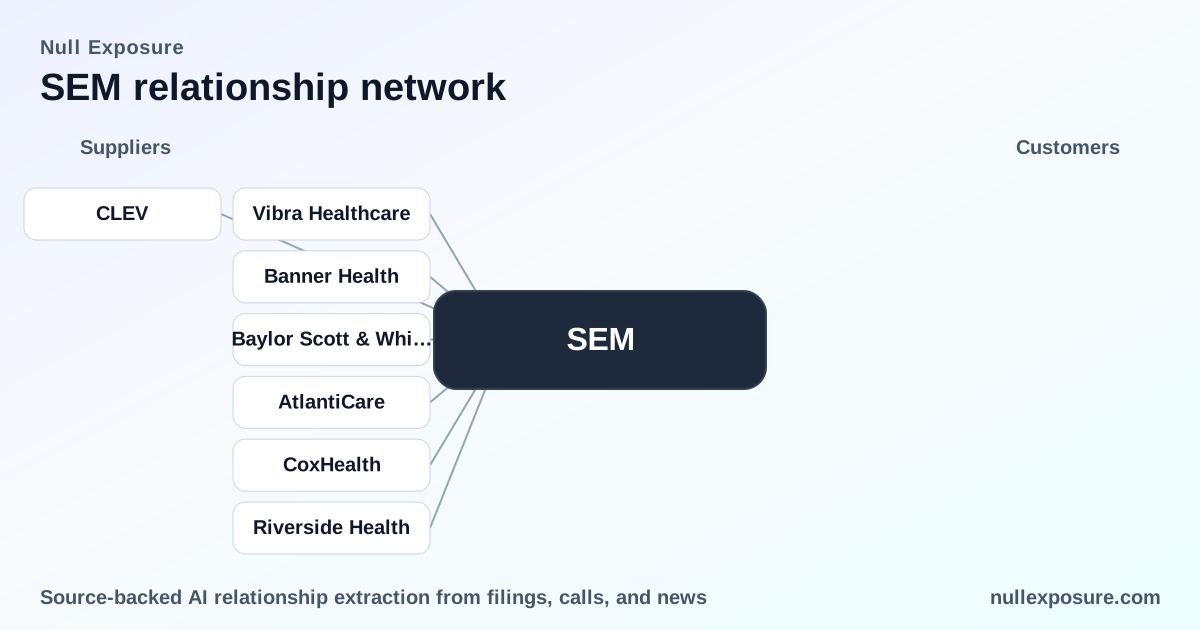
Select Medical Holdings (SEM): Customer Relationships That Drive Growth and Risk
Select Medical operates and monetizes a nationwide network of critical illness recovery hospitals, rehabilitation hospitals, outpatient rehabilitation clinics, and occupational health centers by contracting with health systems, insurers, government programs, and self-pay patients for inpatient and outpatient rehabilitation services. The company generates revenue primarily from patient care across three segments—critical illness recovery, rehabilitation hospitals, and outpatient rehabilitation—while scaling through joint ventures and strategic partnerships with regional health systems. Investors should value SEM as a service-oriented healthcare operator with recurring revenue tied to payer mixes and strategic partner rollouts. For broader coverage of healthcare operators and partner dynamics, visit https://nullexposure.com/.
Executive takeaway: predictable cash flow, partner-driven growth, payer sensitivity
Select Medical’s model converts clinical capacity into contracted revenue streams with health-system partners and government payers; growth comes from opening joint-venture hospitals and expansions with named partners. The company benefits from predictable Medicare exposure and repeatable joint-venture rollouts, but that same profile creates concentration and reimbursement sensitivity that directly impacts margins and valuation.
How SEM monetizes relationships and structures contracts
Select Medical operates principally as a service provider to patients and partner health systems. Revenue recognition flows from clinical services billed to Medicare, commercial insurers, workers’ compensation, and patients; company filings report Medicare accounted for roughly 31% of revenue in 2022–2023 and 29% in 2024, underlining government payers’ material role in SEM’s economics. Contracting with large health systems frequently takes the form of joint ventures and management agreements that deliver stable bed utilization and referral pipelines, while capital for new facilities may be shared or structured through partner arrangements. This mix creates recurring cash generation but ties margins to reimbursement policy and payer concentration.
Customers mentioned in the Q4 2025 earnings call (complete list)
Below are every relationship cited in the company’s Q4 2025 earnings call transcript; each entry includes a concise plain-English description and a source reference.
AtlantiCare
Select Medical is developing a 60‑bed hospital with AtlantiCare in southern New Jersey expected to open in Q4 2026, representing another joint-venture expansion into a regional health-system market. According to the company’s Q4 2025 earnings call transcript published on Investing.com (May 3, 2026), this project is part of SEM’s near-term buildout pipeline.
Banner Health
SEM opened a 58‑bed hospital with Banner Health in Tucson, Arizona, marking the fourth joint venture with Banner and signaling continued partnership scale in that market. This was disclosed on the Q4 2025 earnings call transcript on Investing.com (May 3, 2026).
Baylor Scott & White Health
Select Medical opened its fifth inpatient rehabilitation hospital with Baylor Scott & White Health in Temple, Texas, operating 45 beds, underscoring a repeatable partner relationship and local footprint expansion. The detail is in the Q4 2025 earnings call transcript on Investing.com (May 3, 2026).
Cleveland Clinic
The company flagged a new 32‑bed hospital with the Cleveland Clinic as part of its development slate, reflecting SEM’s strategy to partner with large academic systems for specialty rehabilitation capacity. This project was noted during the Q4 2025 earnings call transcript on Investing.com (May 3, 2026).
CoxHealth
A 63‑bed hospital with CoxHealth in Ozark, Missouri, is included in the company’s planned openings, demonstrating SEM’s mix of regional health-system joint ventures across different geographies. The Q4 2025 earnings call transcript on Investing.com (May 3, 2026) provides the disclosure.
Riverside Health
SEM is executing a 10‑bed expansion at its rehabilitation hospital with Riverside Health in Virginia, indicative of incremental capacity additions within established partnerships rather than greenfield development alone. This expansion was described in the Q4 2025 earnings call transcript on Investing.com (May 3, 2026).
Vibra Healthcare
The company is acquiring a 76‑bed rehabilitation hospital in southern Kentucky in partnership with Vibra Healthcare, reflecting SEM’s use of acquisitions alongside joint-venture models to accelerate scale. The acquisition detail appears in the Q4 2025 earnings call transcript on Investing.com (May 3, 2026).
What the relationships collectively signal about SEM’s operating model
- Contracting posture: SEM predominantly operates via joint ventures and management partnerships with health systems, which distributes capital needs and provides referral stability while preserving operating leverage tied to bed-fill and payer mix.
- Customer concentration and payer exposure: Company disclosures show material dependence on government payers—Medicare accounted for around 29–31% of revenue in recent years—so reimbursement policy is a first‑order risk to profitability across these partnerships.
- Geographic reach and scalability: Operations in 40 states and D.C. enable SEM to replicate partner models across geographies; the Q4 pipeline spans New Jersey, Arizona, Texas, Ohio/Cleveland Clinic market, Missouri, Virginia, and Kentucky, demonstrating both national reach and regional diversification.
- Criticality and maturity: These partners are large, established health systems (e.g., Cleveland Clinic, Banner, Baylor Scott & White). Their involvement signals high criticality for SEM’s local referral flow and confirms the maturity of SEM’s joint-venture playbook.
Constraints and how they affect credit and valuation narratives
Company-level disclosures and filings generate several actionable constraints investors should deploy in risk models: government payers are a dominant counterparty type with high confidence; a substantial share of receivables relates to individual patients; operations span North America; payer-driven revenue is material to results; SEM’s role is service-provision across three segments. Taken together, these constraints imply lower revenue volatility from commercial contracts but higher sensitivity to Medicare policy and utilization trends, which should be reflected in terminal growth and margin assumptions. Company filings explicitly note Medicare’s revenue share for years ended Dec. 31, 2022–2024.
Risk and opportunity map for investors
- Opportunity: Repeatable joint-venture rollouts with large systems provide predictable capacity additions and faster local penetration without assuming full development risk.
- Risk: Reimbursement exposure is material and changes to Medicare rates, case-mix, or utilization could compress margins quickly. Partner concentration in specific markets could create referral or regulatory risk at a local level.
- Operational leverage: Incremental beds and expansions (e.g., Riverside Health expansion, multiple repeat partners) point to potential margin expansion if utilization normalizes and labor costs stabilize.
Bottom line and next steps
Select Medical’s customer set—composed of major health systems and repeat JV partners—validates its strategy of scaling through partnerships while retaining exposure to reimbursement dynamics that materially influence cash flow. For valuation work, model explicit scenarios for Medicare reimbursement and JV ramp schedules tied to the disclosed pipeline (AtlantiCare, Banner, Baylor Scott & White, Cleveland Clinic, CoxHealth, Riverside Health, Vibra/Vibra Healthcare openings/expansions). For continued monitoring and idea flow, see more analysis at https://nullexposure.com/.
Note on sources: relationship disclosures come from SEM’s Q4 2025 earnings call transcript (Investing.com, May 3, 2026) and company filings that report Medicare revenue percentages and multi‑state operations through Dec. 31, 2024.