Semrush (SEMR) and the Adobe Sale: Customer relationships, contract posture, and what the filings reveal
Semrush is a subscription-first, online-visibility SaaS business that monetizes through recurring monthly and annual licenses sold via a mix of self-service product-led growth and sales-led enterprise motions. The company derives substantially all revenue from premium subscriptions across a global customer base that spans SMBs, mid-market accounts and enterprise clients; this recurring model drives strong upsell potential but also concentrates business risk around renewal behavior and pricing for incremental usage. For investors and counterparty risk managers, the pending sale of Semrush to Adobe for $12.00 per share (approximately $1.9 billion equity value) reframes counterparty outcomes and creates near-term litigation, regulatory and closing risks that should be priced into any credit or partnership decisions. For more detailed relationship intelligence, visit https://nullexposure.com/.
The single counterparty that dominates the news: Adobe and the proposed acquisition
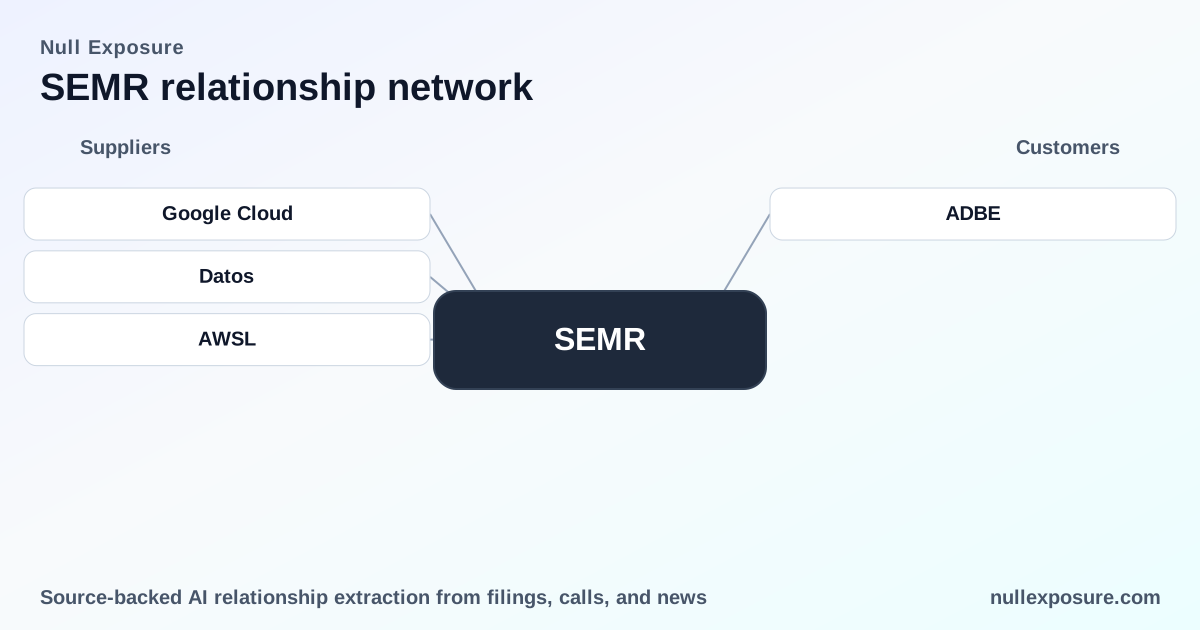
The only material counterparty identified across the customer-relationship results is Adobe Inc. (ADBE). The corpus of notices and alerts documents the proposed sale of Semrush to Adobe and the immediate investor reaction — including multiple shareholder inquiries and law-firm investigations into process and price.
What the records say, line by line
- A PR Newswire release on January 7, 2026 reported that the law firm Kahn Swick & Foti LLP and former Louisiana AG Charles Foti are investigating the proposed sale of Semrush to Adobe, focusing on the adequacy of the sale price and the process used to negotiate the transaction. (PR Newswire, Jan 7, 2026)
- A Sahm Capital note first filed March 10, 2026 reiterated that shareholder investigators are scrutinizing the proposed sale of Semrush to Adobe, signaling continuing shareholder activism around deal terms. (SahmCapital, Mar 10, 2026)
- A December 20, 2025 Sahm Capital alert placed the Semrush sale to Adobe within a broader run of MA-focused investigations, indicating that transactional scrutiny began in late 2025 as the deal was announced or circulated. (SahmCapital, Dec 20, 2025)
- GlobeNewswire published a shareholder notice on November 19, 2025 identifying the proposed sale price as $12.00 per share, valuing Semrush at approximately $1.9 billion, and announcing counsel interest in investigating the transaction. (GlobeNewswire, Nov 19, 2025)
- GlobeNewswire issued a follow-up shareholder notice on January 14, 2026 repeating the $12.00 per share figure and reaffirming investor interest in potential challenges to the deal process and price. (GlobeNewswire, Jan 14, 2026)
- Additional duplicate notices filed to the wire and republished by legal and investor-alert services confirm the same core facts: Adobe is the acquirer and shareholders and plaintiff firms are actively investigating deal fairness and process (multiple PR/notice filings spanning Nov 2025–Mar 2026).
Key relationship takeaway: Adobe is the buyer in a contested acquisition narrative; the transaction price and process are under active legal scrutiny, and multiple shareholder notices confirm that the deal is the principal counterparty event affecting Semrush customers and investors today.
How SEMR’s commercial model conditions this relationship
Semrush operates with a mix of subscription and framework-based contracting that shapes how counterparties will react to an ownership change.
- Subscription-first revenue: The company sells its online-visibility platform primarily through monthly and annual subscriptions, with self-service for smaller accounts and direct sales for larger clients. This structure produces predictable recurring revenue but exposes value to churn and price sensitivity. (Company disclosures describing subscription pricing and sales motions)
- Enterprise frameworks accelerate expansion: Semrush maintains master subscription agreements for enterprise customers, enabling accelerated cross-sell and up-sell after an initial enterprise contract is in place; this institutional relationship model increases switching frictions for large customers but also concentrates strategic value in a relatively small set of higher-ARR accounts.
- Short-term flexibility for many customers: A material share of customers choose monthly terms, giving them the ability to exit or resize quickly and meaningfully increasing near-term churn risk if product strategy or positioning changes under new ownership.
- Customer mix and scale: As of Dec 31, 2024 Semrush reported approximately 117,000 paying customers and ARR expansion to $411.6 million, demonstrating broad adoption across SMB, mid-market, and enterprise segments in over 150 countries; the company is therefore global and software-centric in its counterparty exposure.
- Spending profile: Median spend characteristics imply a per-customer ARR in the low thousands (reported ARR per paying customer of about $3,522), situating most accounts in a sub-$100k spend band while a smaller cohort drives outsized revenue.
These characteristics mean the Adobe transaction is not simply an owner swap; it has direct implications for renewal behavior, enterprise contract continuity, and cross-sell economics under an acquirer that leverages large-bundle product strategies.
What constraints and maturity signals mean for counterparties
- Contracting posture: The mix of monthly subscriptions and enterprise master agreements indicates Semrush uses a layered contracting strategy — quick-to-exit for SMBs and sticky frameworks for enterprise. This lowers immediate integration risk for low-value customers but places premium on retaining enterprise frameworks through a transition.
- Materiality and criticality: Semrush states that customers treat the platform as critical for online visibility; revenue concentration in recurring subscriptions means a successful transition preserves near-term cash flows, while lost renewals would be immediately visible in ARR and cash metrics.
- Operational maturity: Global scale across 150+ countries and a blended PLG + sales motion demonstrate a mature commercial model that is scalable but sensitive to pricing and go-to-market shifts post-acquisition.
- Warranty and indemnity posture: Company disclosures indicate warranty costs to date are immaterial, and standard indemnification language for intellectual property is in place, suggesting limited contingent liability from existing customer contracts.
Risks and upside that investors and partners must weigh
- Near-term legal and closing risk: Multiple shareholder investigations and class-action scrutiny raise the probability of delay, renegotiation, or adverse settlement pressure on deal economics. These processes will affect integration timelines and counterparty confidence among large customers.
- Retention and upsell risk under new owner: Adobe’s product bundling strategy could either unlock cross-sell or accelerate churn among customers who prefer Semrush’s independent product posture; enterprise master agreements provide some protection for high-value accounts but not immunity.
- Value capture opportunity: If Adobe successfully integrates Semrush and preserves enterprise frameworks, the company gains access to an established recurring revenue base and a large installed SMB footprint that can be monetized through broader Adobe channels.
Bottom line and investor action points
- Adobe is the single material counterparty event for Semrush: the acquisition is fully documented in multiple shareholder notices and press releases at $12.00 per share (~$1.9bn equity value); shareholder litigation risk is active and priced into near-term uncertainty. (GlobeNewswire Nov 2025; PR Newswire Jan 2026; SahmCapital Dec 2025–Mar 2026)
- Semrush’s subscription-first model is both a stabilizer and a lever for acquirers: recurring revenue and enterprise frameworks reduce integration friction for large accounts, but monthly terms and mid-market SMB exposure create immediate churn risk.
- For deeper counterparty and transaction monitoring, track filings and shareholder notices as they settle; for actionable monitoring and relationship intelligence, see https://nullexposure.com/ for continuous updates.
Investors evaluating SEMR should prioritize deal-closing milestones, any court filings or settlement disclosures, and renewal rates among enterprise cohorts as leading indicators of post-deal value retention.