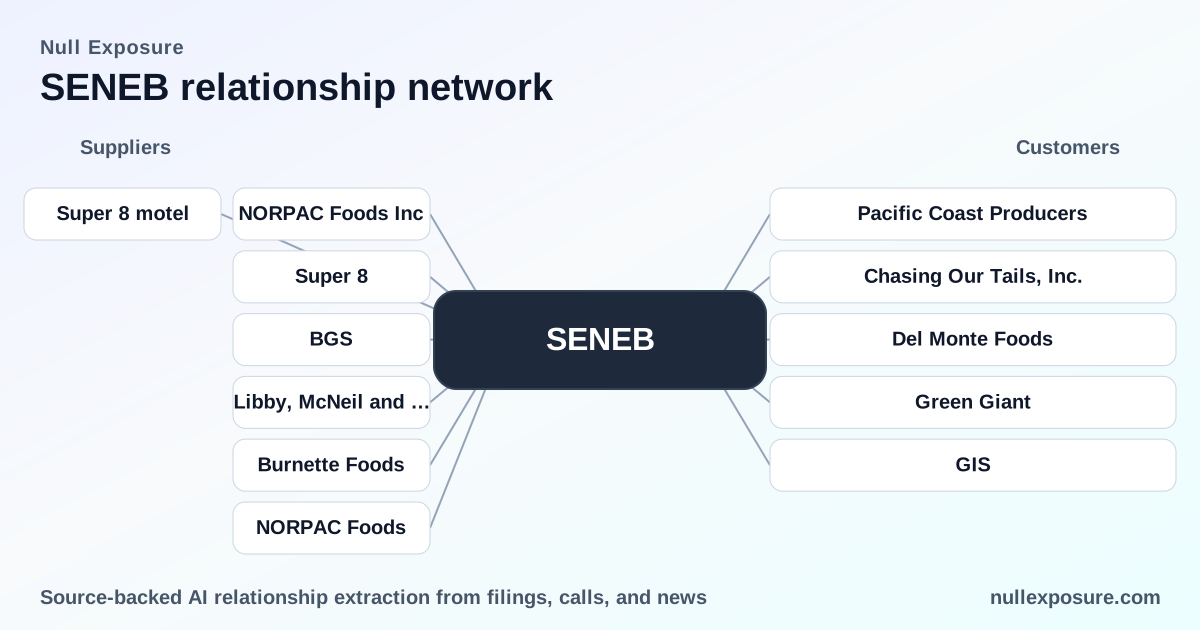
Seneca Foods (SENEB) — customer relationships that shape margin stability and concentration risk
Seneca Foods operates as an industrial processor and packager of fruits and vegetables, monetizing through bulk manufacturing contracts, private-label and co-manufactured branded goods sales, and occasional asset sales of facilities. The company’s revenue mix is driven by large, recurring contracts with foodservice, retail and government channels, and by manufacturing alliances with major consumer packaged goods firms — a structure that supports predictable volumes but concentrates counterparty risk among a small number of large customers. For further context on counterparty exposures and historical customer events, see Null Exposure’s customer intelligence at https://nullexposure.com/.
How to read Seneca’s customer footprint
Seneca’s operating model is classic contract manufacturing at scale: long-tenured facilities produce private-label and branded products for large retailers and CPGs, while Seneca also sells into foodservice, industrial and government programs. That dual role — contract manufacturer and branded seller — increases revenue durability but creates commercial dependency on major partners. The company’s top ten customers accounted for roughly 53% of net sales in FY2025, an explicit concentration that colors credit and operational risk assessments.
- Contracting posture: Seneca runs as a supplier-first operator, often producing under another firm’s label or on specified contract terms, which drives predictable throughput but limits pricing flexibility.
- Concentration and criticality: With the top customers representing over half of sales, loss or disruption of a single major account would be material to margins and utilization.
- Geographic profile: Seneca is heavily U.S.-centric (about 94.5% of net sales in the United States), while retaining export reach to roughly 55 countries, which moderates but does not eliminate domestic demand sensitivity.
- Business maturity: Founded in 1949, Seneca leverages 26 U.S. facilities and decades of customer relationships as a competitive moat for large-scale vegetable and fruit processing.
Explore more customer-level signals and their implications at https://nullexposure.com/.
Relationship-by-relationship compendium (plain English, sourced)
Below are the customer and counterparty mentions pulled from public reporting. Each entry is a concise, plain-English summary with the source cited.
-
Pacific Coast Producers — Seneca negotiated the sale of a California fruit processing facility to Pacific Coast Producers, but the transaction was later called off and ultimately terminated; regulatory review and DOJ timing influenced the outcome. Source: Food Engineering and Just-Food coverage of the 2015 negotiations and subsequent termination (see https://www.foodengineeringmag.com/articles/94005-seneca-foods-and-pacific-coast-producers-terminate-acquisition-agreement and https://www.just-food.com/news/seneca-foods-to-sell-fruit-plant-to-pacific-coast-producers/).
-
GIS (General Mills, ticker GIS) — Seneca has provided vegetable products used under General Mills’ Green Giant brand, reflecting a long-standing supply relationship that ties Seneca to a major branded CPG customer. Source: Food Business News report on a 2014 strategic stake and product supply (https://www.foodbusinessnews.net/articles/4118-seneca-acquires-50-stake-in-family-owned-food-processor).
-
Green Giant (brand) — Seneca’s facilities pack products sold under the Green Giant label, indicating operational integration with one of General Mills’ primary vegetable brands. Source: Investigative reporting on facility operations and production relationships (Milwaukee Journal Sentinel, https://www.jsonline.com/in-depth/news/investigations/reports/2021/05/20/migrant-workers-seneca-foods-green-bean-canning-facility-wisconsin-died-covid-19/3941563001/).
-
Gemline — A 2020 recall incident shows Seneca-manufactured apple chips sold via partners including Gemline were pulled for possible Salmonella contamination, illustrating reputational and product-risk exposure when Seneca products are co-distributed by third parties. Source: WRAL coverage of the ALDI/Amazon/Gemline recall (https://www.wral.com/story/recall-clancy-s-and-seneca-apple-chips-sold-at-aldi-and-online-recalled-due-to-possible-salmonella/19321826/).
-
Amazon (AMZN) — Seneca products were sold online through Amazon channels and implicated in the same recall, highlighting how e-commerce platforms expand distribution reach but also accelerate issue visibility. Source: WRAL recall reporting noting Amazon as an online sales channel (https://www.wral.com/story/recall-clancy-s-and-seneca-apple-chips-sold-at-aldi-and-online-recalled-due-to-possible-salmonella/19321826/).
-
General Mills — Beyond the Green Giant label, Seneca operates an alliance with General Mills’ subsidiary to produce canned and frozen vegetables sold under that brand, confirming a supplier-manufacturer relationship that delivers scale revenue to Seneca. Source: Reliable Plant article summarizing the alliance and production arrangements (https://www.reliableplant.com/Read/25183/Seneca-Foods-to-acquire-Unilink).
-
Chasing Our Tails, Inc. — Seneca sold a packing plant in Sleepy Eye to Chasing Our Tails, a pet-treat manufacturer, demonstrating Seneca’s occasional asset divestitures to refocus operations or monetize non-core capacity. Source: Pet Food Processing coverage of the 2021 plant sale (https://www.petfoodprocessing.net/articles/14389-pet-treat-manufacturer-purchasing-former-del-monte-facility-in-sleepy-eye).
-
Del Monte Foods — Seneca appears as a large unsecured creditor in Del Monte’s bankruptcy filings, owed over $19.9 million, indicating receivable exposure tied to another food industry counterparty and the attendant credit risk. Source: The Mirror’s reporting on Del Monte creditor standings (https://www.themirror.com/news/us-news/del-monte-foods-bankruptcy-1240804).
-
ALDI — Retail distribution relationships include ALDI, where Seneca-branded apple chips sold through the chain were part of the 2020 recall, highlighting direct retail partnerships and associated product-safety channels. Source: WRAL recall coverage (https://www.wral.com/story/recall-clancy-s-and-seneca-apple-chips-sold-at-aldi-and-online-recalled-due-to-possible-salmonella/19321826/).
Strategic implications for investors and operators
- Revenue durability with concentration risk: Seneca’s model generates stable factory throughput from large CPG partners and government programs, but top-ten customer concentration (≈53% of sales) is a material single-point risk that should factor into stress testing and covenant analysis.
- Counterparty mix spans retail, CPG and government: The firm’s customer set includes major brands (General Mills/Green Giant), national retailers (ALDI, Amazon channels), and government food programs — this gives diversification across channels but keeps revenue highly correlated to a few large buyers.
- Operational risks are front-line exposures: Product recalls and plant divestitures underscore that production disruptions, quality events and asset rationalizations directly affect both margin and reputation; these operational outcomes propagate quickly through retail partners and e-commerce platforms.
- Credit exposure to industry peers: Receivable risk with industry players (e.g., Del Monte) yields potential cashflow volatility if counterparties file or delay payments.
Bottom line
Seneca is a proven, scale-focused packager whose commercial model is built on long-term manufacturing relationships with CPGs and large retailers — a business that provides stable volumes and margin support while concentrating counterparty exposure. Investors should weigh the benefits of integrated manufacturing scale against customer concentration and operational-risk channels when modeling downside scenarios. For a deeper, relationship-level view and continuous monitoring, see Null Exposure’s customer intelligence at https://nullexposure.com/.