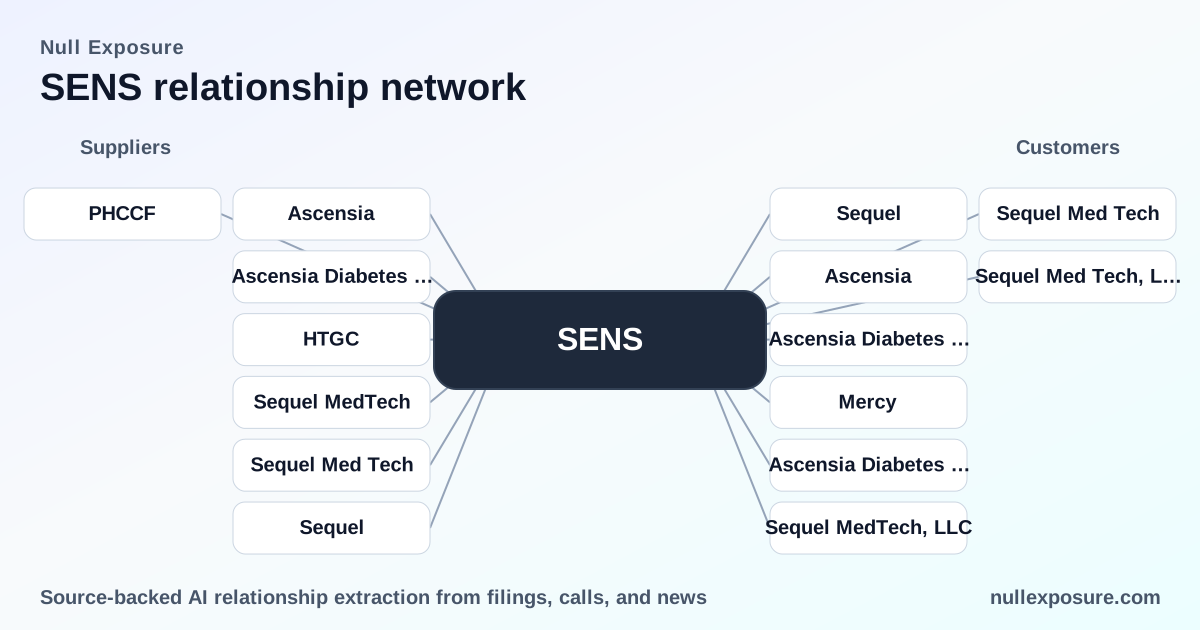
Senseonics (SENS): Customer Relationships That Drive Commercial Trajectory
Senseonics develops and sells the Eversense family of long‑term, implantable continuous glucose monitoring (CGM) systems and monetizes through device sales to distributor partners and direct commercial channels, recurring sensor and accessory revenue, and strategic integrations with insulin delivery partners that broaden clinical adoption and product stickiness. Investors should value SENS as a device‑plus‑ecosystem business where distributor economics, partner integrations, and the pace of bringing commercialization in‑house determine revenue scalability and margin expansion. For detailed tracking of partner signals and filings visit NullExposure.
Why customers and partners matter more than ever
Senseonics’ revenue profile is concentrated and partner‑driven: the company books large chunks of revenue via distribution agreements and recognizes accounts receivable tied to those partners. Commercial transitions, such as Ascensia handing back distribution to Senseonics or new integrations with insulin pump makers, materially change revenue timing, working capital and go‑to‑market leverage. The operational posture is a hybrid of distributor reliance and direct commercialization with consignment and healthcare professional arrangements layered in.
Itemized relationship evidence (each mention in the record)
-
Sequel — earnings call (2025 Q4): Senseonics described an integration with Sequel’s twiist automated insulin delivery system as “another significant milestone in 2025,” signaling commercial interoperability that enables closed‑loop insulin delivery using Eversense data. Source: Senseonics 2025 Q4 earnings call (March 2026).
-
Ascensia — 2024 Form 10‑K (FY2024): The 2024 Form 10‑K discloses $18.5 million of revenue from Ascensia for the year and $4.9 million receivable at December 31, 2024, demonstrating Ascensia’s material contribution to SENS’s top line in FY2024. Source: Senseonics 2024 Form 10‑K (filed for FY2024).
-
Ascensia Diabetes Care Holdings AG — 2024 Form 10‑K (FY2024): The filing states Ascensia began commercializing Eversense 365 in the U.S. in October 2024, establishing Ascensia as the initial U.S. commercialization partner for the one‑year sensor. Source: Senseonics 2024 Form 10‑K (FY2024).
-
Mercy — Mercy news release (Oct 2024): Mercy placed the first commercial Eversense 365 patient, validating early clinical adoption through a healthcare system rollout and publicized by Mercy in October 2024. Source: Mercy newsroom release (Oct 10, 2024).
-
Ascensia Diabetes Care — MocoShow news (June 2022): Reporting on earlier approvals, Ascensia is referenced as Senseonics’ commercial partner that made the improved six‑month system available internationally beginning Q3 2022, indicating a longstanding distributor relationship. Source: MocoShow (June 22, 2022).
-
Ascensia Diabetes Care — TradingView / company release (FY2026): A press summary notes that Senseonics executed agreements for Ascensia to return commercialization and distribution of Eversense to Senseonics effective January 1, 2026, marking a material shift in go‑to‑market responsibility. Source: TradingView summary of Senseonics Q4/Full‑Year 2025 results (reported in early 2026).
-
Sequel MedTech, LLC — Yahoo Finance release (FY2026): A Senseonics press release quoted on Yahoo Finance emphasizes a partnership to provide glucose monitoring data to power Sequel’s twiist Loop algorithm, framing Sequel as a technology partner that consumes Eversense telemetry for insulin delivery decisions. Source: Yahoo Finance press coverage (2026).
-
Sequel Med Tech, LLC — GlobeNewswire (Feb 2026): GlobeNewswire announced full U.S. availability of the twiist AID System integrated with the Eversense 365 system, confirming commercialization at scale between the two companies. Source: GlobeNewswire press release (Feb 19, 2026).
-
Ascensia Diabetes Care — GlobeNewswire (Aug 2025): Ascensia described itself as the exclusive global distribution partner for Eversense, underlining the past distribution concentration with Ascensia prior to the 2026 transition back to Senseonics. Source: Ascensia corporate release via GlobeNewswire (Aug 6, 2025).
-
Ascensia Diabetes Care — GlobeNewswire (Apr 2025): Senseonics noted that Eversense 365 is developed by Senseonics and “brought to patients by Ascensia Diabetes Care,” reinforcing the product‑developer / distributor split in commercial execution. Source: GlobeNewswire press release (Apr 29, 2025).
-
Ascensia Diabetes Care — GlobeNewswire (Nov 2025): A memorandum of understanding (MOU) was signed with Ascensia to transition commercial responsibility for Eversense back to Senseonics, documenting negotiated handback activity. Source: Senseonics press release summarized on GlobeNewswire (Nov 5, 2025).
-
Ascensia — Quiver Quant (FY2026 summary): Company commentary in FY2026 highlights risks and uncertainties linked to the commercial transition from Ascensia and Senseonics’ need to stand up European capabilities — an explicit callout that transition execution is a near‑term risk factor. Source: Quiver Quant summary (2026).
-
Sequel Med Tech — GlobeNewswire (Feb 2026 duplicate): GlobeNewswire also covered Sequel/ Senseonics integration, restating the same availability announcement and underscoring dual press distribution of the partnership news. Source: GlobeNewswire (Feb 19, 2026).
-
Sequel — InsiderMonkey transcript (Q4 2025 earnings): Management described the Sequel collaboration as combining sensing, algorithm control and pumping technologies and positioned it as a template for future pump partner relationships. Source: Earnings call transcript posted to InsiderMonkey (March 2026).
-
Mercy — SimplyWallSt summary (FY2025): Media summaries tracked Mercy’s first commercial Eversense 365 case in October, corroborating adoption activity within health systems during FY2025. Source: SimplyWallSt (Oct 2025 coverage).
-
Sequel Med Tech, LLC — Beyond Type 1 (FY2025): Public advocacy and patient community coverage documented a commercial development agreement between Sequel and Senseonics on integrated diabetes technologies. Source: Beyond Type 1 community post (2025).
-
Sequel Med Tech, LLC — HitConsultant (Apr 2025): Trade reporting flagged the integration between Sequel’s twiist AID system and Senseonics’ Eversense 365, calling it a significant commercial development agreement in the diabetes device market. Source: HitConsultant (Apr 30, 2025).
(Each of the entries above maps to the primary mention in the company filings and press releases included in Senseonics’ customer relationship record.)
Operational constraints and what they signal for investors
Senseonics’ filings and disclosures establish three company‑level commercial characteristics:
- Distributor‑centric sales model: The company “primarily sell[s] directly to our network of distributors, strategic fulfillment partners,” which creates concentrated counterparty exposure but also scalable distribution when executed well. Evidence: Form 10‑K excerpts on distributor sales.
- Mixed contracting posture (consignment and direct): Senseonics uses a consignment model with healthcare professionals and reseller arrangements, indicating revenue recognition and inventory complexities that influence working capital. Evidence: Company disclosures describing consignment arrangements.
- Counterparty mix includes individual/clinical prescribers: The commercial pathway funnels through distributors to healthcare providers and patients, meaning adoption depends on provider training and implant logistics rather than purely retail channels.
These signals together imply execution risk during the Ascensia transition, higher working capital variability, and concentrated partner revenue until direct commercialization scales.
Investment implications and risk framing
- Upside: Integrations with insulin pump providers such as Sequel materially increase Eversense’s clinical value proposition and could drive device stickiness and recurring sensor sales. The Sequel integration is a strategic commercial booster.
- Downside: Transitioning distribution in‑house from Ascensia creates near‑term revenue timing risk and operational demands in Europe and other markets; FY2024 receivables tied to Ascensia illustrate the financial significance of the partner relationship.
- Key monitorables: Receivables and revenue by partner (reported in 10‑K/earnings), execution milestones on the Ascensia handback, and uptake at health systems (e.g., Mercy placements).
Read the filings, track the roll‑out, act
Analysts and operators should prioritize the company’s Q‑by‑Q disclosures on the Ascensia transition, commercial rollout metrics for Eversense 365, and measurable uptake from pump integrations like Sequel. For ongoing partner and counterparty monitoring, see resources and aggregated relationship signals at NullExposure.
Bold takeaways: Ascensia historically drove meaningful revenue and receivables; Senseonics is reclaiming commercial control in 2026, which accelerates upside if operational execution succeeds but concentrates near‑term execution risk.