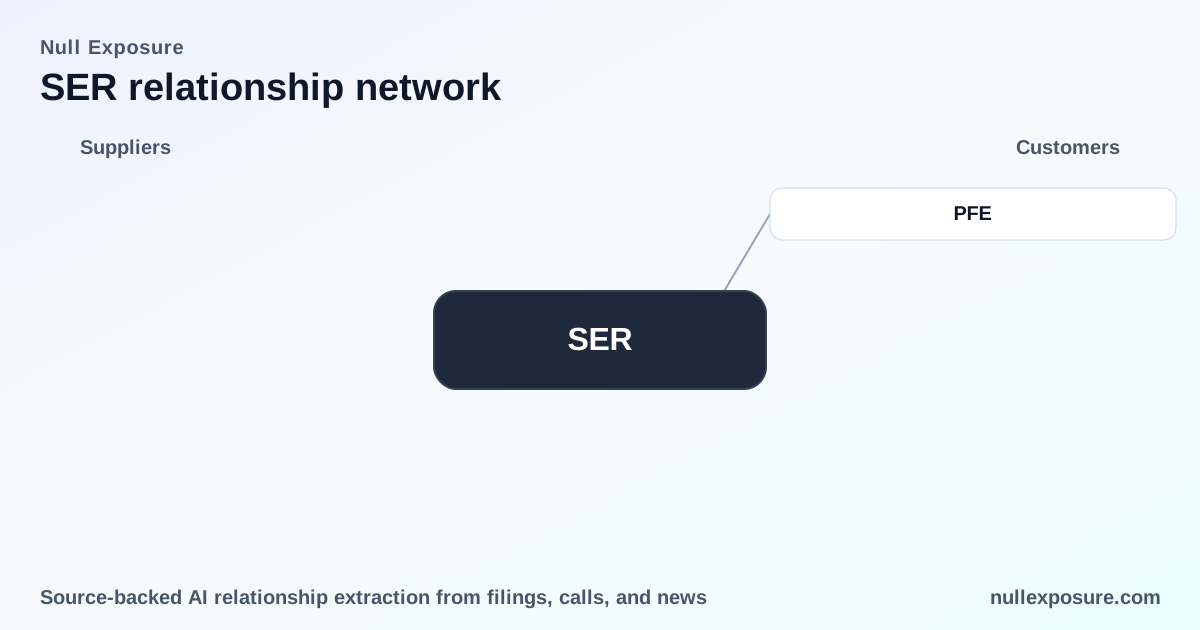
Serina Therapeutics (SER): Customer Relationships and What They Mean for Value
Serina Therapeutics commercializes a proprietary POZ polymer drug‑delivery platform that it licenses to third parties and pairs with internally developed oncology and neurology programs. The company monetizes through non‑exclusive licensing arrangements and partnership fees, with the potential for milestone and royalty income as partners deploy POZ in lipid nanoparticle (LNP) and other delivery formulations. For investors, the core thesis is simple: external validation from large pharma partners accelerates de‑risking and creates optionality for outsized upside, but Serina’s current economics—minimal revenue and substantial operating losses—mean partner deals must scale materially to transform the equity story.
If you want a compact view of related signals and links to source material, visit https://nullexposure.com/ for a consolidated feed.
Why a pharma licensing partner changes the profile of a small biotech
Large pharmaceutical partners licensing platform technology confer two concrete benefits. First, validation from an established R&D and commercial engine increases the platform’s credibility and raises the probability of downstream revenue. Second, large‑scale LNP programs provide a potential revenue base via upfronts, milestones, and royalties that is otherwise unavailable to a company generating $130k in trailing‑twelve‑month revenue and operating at a heavy loss (EBITDA -$23.9m). Serina’s market capitalization (~$28.3m) and thin institutional ownership (2.9%) make the company especially sensitive to the timing and size of partner payments.
Key operating facts: Serina reported TTM revenue of $130k, negative gross profit (‑$13.025m), and a diluted EPS of ‑$2; insiders hold a material stake (~34%), which concentrates governance and orientation toward long‑term R&D. These metrics frame why customer relationships—especially with top‑tier pharma—are strategically critical.
Customer signals: every relationship record in the feed
Below are the relationship records surfaced in public reporting. Each entry is summarized in plain English with a concise source reference.
PFE — GlobeNewswire press release (Dec 11, 2025)
A GlobeNewswire release discloses a non‑exclusive license agreement with Pfizer, Inc. granting Pfizer rights to use Serina’s POZ polymer technology in lipid nanoparticle (LNP) delivery formulations. See the GlobeNewswire announcement (Dec 11, 2025) for the original notice: https://www.globenewswire.com/news-release/2025/12/11/3204315/0/en/Serina-Therapeutics-Strengthens-Leadership-Team-with-Appointment-of-Dr-Joshua-Thomas-as-VP-Head-of-Chemistry.html
Pfizer, Inc. — GlobeNewswire press release (same item)
The same GlobeNewswire item is indexed again under the name “Pfizer, Inc.”, reiterating that the arrangement is non‑exclusive and targeted at LNP delivery applications, which aligns Serina’s POZ chemistry with established mRNA/oligonucleotide platform work. See the GlobeNewswire release: https://www.globenewswire.com/news-release/2025/12/11/3204315/0/en/Serina-Therapeutics-Strengthens-Leadership-Team-with-Appointment-of-Dr-Joshua-Thomas-as-VP-Head-of-Chemistry.html
PFE — TradingView/Benzinga mention (relating historical disclosure)
A TradingView item quoting Benzinga references a prior license agreement under which Pfizer licensed Serina’s POZ polymer technology on a non‑exclusive basis, indicating the relationship has circulated in multiple investor‑facing news outlets and received attention beyond company press channels. That coverage is archived on TradingView/Benzinga: https://www.tradingview.com/news/benzinga:c08a45e48094b:0-what-s-going-on-with-penny-stock-agex-therapeutics/
Pfizer Inc — TradingView/Benzinga (duplicate indexing)
The TradingView feed also lists the partner name as “Pfizer Inc”, repeating the same license narrative tied to earlier fiscal periods; this duplication in news indexing confirms the licensing arrangement is the primary customer signal in public media. See the TradingView link: https://www.tradingview.com/news/benzinga:c08a45e48094b:0-what-s-going-on-with-penny-stock-agex-therapeutics/
What the constraints tell us about Serina’s commercial posture
The relationship constraints included in the feed provide company‑level signals that shape how investors should think about future revenue cadence and deal economics:
- Spot contracting posture (90% confidence): Evidence indicates Serina engages in spot or one‑off commercial transactions rather than large master collaboration agreements. This suggests revenue will be lumpy and tied to discrete licensing events rather than predictable recurring streams.
- Buyer role signal (90% confidence): An extracted excerpt references asset purchase activity, registering Serina in a buyer posture in at least one reported transaction, which reflects opportunistic corporate actions beyond pure licensor activity.
- Active relationship stage (60% confidence): The feed classifies at least one engagement as active, though the confidence is moderate; treat this as a signal that some partnerships are contemporaneous but that life‑cycle details are still limited.
- Spend band $10m–$100m (90% confidence): The constraints point to transaction scale in the mid‑double‑digit millions, which—if attributable to licensing or asset transactions—would be meaningful relative to Serina’s current enterprise value and could materially alter the balance sheet if realized.
These constraints do not assign a specific partner; they are company‑level operational indicators derived from public excerpts.
Investment implications: upside, concentration, and timing
Serina’s licensing of POZ to Pfizer is a material validation event. For investors, three takeaways matter:
- Upside: A non‑exclusive license to a large pharmaceutical company builds credibility and opens the path to milestone and royalty streams that scale with partner program success. If Pfizer advances LNP programs that deploy POZ, Serina could capture meaningful economics that dwarf current revenue.
- Concentration and execution risk: Serina’s business remains highly concentrated—public signals point to a small number of partner relationships driving valuation. Execution on partner development and the timing of payments are the key value drivers.
- Financial runway and dilution sensitivity: With substantial operating losses and tiny revenue, any large deal is binary for equity value; absent scaled partner receipts, the company will remain reliant on financing or strategic transactions. Insider ownership (34%) adds governance stability but also concentrates outcome exposure.
Consider these succinct risk/reward points:
- Upside from partner milestones and royalties is asymmetric relative to current valuation.
- Revenue will be lumpy under a spot contracting posture; investor returns hinge on timing and magnitude of partner payments.
- Mid‑double‑digit million transaction scale implied by constraints would be transformative relative to current financials.
Bottom line and next steps for due diligence
Serina’s relationship signals—chiefly the Pfizer non‑exclusive POZ license—shift the company’s profile from early‑stage chemistry developer to a platform licensor with validated industry interest. However, the company’s tiny revenue base, substantial losses, and low institutional ownership mean that validation alone does not guarantee value realization; conversion of licensing agreements into material cash flows is the pivotal catalyst.
For a one‑stop view of how these relationship signals map to public filings and market commentary, visit https://nullexposure.com/. If you are evaluating Serina as a strategic or financial investment, prioritize confirming the financial terms and milestone schedules of partner agreements and reassessing runway assumptions against potential upfronts and royalty streams disclosed in future filings.