Sera Prognostics: how payer partnerships and PreTRM sales define near-term value (SERA)
Sera Prognostics sells a clinically validated blood test, PreTRM, that quantifies a pregnant patient’s risk of preterm birth and is monetized primarily through test sales to payers and health systems plus strategic payer collaborations. Revenue generation is concentrated, reimbursement-driven and tied to a small number of large customers and pilots with payers like Elevance Health; commercial traction and favorable coverage decisions will drive valuation more than near-term GAAP revenue. For deeper model and counterparty analytics, visit https://nullexposure.com/.
One-line commercial thesis
Sera is an early-commercial medical diagnostics company whose economics depend on converting clinical validation into payer coverage and volume sales of the PreTRM test; the company functions as a seller of a single core product to large payers, government programs and health systems while it scales real-world evidence and trial results to unlock broader reimbursement.
What the Elevance relationship signals for investors
According to an industry note hosted on Intellectia (March 10, 2026), Jefferies highlighted Sera’s “early traction with Elevance partner and Medicaid pilot programs” as a positive catalyst in its Buy thesis, citing an attractive U.S. addressable market and PreTRM’s first-to-market validation (https://intellectia.ai/stock/SERA). This report underpins market interest in payer-led adoption.
A second mention in the same Intellectia note reiterates Elevance’s role in Sera’s commercialization path and is consistent with Sera’s accounting disclosure that identifies Elevance Health as a customer and unit of account for PreTRM sales under ASC 606, confirming the payer is an active commercial counterparty (Intellectia, March 2026; Sera filings). Elevance is therefore both a strategic partner for payer pilots and an accounted-for revenue counterparty.
Contracting posture, concentration and commercial maturity
Sera’s disclosures show a long-term contracting posture for at least some payer collaborations: the company’s commercial collaboration language specifies that, unless terminated for breach, the agreement remains effective through the later of the third anniversary of the effective date or a purchase milestone tied to a fixed number of PreTRM tests. That structure signals multi-year engagement and built-in runway for adoption under a defined purchase cadence.
At the same time, Sera reports customer concentration risk as a company-level characteristic: management expects reliance on a limited number of direct customers for a significant portion of revenue in the near term. The company also acknowledges that government payers (Medicare/Medicaid) and large managed-care organizations are critical decision-makers for reimbursement and adoption, which concentrates commercial risk around a handful of large enterprise and government counterparties.
Commercial maturity remains early: filings disclose no material revenues from the Commercial Collaboration Agreement in 2023–2024, while Sera expects sales of PreTRM to supply substantially all near-term revenue. Taken together, the posture is long-term contracting but early-stage realization — durable contracts exist, but revenue outcomes are contingent on scale and coverage decisions.
Product centrality and go-to-market constraints
PreTRM is explicitly the company’s core product: Sera receives substantially all revenues from PreTRM sales, and the test is positioned as the only broadly validated blood-based biomarker test for preterm birth risk currently on the market. That makes PreTRM both the commercial linchpin and a single-point-of-failure for near-term revenue growth.
Key operating constraints for investors to model into valuation:
- Reimbursement dependency: Sales both domestically and internationally hinge on commercial and government payer reimbursement decisions and established coverage policies.
- Concentration of demand: Near-term revenue will likely come from a limited set of payers and health systems, producing asymmetric downside if pilot programs do not scale.
- Early revenue profile: Historical revenue is negligible and recent gross profit has been negative, so operating leverage is unproven until volume and contractual pricing are realized.
- International upside optionality: Sera is evaluating European expansion, offering secular growth beyond the U.S. but requiring localized coverage and regulatory pathways.
These constraints should be treated as company-level signals unless a specific excerpt explicitly names a counterparty.
Relationship-level summaries (every listed relationship)
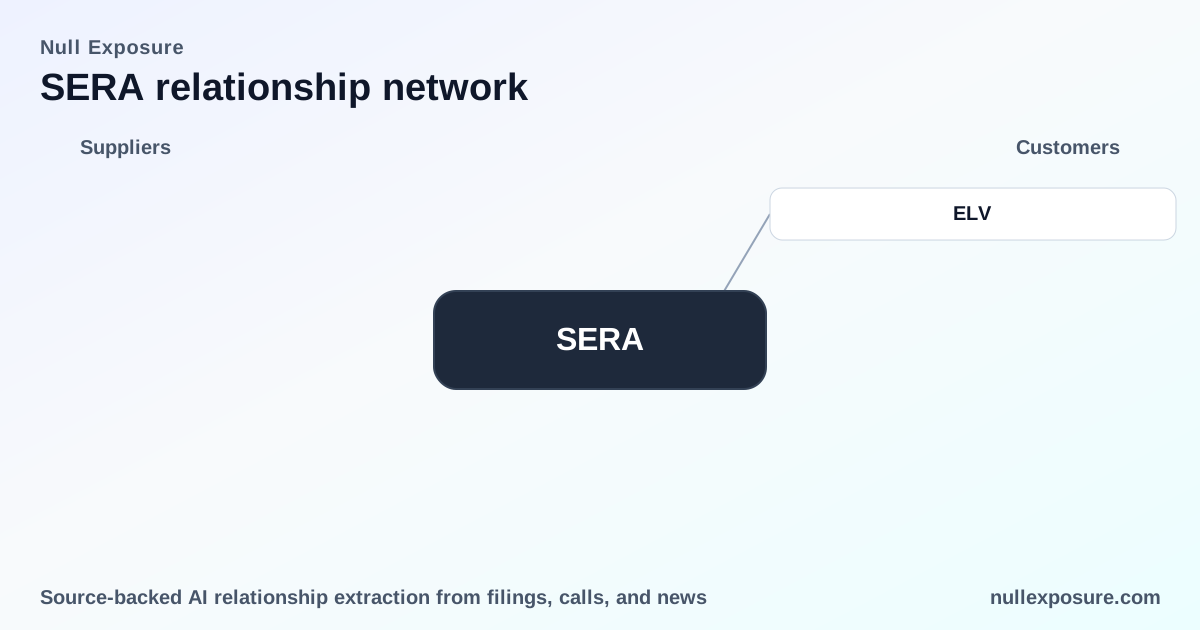
Elevance / ELV — entry 1: Jefferies cited Sera’s PreTRM clinical validation and noted early traction with Elevance partner and Medicaid pilot programs as a driver for a Buy rating, highlighting an attractive U.S. addressable market estimated at $1.6 billion (Intellectia, March 10, 2026).
Elevance / ELV — entry 2: The second news mention duplicates the market note and reinforces that Elevance Health is an active commercial partner and purchaser in pilot programs; Sera’s accounting further treats Elevance as a customer under ASC 606 (Intellectia, March 10, 2026; Sera filings).
(These two entries in the results reference the same payer relationship and together establish Elevance as both a strategic collaborator and an accounted-for purchaser.)
Why these relationship signals matter to investors
- Revenue path dependency: The Elevance relationship exemplifies the company’s commercial playbook — secure large-payer pilots, convert pilots to coverage, then scale test volume. If Elevance scales purchases per contractual milestones, Sera could cross the threshold from pilot revenue to meaningful commercial receipts.
- Reimbursement as a gating factor: Sera’s growth is not purely adoption-driven; payer policy and government reimbursement will determine price realization and unit economics, so investor returns hinge on favorable coverage outcomes from MCOs and Medicaid programs.
- Concentration risk vs. partnership optionality: Long-term collaboration agreements provide stability but also concentrate downside if a small number of partners fail to convert pilots into recurring purchases. Conversely, successful scale through a partner like Elevance would materially derisk the model.
Investment implications and risk-adjusted view
Sera is a classic coverage-to-volume binary investment in diagnostics: upside comes from payer adoption of PreTRM (volume growth and reimbursement), downside from slow conversion and concentrated customer exposure. Current financials show very limited revenue and negative margins, so near-term upside is primarily episodic — driven by pilot outcomes, coverage wins and international expansion.
Key items investors should monitor next:
- Milestones or purchase schedules under the Elevance collaboration and any evidence of step-up in test orders.
- Coverage decisions or coding/payment announcements from commercial insurers and Medicaid programs.
- Readouts from PREVENT-PTB, AVERT PRETERM and the PRIME study that Sera references as drivers for payer contracting.
- Any shift from pilot status to recurring programmatic adoption among large MCOs.
For a structured view of counterparty and contract exposure across Sera’s commercial relationships, see the company-level analytics available at https://nullexposure.com/.
Bottom line
Sera’s commercial value is concentrated in a single, clinically validated product sold into large payers and health systems, with Elevance Health an illustrative partner that validates the company’s market approach but also highlights concentration and reimbursement risk. Investors should treat Sera as a coverage-dependent, early-commercial diagnostic where partnership milestones and payer policy developments are the primary drivers of de-risking and value realization.