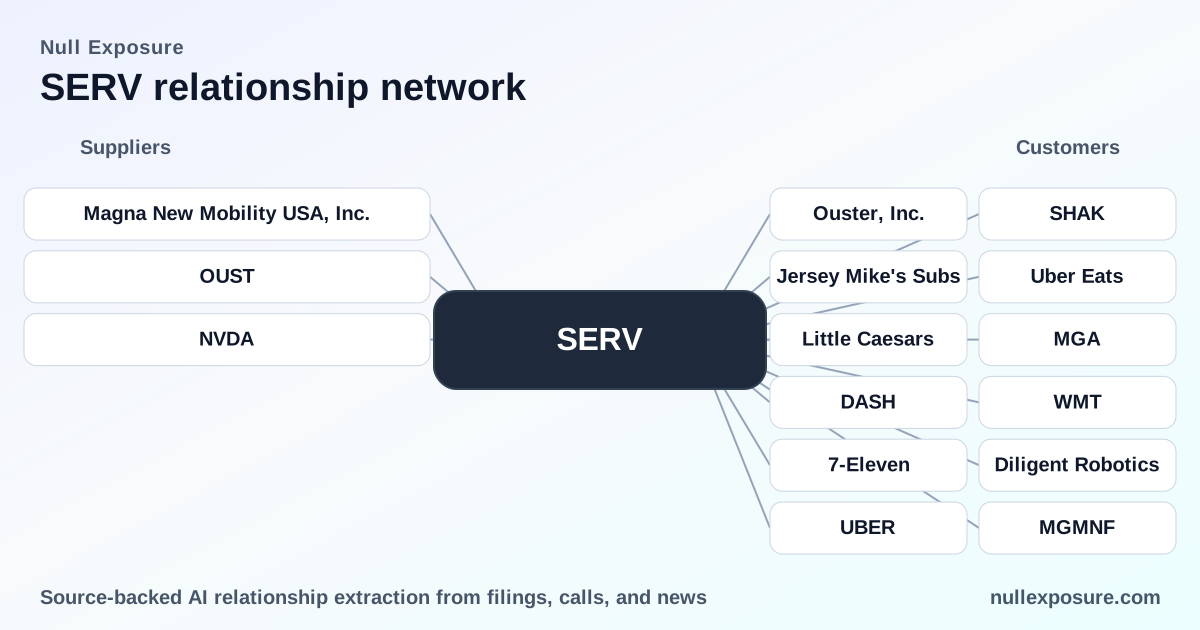
Serve Robotics: customer map, contractual levers, and what investors should know
Serve Robotics designs, deploys and operates autonomous sidewalk delivery robots and monetizes through a combination of delivery service fees, software licensing and commercial partnerships with delivery platforms and enterprise merchants. The company sells robot-enabled delivery as a service to platforms (platform integrations and Project Plans), licenses software to manufacturing partners and contracts directly with merchants and retailers for fulfillment; platform agreements and a small number of large counterparties drive both distribution and revenue concentration. Learn more about our coverage at https://nullexposure.com/.
The commercial spine: platform partnerships and enterprise deals drive scale
Serve’s operating model is clearest when viewed through its platform relationships. The company provides robots, operating systems and dispatch integration that sit on top of delivery platforms such as Uber Eats and DoorDash, and also signs merchant-level partnerships with restaurant and retail brands to drive volume and density. That structure produces two important business characteristics: high counterparty concentration (large platform partners account for a meaningful share of revenue) and platform-led scale (multi-platform integrations improve utilization and route density). Those characteristics shape capital needs, margin progression and valuation sensitivity.
Relationship roll call — one-line takeaways and sources
Below are every customer relationship surfaced in the filings and press coverage, each with a short plain‑English summary and source reference.
-
Uber / Uber Eats — Serve operates on Uber Eats’ platform under multi‑city Project Plans and ongoing integrations that give Serve real‑time order dispatch and broad geographic reach across Los Angeles, Miami, Dallas–Fort Worth, Atlanta, Chicago, Fort Lauderdale and Alexandria, VA. Source: 2024 Form 10‑K and multiple press releases (GlobeNewswire, Q1–FY2026 press coverage).
-
DoorDash (DASH) — DoorDash is a recent commercial partner; the relationship expands Serve’s multi‑platform distribution and enables the company to offer robots across DoorDash’s network, broadening reach beyond Uber Eats. Source: Q3 2025 earnings call and multiple media reports (TechCrunch, Benzinga, FY2025–FY2026 coverage).
-
Magna New Mobility USA, Inc. / Magna (MGMNF) — Serve has a strategic partnership and a non‑exclusive licensing arrangement with Magna New Mobility that grants Magna access to Serve’s technology for AMR projects, supporting manufacturing and scale initiatives. Source: Press coverage and 2024 10‑K disclosures (Therobotreport, FY2026 summaries).
-
Shake Shack (SHAK) — Shake Shack is a branded restaurant partner for which Serve powers robotic deliveries via platform partners in select Los Angeles locations. Source: Q3 2025 earnings call and Restaurant Dive press (FY2026 reporting).
-
Little Caesars — Little Caesars is a restaurant partner added to Serve’s merchant roster as the company expands its branded delivery footprint. Source: Q3 2025 earnings call (2025Q3).
-
Jersey Mike’s Subs — Jersey Mike’s has been added to Serve’s merchant list, giving access to the sub‑sandwich chain’s network for robot deliveries. Source: Q3 2025 earnings call (2025Q3).
-
7‑Eleven — Serve has completed tens of thousands of deliveries for convenience retailer 7‑Eleven, reflecting retailer use cases beyond restaurants. Source: GlobeNewswire press and FY2025–FY2026 news summaries.
-
White Castle — White Castle partnered with Serve to deliver menu items via Serve’s robots on the Uber Eats platform in select U.S. cities, a merchant tie‑in that underscores enterprise retail adoption. Source: White Castle press release distributed on GlobeNewswire (Mar 2026).
-
Walmart (WMT) — Walmart is listed among larger customers in media coverage, indicating pilot or enterprise‑level engagements with major retail operators. Source: TheRobotReport coverage summarizing Serve’s customer base (FY2026 reporting).
-
Ouster, Inc. — Ouster appears as a strategic customer agreement counterparty in Serve’s disclosures and is referenced in the company’s 2024 10‑K filing. Source: 2024 Form 10‑K (serv‑2024‑12‑31).
-
Diligent Robotics — Serve announced the acquisition of Diligent Robotics to expand beyond sidewalk delivery into indoor/hospital assistant robots, with plans to integrate Diligent’s products and share technology. Source: TechCrunch and Serve press releases (Jan–Mar 2026).
What the contract and relationship constraints tell investors
Serve’s disclosed constraints and contract language provide a practicable lens into risk and operational posture.
-
Contracting posture: framework agreements + project plans. Serve operates under a Master Framework Agreement model with multi‑year terms and renewals that create predictable operational corridors and allow phased city rollouts under Project Plans. That structure supports scale but locks the company into multi‑year execution schedules. Source: Master Framework Agreement text cited in company 10‑K.
-
Concentration is material. Management discloses that a significant portion of revenue is concentrated with two customers, and the 2024 10‑K shows sales to Magna and Uber represented 65% and 26% of revenues for the year ended December 31, 2024. Revenue concentration is a primary single‑name risk. Source: 2024 Form 10‑K.
-
Geography: North America first. Serve currently primarily operates within the U.S., with Project Plans focused on multi‑city U.S. deployments; this creates regulatory and unit economics homogeneity but concentrates regulatory and market risk in North America. Source: 2024 10‑K excerpts and Project Plan descriptions.
-
Relationship roles: service provider and licensor. Serve is both a hands‑on service provider—operating robots and receiving per‑delivery fees under platform arrangements—and a licensor, recognizing revenue from software services and licensing. This dual role provides multiple monetization routes but also complicates margin forecasting. Source: 2024 10‑K disclosures.
-
Stage: active deployments and scale underway. Project Plan disclosures and press reporting show active deployment targets (up to 2,000 robots under Project Plan #2 and fleet expansion to ~2,000 robots in FY2025), signaling execution is beyond pilots and in commercialization. Source: 2024 10‑K and GlobeNewswire/FY2025 press.
(If you want a deeper extraction of contract language and a model of delivery economics, see our analysis at https://nullexposure.com/.)
Investment implications — what drives upside and what creates downside
-
Upside drivers: platform integrations (Uber Eats, DoorDash) create a distribution moat that drives utilization and reduces marginal delivery costs; merchant partnerships with national chains and retailers scale revenue volume; M&A and technology licensing (e.g., Magna relationship, Diligent acquisition) broaden TAM into indoor robotics and manufacturing channels.
-
Downside risks: high revenue concentration with a small number of counterparties, negative operating margins and ongoing cash burn, and execution risk in city‑by‑city rollouts and regulatory acceptance of sidewalk robots. Serving platforms is capital‑intensive and dependent on density to reach attractive unit economics.
-
Near‑term catalysts: rollout of DoorDash integration, merchant additions (White Castle, Little Caesars, Shake Shack) and the Diligent acquisition transition into healthcare and indoor robotics revenue streams. These items will determine whether Serve converts platform reach into sustainable, higher‑margin service revenue.
Bottom line
Serve’s business is built on platform partnerships and a hybrid monetization model: delivery services at scale plus software licensing. The firm has moved past pilots into multi‑city deployments and multi‑platform integrations, but revenue concentration and negative margins are the central valuation risks. Investors should track platform penetration metrics, per‑robot utilization, and the pace at which merchant and retail partnerships shift the revenue mix away from a few large counterparties.
For the full Serve customer mapping and ongoing monitoring, visit https://nullexposure.com/ for our coverage and data summaries.