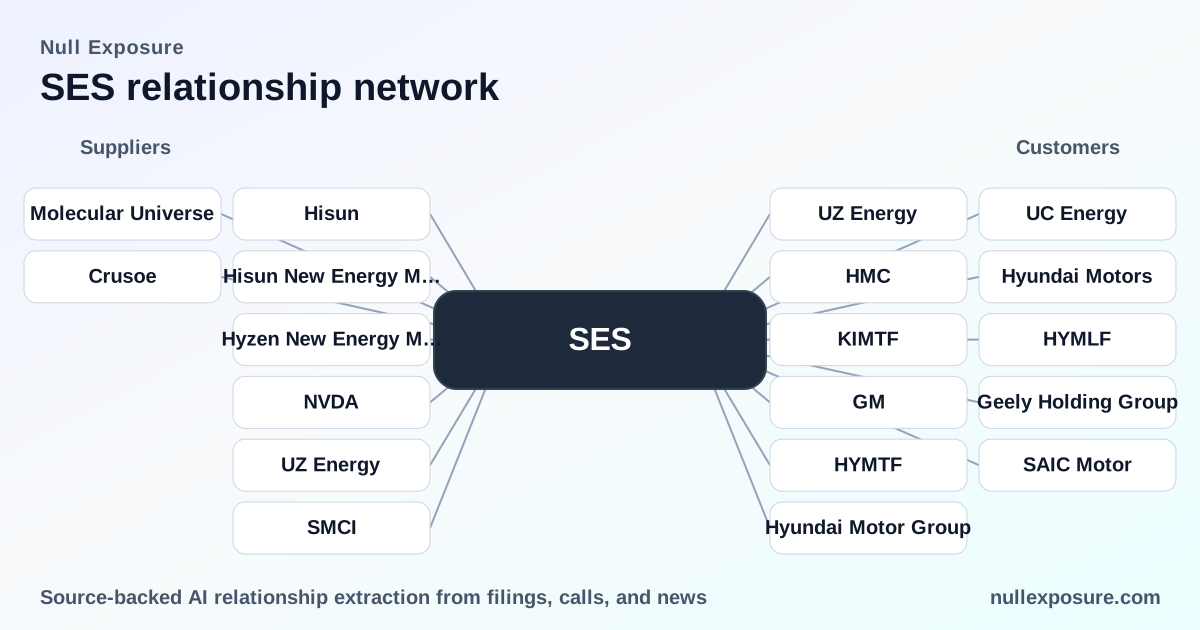
SES AI Corp: customer map and what it means for investors
SES AI Corp develops lithium-metal battery cells, electrolyte materials and related engineering services for automotive and industrial customers, and it monetizes through two clear channels: product sales recognized at delivery (spot) and short-term service contracts (1–2 years) for design and development work with OEMs. Recent revenue growth is concentrated in a small set of OEM development agreements and APAC sales, producing meaningful upside on execution but creating concentration and repeatability challenges for valuation.
How SES sells — the business model in plain language
SES’s commercial model combines one-off product deliveries (Li‑metal cells and battery materials) with services revenue tied to development programs for automakers. Company disclosures show product revenue is recognized at transfer of control upon delivery, while service contracts generally run one to two years, creating a revenue mix that is transactional and project-based rather than subscription-like. These mechanics underline two investing implications: near-term revenue visibility is linked to project milestones and deliveries, and scalability depends on converting development work into recurring product orders (company filing for year ended Dec 31, 2024 and SES 2025 Q4 earnings call).
If you want the full customer dataset and automated relationship signals, visit the NullExposure homepage: https://nullexposure.com/
Operational constraints that matter to valuation
- Contracting posture — short-term and spot-oriented. Company filings state service contracts commonly run one to two years while product sales are recognized at the point of delivery, indicating SES operates on transactional project timelines rather than long multi‑year supply contracts.
- Geographic concentration — APAC revenue exposure. For the year ended Dec 31, 2024, 100% of revenue (by customer billing address) was in the Asia Pacific region, which concentrates market and regulatory risk in APAC markets.
- Revenue concentration — single-customer risk. The company reported that one customer accounted for ~90% of revenue and receivables in 2024, a critical concentration that elevates counterparty risk and cash‑flow volatility.
- Competing corporate signals on dependence. Management also states the business does not “substantially depend on any one customer,” a narrative that coexists with the 90% concentration disclosure; treat this as a company-level tension between aspiration and current revenue reality.
- Segment mix — core product vs services. Filings describe product revenue as Li‑metal cells and materials sold to OEMs, while service revenue derives from design and development engagements—this supports an expectation of lumpy margins as SES transitions from R&D contracts to production sales.
Sources: SEC-style company filing disclosures for year ended Dec 31, 2024; SES 2025 Q4 earnings call (Mar 7, 2026).
Customer relationships and what each means for growth
Below I cover every relationship referenced in available materials; each entry is a concise, plain-English read with the relevant source.
UZ Energy
SES referenced UZ Energy in the 2025 Q4 earnings call, noting UZ Energy’s scale in energy storage systems and its sales footprint across residential, commercial and grid customers; the mention positions UZ Energy as a commercial partner or customer in the ESS channel. (SES 2025 Q4 earnings call, Mar 7, 2026)
Honda / Honda Motor (HMC)
SES identified Honda as a party to services agreements that delivered final contributions to 2025 results after completion of EV development work, and company disclosures attribute part of 2025’s service revenue to the Honda program. (SES 2025 Q4 earnings call; The Globe and Mail press release recap, FY2026)
Hyundai / Hyundai Motor Group / Hyundai Motors
SES repeatedly cites development work with Hyundai across filings and interviews: Hyundai was a joint-development partner on electrolyte and cell work and contributed to 2025 non‑recurring service revenue alongside Honda. Management also described preparing a production line with Hyundai Motor Group in Korea. (SES 2025 Q4 earnings call; The Globe and Mail/Motley Fool coverage; The Korea Herald interview, FY2023)
General Motors (GM)
General Motors is listed among strategic PIPE investors during SES’s SPAC combination, signaling an investor‑strategic relationship and potential route to OEM collaboration or offtake discussions. (Saur Energy report on SPAC completion, FY2022)
Kia Corporation
Kia is also named among the PIPE investor and strategic partner group at the company’s SPAC listing, indicating OEM interest at the investor level that supports credibility with automaker customers. (Saur Energy, FY2022)
SAIC Motor
SAIC Motor appears on the list of PIPE investors/strategic partners in the SPAC transaction coverage, reflecting engagement with major Chinese OEMs during the company’s market entry phase. (Saur Energy, FY2022)
Geely Holding Group
Geely is listed among strategic parties in coverage of the transaction that brought SES public, placing another large Chinese OEM in SES’s early strategic investor set. (Saur Energy, FY2022)
Koch Strategic Platforms
Koch Strategic Platforms is included in reporting on the PIPE investors backing SES’s SPAC transaction, representing institutional strategic capital among the company’s early backers. (Saur Energy, FY2022)
LG Technology Ventures
LG Technology Ventures was named as a PIPE investor and strategic partner in the company’s SPAC coverage, underscoring SES’s access to broader battery and materials ecosystems through investor relationships. (Saur Energy, FY2022)
Chunghwa Telecom (CHT)
Chunghwa Telecom has signed an MoU with SES (MEO operator) to establish a second-generation MEO O3b mPower ground station/Gateway in Taiwan and to integrate multi-orbit satellite connectivity and IoT applications, positioning SES in telecom infrastructure partnerships in North Asia. (TheFastMode; TelecomTV; Taipei Times; InsiderMonkey, FY2025–FY2026)
UC Energy
SES previously supplied a database/machine learning model to UC Energy to help improve battery management system accuracy, indicating a supplier/technology collaboration in analytics and BMS. (The Globe and Mail/Motley Fool transcript coverage, FY2025)
Investment implications — what to watch next
- Conversion of development work into recurring product orders is the primary de‑risking vector. The business model’s reliance on short-term services and project deliveries means forecasts must be driven by confirmed production contracts or framework purchase agreements.
- Concentration risk is high today. With APAC accounting for 100% of 2024 revenue and one customer representing ~90% of revenue, top-line volatility and counterparty dependence are material valuation risks until customer diversification or long-term supply contracts are secured.
- OEM investor relationships are a positive signal but not a guarantee of offtake. The presence of major OEMs and strategic investors in early financings provides validation and potential commercial paths, but investors should separate investor‑status from confirmed supply commitments.
If you want a structured view of these customer signals and continuous monitoring, see more at NullExposure: https://nullexposure.com/
Bottom line
SES’s current commercial footprint is project-driven, APAC-centric and concentrated, with clear strategic links to major OEMs through development agreements and investor relationships. The company’s valuation path depends on converting R&D and short-term service wins into predictable product revenue streams and diluting near-term customer concentration.