Seven Hills Realty Trust (SEVN): Loan-first REIT, short-duration cash yield for investors
Seven Hills Realty Trust originates and invests in floating-rate, first mortgage loans secured by middle-market commercial real estate across the United States and monetizes through interest income and loan-originations gains; the manager, Tremont Realty Capital, sources and executes financing for sponsor-backed transitional CRE and occasionally supports capital raises for the Trust. For income-oriented investors, SEVN’s model is a play on short-term floating-rate credit secured by real assets, supplemented by occasional equity support from its manager. For a concise view of coverage tools and signals, visit https://nullexposure.com/.
How SEVN actually operates and where the cash comes from
SEVN runs a focused originations business: floating-rate first mortgage loans with target terms of five years or less, sized to the middle-market and secured by transitional properties. The firm favors short-term, bridge-style positions that generate floating interest income and allow portfolio rotation as loans mature or refinance. The company reports a portfolio of first mortgages (21 loans as of Dec 31, 2024) with a weighted average maximum maturity of 2.6 years and an all-in yield around 8.6%, positioning the Trust to capture higher current yields and reprice exposure in a rising-rate environment. These attributes create a contracting posture that is transactional and repeatable rather than long-duration, lease-like revenue.
- Contracting posture: Short-term, loan-based commitments (generally ≤5 years) that prioritize yield and turnover.
- Counterparty profile: Middle-market sponsors and owners; underwriting assumes experienced, well-capitalized borrowers.
- Geography and diversification: National U.S. coverage across property types rather than concentrated local exposure.
- Criticality and seniority: First-mortgage collateral provides recovery priority, but credit risk remains tied to transitional asset performance.
- Stage and maturity: Active deployment; portfolio actively managed with frequent loan originations and refinancings.
Notable customer and sponsor relationships — what recent deals disclose
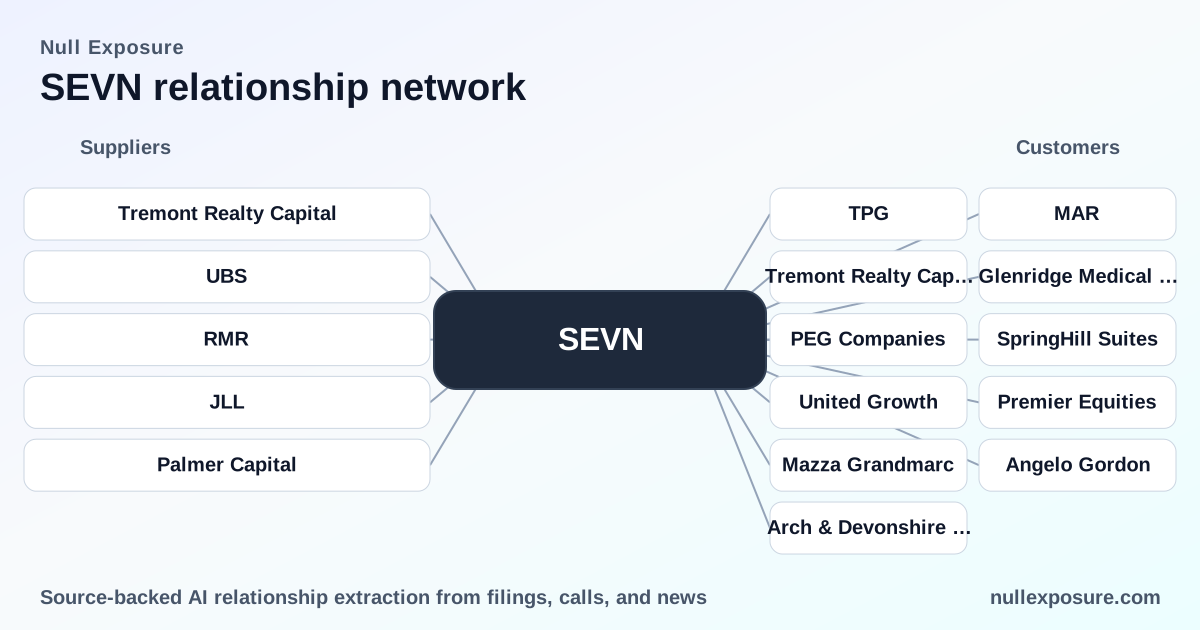
Below are plain-English summaries of every customer/sponsor relationship captured in recent coverage, each with the source noted.
Mazza Grandmarc — Seven Hills provided a $37.3 million first mortgage on Mazza Grandmarc, a 628-bed student housing complex near the University of Maryland, anchoring the Trust’s deployment in FY2025. According to CityBiz (March 2026), this loan was a headline transaction in the Trust’s recent originations.
SpringHill Suites (Revere, MA) — SEVN acquired a $37.0 million first mortgage secured by a 168-room, Marriott-branded SpringHill Suites in Revere, MA; the loan targets hospitality recovery in that market and was reported in the company’s FY2025 deployments. CityBiz (March 2026) described this as a core hospitality loan in the Trust’s portfolio.
Mazza Grandmarc (additional reporting) — REBusinessOnline and CityBiz both flagged the Mazza Grandmarc loan as a material deployment in FY2025, underscoring SEVN’s student-housing exposure in College Park, MD (CityBiz, March 2026; REBusinessOnline, March 2026).
Glenridge Medical Center — Seven Hills closed a $30.5 million loan secured by Glenridge Medical Center in FY2026, illustrating the Trust’s healthcare exposure and willingness to finance specialized institutional assets (Intellectia.ai / press aggregation, FY2026 coverage).
United Growth — SEVN funded a $19.5 million loan to finance the acquisition of Town Center Plaza, a grocery-anchored retail property in Palm Desert, CA, sourced through third-party broker Palmer Capital and brought to Tremont (Pulse2, FY2026).
PEG Companies — A $17.5 million refinancing loan for SpringHill Suites Scottsdale was sourced by JLL on behalf of PEG Companies and introduced to Tremont, showing SEVN’s pattern of financing sponsor-led hotel assets (Pulse2, FY2026).
Arch & Devonshire LLC — A transaction involving a mixed-use borrower advised by JLL and introduced to SEVN’s manager demonstrates the Trust’s reliance on brokered deal flow; the origin was reported in NEREJ as part of FY2025 activity (NEREJ, FY2025).
TPG (and affiliated sponsors) — A CityBiz report noted that Meridian Capital Group advised deals involving sponsors such as TPG Angelo Gordon and Premier Equities, which were introduced to Tremont for a $34.5 million mortgage refinancing of a mixed-use property—evidence that SEVN’s manager participates in sponsor-sponsored financings (CityBiz, March 2026).
Angelo Gordon — Cited as a sponsor in the CityBiz account of the $34.5 million refinance, Angelo Gordon was part of the sponsor group associated with a mortgage transaction introduced by Meridian Capital Group (CityBiz, FY2025).
Premier Equities — Also named as a sponsor alongside Angelo Gordon and TPG in CityBiz coverage of the mixed-use refinancing, illustrating SEVN’s engagement with established private equity real estate sponsors (CityBiz, FY2025).
Tremont Realty Capital LLC — Tremont is SEVN’s manager and deal originator and was the backstop purchaser for a FY2025 rights offering, agreeing to exercise pro rata subscription rights and to buy remaining shares; Tremont also purchased 2,015,748 common shares for ~$17.4 million, supporting both capital markets activity and pipeline generation (BizWire/FinancialContent and Yahoo Finance, December 2025 / March 2026).
Marriott (MAR) / Travel-branded assets — Travel and Tour World (March 2026) and other industry reports linked SEVN to multiple Marriott-branded hospitality loans, including the Revere SpringHill Suites, demonstrating the Trust’s engagement with branded lodging collateral as a repeat sector.
SpringHill Suites (Scottsdale) — The Scottsdale SpringHill Suites refinancing loan (FY2026) evidences SEVN’s repeat activity in the Marriott SpringHill platform and a strategy that spans gateway and secondary hospitality submarkets (Pulse2, FY2026).
(Each of the items above is documented in public press coverage and filings between FY2025–FY2026 as cited.)
What the relationships imply about risk, concentration and underwriting
The recent deals collectively confirm SEVN’s middle-market, short-duration loan playbook: loans clustered in the $17–37 million range, secured by sponsor-operated hospitality, student housing, medical and retail assets. That structure yields important operating signals:
- Underwriting orientation: Sponsor-backed, transitional CRE with operational complexity requires active asset oversight and selective credit work; the Trust’s manager sources deals through brokers like JLL and Meridian Capital Group, indicating dependence on sponsor networks.
- Concentration risk: Multiple material loans to hospitality and student housing increase sensitivity to demand cycles in those sectors; however, the national geographic spread and diversified property types reduce single-market exposure.
- Interest-rate profile: Floating-rate coupons and short maturities create a portfolio that reprices quickly, preserving yield in higher-rate environments but requiring continued access to sponsor refinancing or capital markets at maturity.
- Sponsor support and liquidity: Tremont’s backstop and direct equity purchase of shares is positive governance and liquidity evidence; it signals alignment between manager and equity holders in FY2025 capital actions.
Bottom line for investors
Seven Hills is a loan-originating REIT that converts middle-market CRE financing into current income for shareholders. The Trust’s recent transactions show a repeatable sourcing pipeline through Tremont and major broker channels and a willingness to finance branded hospitality, student housing, healthcare, and retail sponsors. Key investor takeaways: short-duration floaters, sponsor-dependent underwriting, and active capital deployment—attributes that position SEVN as a tactical income vehicle rather than a long-duration property owner.
For more detailed relationship signals and ongoing monitoring of SEVN’s counterparties, explore the coverage at https://nullexposure.com/.