Sezzle’s merchant footprint: how partnerships and a virtual card extend revenue channels
Sezzle is a technology-enabled buy-now-pay-later (BNPL) operator that monetizes through merchant fees on short-term “pay-in-four” transactions, interest-bearing installment lending arranged via third‑party lenders for larger tickets, and consumer subscriptions (Sezzle Premium and Sezzle Anywhere). The company generates fee and interest income while also capturing recurring revenue from subscriptions; Sezzle’s FY2025 results show a profitable operating profile and meaningful margins that validate the unit economics of its merchant- and consumer-facing products. For investors, the key question is whether recent merchant activations — notably the Canadian virtual card rollout and curated partnerships — scale acceptance and consumer penetration across higher-value retail categories. Learn more at https://nullexposure.com/.
Why the recent merchant list matters for revenue mix
Sezzle’s announced merchant relationships in 2026 are not a random collection of storefronts: they reflect a deliberate push to convert online-first BNPL usage into in-store spend via a virtual card, and to anchor category-specific partnerships (weddings, footwear, toys, home goods) that drive repeat purchase behavior. The virtual card broadens acceptance to legacy retail where Sezzle previously relied on e-commerce integrations, creating a second distribution channel for the same consumer accounts and subscription products.
A second call-to-action for detailed counterparty analytics is available at https://nullexposure.com/.
Full list of reported merchant relationships (plain-English summaries and sources)
-
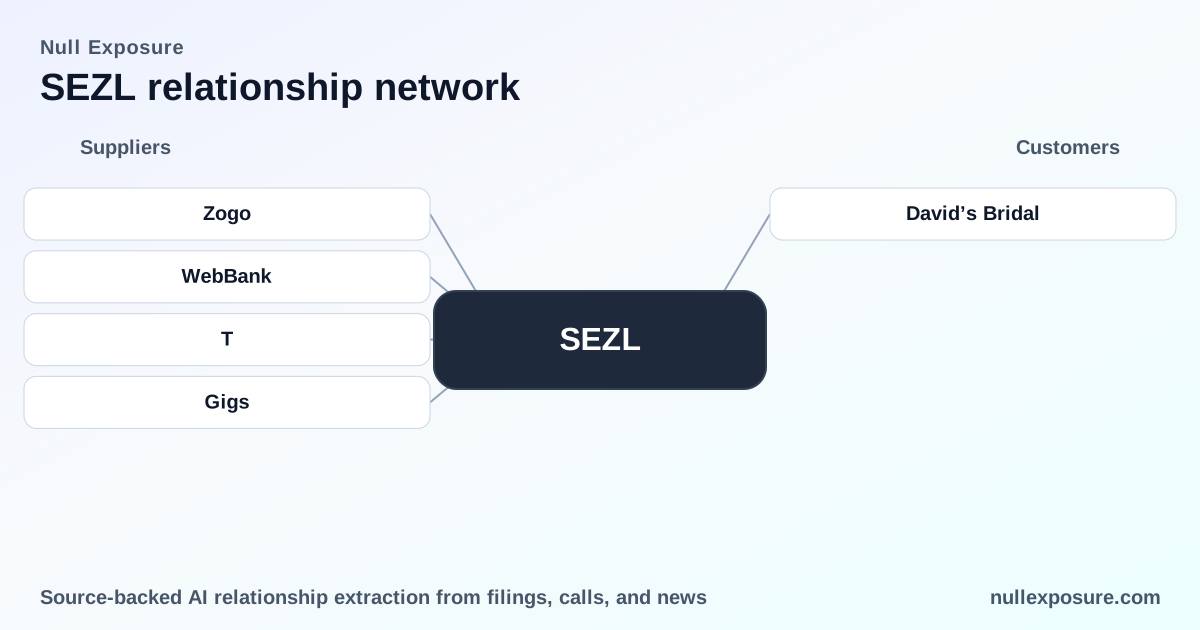
David’s Bridal — Sezzle partnered with David’s Bridal to promote wedding affordability, positioning Sezzle as a payments option for couples managing ceremony and wardrobe costs. Source: GlobeNewswire press release, February 17, 2026 — https://www.globenewswire.com/news-release/2026/02/17/3239452/0/en/Sezzle-and-David-s-Bridal-Bring-Love-in-Times-Square-to-Life-Championing-Love-and-Financial-Wellness.html.
-
JD Sports Canada — JD Sports Canada is among the initial Canadian retailers accepting Sezzle’s Virtual Card at launch, expanding Sezzle’s footprint into athletic and footwear retail in Canada. Source: Investing.com coverage of Sezzle Virtual Card launch, May 3, 2026 — https://www.investing.com/news/company-news/sezzle-launches-virtual-card-for-instore-payments-in-canada-93CH-4612682.
-
Mastermind Toys — Mastermind Toys is listed as a launch partner for the Canadian Virtual Card, giving Sezzle exposure to family and toy retail spending. Source: GlobeNewswire press release, April 14, 2026 — https://www.globenewswire.com/news-release/2026/04/14/3273320/0/en/sezzle-canada-launches-virtual-card-expanding-buy-now-pay-later-capabilities.html.
-
QE Home — QE Home, a home goods retailer, is included among the first merchants accepting the Virtual Card, adding higher-ticket home category transactions to Sezzle’s addressable in-store volume. Source: Investing.com and GlobeNewswire, May–April 2026 — https://www.investing.com/news/company-news/sezzle-launches-virtual-card-for-instore-payments-in-canada-93CH-4612682; https://www.globenewswire.com/news-release/2026/04/14/3273320/0/en/sezzle-canada-launches-virtual-card-expanding-buy-now-pay-later-capabilities.html.
-
SoftMoc — SoftMoc (footwear retailer) appears as a launch partner for the Virtual Card, helping Sezzle reach brick-and-mortar shoe buyers in Canada. Source: GlobeNewswire press release, April 14, 2026 — https://www.globenewswire.com/news-release/2026/04/14/3273320/0/en/sezzle-canada-launches-virtual-card-expanding-buy-now-pay-later-capabilities.html.
-
West Coast Kids — West Coast Kids is named among early Virtual Card acceptors, extending Sezzle into children’s apparel and gear retail. Source: Investing.com and GlobeNewswire, May–April 2026 — https://www.investing.com/news/company-news/sezzle-launches-virtual-card-for-instore-payments-in-canada-93CH-4612682; https://www.globenewswire.com/news-release/2026/04/14/3273320/0/en/sezzle-canada-launches-virtual-card-expanding-buy-now-pay-later-capabilities.html.
-
Quarks — Quarks is listed in the Virtual Card launch roster, indicating Sezzle’s efforts to recruit boutique and specialty retailers in Canada. Source: GlobeNewswire press release, April 14, 2026 — https://www.globenewswire.com/news-release/2026/04/14/3273320/0/en/sezzle-canada-launches-virtual-card-expanding-buy-now-pay-later-capabilities.html.
-
Kit & Ace — Kit & Ace appears among the launch merchants for the Canadian Virtual Card, providing access to premium apparel spend. Source: GlobeNewswire press release, April 14, 2026 — https://www.globenewswire.com/news-release/2026/04/14/3273320/0/en/sezzle-canada-launches-virtual-card-expanding-buy-now-pay-later-capabilities.html.
-
Popeye’s Supplements (Ontario) — Popeye’s Supplements is included in the initial Virtual Card acceptance list, diversifying Sezzle’s cross-category exposure into health and supplements. Source: GlobeNewswire press release, April 14, 2026 — https://www.globenewswire.com/news-release/2026/04/14/3273320/0/en/sezzle-canada-launches-virtual-card-expanding-buy-now-pay-later-capabilities.html.
-
Atlas Tools & Machinery — Atlas Tools & Machinery is cited as a launch partner, signaling Sezzle’s intent to serve higher-ticket and specialty hardware purchases via installment options. Source: GlobeNewswire press release, April 14, 2026 — https://www.globenewswire.com/news-release/2026/04/14/3273320/0/en/sezzle-canada-launches-virtual-card-expanding-buy-now-pay-later-capabilities.html.
-
CLÉMENT — CLÉMENT is named among Canadian merchants accepting the Virtual Card, broadening Sezzle’s retail vertical reach. Source: GlobeNewswire press release, April 14, 2026 — https://www.globenewswire.com/news-release/2026/04/14/3273320/0/en/sezzle-canada-launches-virtual-card-expanding-buy-now-pay-later-capabilities.html.
-
Hobbiesville — Hobbiesville is listed in the Virtual Card launch, adding specialty hobby retail to Sezzle’s in-store acceptance footprint. Source: GlobeNewswire press release, April 14, 2026 — https://www.globenewswire.com/news-release/2026/04/14/3273320/0/en/sezzle-canada-launches-virtual-card-expanding-buy-now-pay-later-capabilities.html.
Operational constraints and what they imply for investors
Sezzle’s public disclosures define several company-level operating constraints that shape revenue durability and partner economics:
-
Contracting posture: Sezzle operates both short-term pay-in-four products (merchant fees on quick installment flows) and long-term installment loans offered through third‑party lenders up to 60 months, creating a blended contract mix that balances quick fee recognition with longer-duration interest income.
-
Revenue sources and role: Sezzle acts primarily as a seller/processor to merchants and earns fees from merchant acceptance, while also monetizing consumers directly through subscription services (Sezzle Premium, Sezzle Anywhere).
-
Counterparty concentration and breadth: Merchant base spans SMBs to large enterprise merchants (enterprise defined as >$500M in gross sales), which reduces single-counterparty concentration risk while allowing Sezzle to target high-volume partnerships that materially move revenue.
-
Geography and lifecycle: The company is North America-focused (U.S. and Canada) and is explicitly winding down operations in India and several European markets, concentrating investment and risk in the NA corridor.
-
Product maturity: Launched in 2017, Sezzle’s platform is a mature payments product positioned to extend into in-store via virtual card capabilities and to capture cross-channel wallet share.
These constraints indicate a mixed-duration contract book, diversified merchant exposure, and a tactical geographic consolidation designed to sharpen profitability and operational focus.
Investment takeaways: risks and levers to watch
-
Upside: The virtual card rollout is a scalable lever to accelerate in-store GMV without requiring full POS integrations; if adoption across the listed merchants grows, merchant-fee revenue and subscription uptake should rise. Sezzle’s FY metrics show robust profitability that supports reinvestment into merchant acquisition.
-
Risks: Execution risk centers on merchant activation and consumer adoption in-store; regulatory focus on BNPL products and competition from incumbents also pressure unit economics. High insider ownership and stock volatility (beta elevated) are governance and market-risk signals to monitor.
-
Monitoring: Track merchant activation rates, in-store transaction volume trends, subscription growth, and any regulatory disclosures around installment lending partnerships.
For a deeper counterparty risk and revenue-concentration model tailored to Sezzle’s merchant list, visit https://nullexposure.com/ for analytical services and periodic updates.