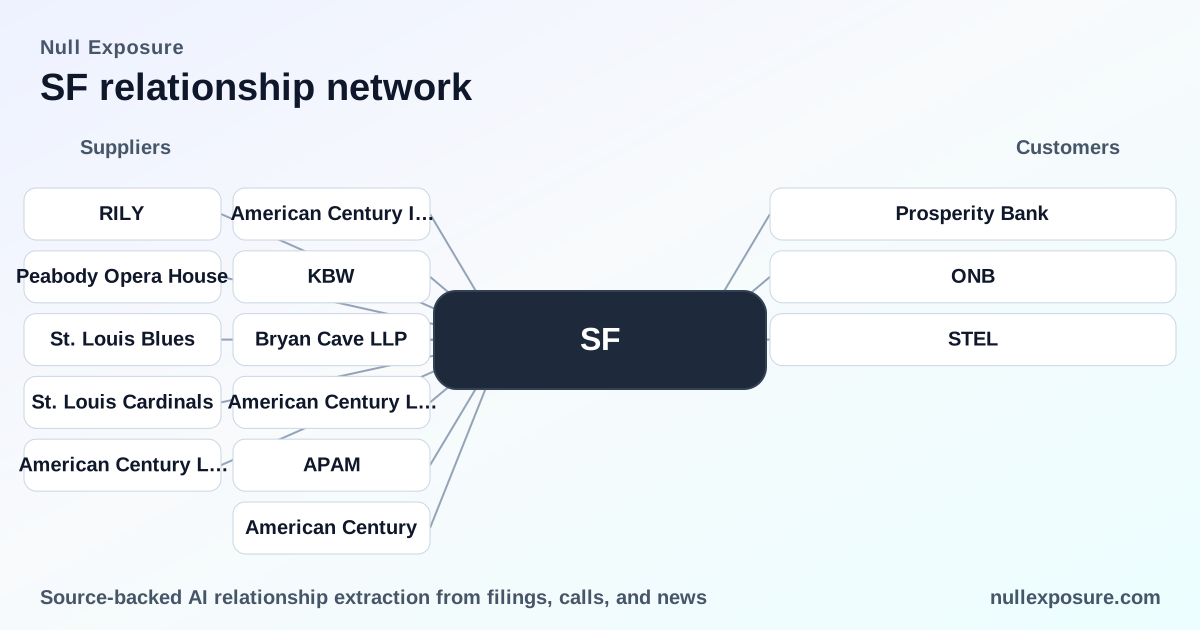
Stifel Financial (SF): Customer Relationships and What They Mean for Investors
Stifel Financial Corporation operates as a full‑service capital markets and wealth management franchise, monetizing through retail brokerage, investment banking, underwriting, trading, and advisory fees, plus banking revenue from its depository franchises. Investment banking and syndicate activity are the primary vectors by which Stifel converts client mandates into fee income; its broker‑dealer subsidiaries are repeatedly listed as underwriters, book‑runners, placement agents, or financial advisors across a wide spectrum of transactions. For a deeper view of client exposure and deal flow, visit https://nullexposure.com/.
Why the client roster matters to equity investors
Stifel’s customer relationships are transactional, repeatable, and geographically diversified. The firm operates with a service‑provider contracting posture—acting as advisor, underwriter or placement agent rather than taking long‑dated balance‑sheet exposure in most deals—which supports cash fee conversion but exposes revenue to underwriting pipelines and underwriting market cycles. No single client is material to revenues, and the client base spans individual investors, institutions, banks, municipalities and governments across North America and growing activity in Europe.
Constraints and company‑level signals that shape risk and opportunity
- Counterparty mix: Stifel serves governments and institutional clients alongside retail and individual investors, signaling diversified demand sources for underwriting and advisory services (company filings, FY2024–FY2026).
- Geographic concentration: The franchise is concentrated in North America with an expanding EMEA presence, which moderates single‑market risk but links performance to U.S./Canadian capital markets activity (company disclosure).
- Materiality: No single client accounts for a material percentage of Stifel’s business, supporting revenue resilience but leaving earnings dependent on aggregated deal flow (company filing).
- Role & segment: Stifel consistently functions as a service provider for securities offerings and M&A, and the company’s revenue mix sits within its services segment rather than product sales, which accentuates fee cyclicality.
If you want a structured extraction of these relationships for portfolio due diligence, see our platform: https://nullexposure.com/.
Deal‑by‑deal relationship log (selected client engagements)
- Prosperity Bank — Stifel represented Stellar in its sale to Prosperity Bank, disclosed on Stifel’s 2025 Q4 earnings call (March 7, 2026).
- Western Copper & Gold (WRN) — Stifel Canada led a syndicate as sole bookrunner for an offering; reporting in March 2026 highlighted Stifel’s lead role on the financing (InvestingNews / TipRanks, FY2026).
- CION Investment Corporation (CICB) — Keefe, Bruyette & Woods (a Stifel company) acted as joint book‑runner on an unsecured notes offering (FinancialContent press release, FY2024).
- Franklin Street Properties (FSP) — Stifel represented FSP in a $320M secured credit facility refinancing and strategic review (GlobeNewswire / press coverage, FY2026).
- Nkarta (NKTX) — Stifel entered a $100M at‑the‑market sales agreement as sales agent, earning up to 3% commission (The Globe and Mail, March 25, 2026).
- Bicara Therapeutics (BCAX) — Stifel, Nicolaus & Co. allocated equity in a prospectus filing showing Stifel as an underwriting participant (SEC filing summary, FY2026).
- Burke & Herbert (BHRB) — Keefe, Bruyette & Woods acted as exclusive financial advisor on the merger with LinkBancorp (CityBiz, FY2025).
- Financial Institutions, Inc. (FISI) — Keefe, Bruyette & Woods served as sole bookrunner for an underwritten offering (Quiver Quant, FY2024).
- Black Rock Coffee Bar (BRCB) — Stifel acted as an additional book‑running manager on the IPO and related filings (SEC and multiple press reports, FY2025).
- BillionToOne (BLLN) — Stifel served as book‑running manager alongside Wells Fargo and BTIG on IPO activity (GlobeNewswire / multiple FY2025 press releases).
- PepGen (PEPG) — Leerink and Stifel named joint book‑running managers on a proposed offering (BioSpace, FY2025).
- Bridger Aerospace (BAER) — Stifel served as sole debt placement agent and financial advisor on a $331M transaction (Yahoo Finance coverage, FY2025).
- Bowhead Specialty Holdings (BOW) — Keefe, Bruyette & Woods and Stifel were joint book‑running managers for a notes offering (AI Journ, FY2025).
- Target Hospitality (TH) — Stifel acted as co‑manager on a secondary offering (Investing.com, FY2026).
- Cardinal Infrastructure (CDNL) — Stifel and William Blair acted as joint book‑running managers for the IPO (PR Newswire / Investing.com, FY2025).
- ConnectOne Bancorp (CNOB) — Keefe, Bruyette & Woods served as financial advisor on an acquisition (NJB Magazine, FY2020–FY2025 filings).
- Equitable Holdings (EQH) — Management cited gains from a February sale to Equitable in Stifel commentary (St. Louis Business Journal, FY2026).
- CrossFirst Bankshares (CFB) — Keefe, Bruyette & Woods acted as financial advisor on an acquisition (CityBiz, FY2022).
- First Foundation / FFWM — Keefe, Bruyette & Woods provided a fairness opinion and acted as lead advisor in the First Foundation transaction (ConnectMoney, FY2025).
- Tornado Infrastructure (TTC) — Stifel Nicolaus Canada provided a fairness opinion to a special committee on a plan of arrangement (DelmarvaNow, FY2026).
- Casella Waste (CWST) — Stifel acted as a co‑manager on a public offering (GlobeNewswire, FY2020).
- GH Research (GHRS) — Stifel listed as a joint book‑running manager and prospectus distributor in SEC and press materials (GlobeNewswire / StreetInsider, FY2025–FY2026).
- Ambiq (AMBQ) — Needham and Stifel acted as joint book‑running managers on an IPO upsizing (GlobeNewswire, FY2025–FY2026).
- Trevi Therapeutics (TRVI) — Stifel is listed among the underwriting group in prospectus materials (GlobeNewswire / Marketbeat, FY2026).
- Apogee Therapeutics (APGE) — Jefferies, TD Cowen, Stifel and Guggenheim were joint book‑runners (Investing.com, FY2026).
- James River Group (JRVR) — Keefe, Bruyette & Woods acted as an IPO underwriter historically and is cited in IPO coverage (MarketBeat, historical FY2014 notes cited in FY2026 content).
- x4 Pharmaceuticals (XFOR) — Leerink, Stifel and Guggenheim named joint book‑running managers for a proposed offering (MarketScreener, FY2025).
- Ardmore Shipping (ASC) — Stifel named as broker in Form 144 filings and associated SEC notices (SEC filings, FY2026).
- Corbus Pharmaceuticals (CRBP) — Stifel Nicolaus named as broker‑dealer in Form 144 filing (StockTitan SEC filing summary, FY2026).
- Vor Bio / VOR — Stifel acted as sole placement agent on a PIPE and as underwriter for ATM activity, cited in company press releases (GlobeNewswire, FY2024–FY2026).
- HeartFlow (HTFL) — Stifel acted as a co‑manager on an upsized IPO (GlobeNewswire, FY2025).
- American Integrity (AII) — Keefe, Bruyette & Woods staff advised on AII’s IP0 and follow‑ons, and the firm’s bankers moved into AII (Investing.com reporting, FY2025–FY2026).
- Medline (MDLN) — Stifel is listed among numerous co‑managers and co‑managers on the offering (GlobeNewswire, FY2025).
- U.S. GoldMining (USGO) — Stifel was added as a co‑agent on an ATM offering, per Globe and Mail press materials (FY2025–FY2026).
- Solarius Capital / SOCAU — Stifel acted as representative of the underwriters on an IPO (SpacInsider, FY2025).
- Vine Hill Capital (VCIC) — Stifel, Nicolaus & Co. acted as sole book‑running manager for an offering (StockTitan, FY2024).
- DarioHealth (DRIO) — Stifel acted as financial advisor on an acquisition and financing (PR Newswire, FY2024).
- Abeona Therapeutics (ABEO) — Stifel served as lead financial advisor on a voucher sale transaction (QuiverQuant, FY2025).
- IsoEnergy (ISOU) — Stifel Nicolaus Canada served as sole bookrunner on a bought‑deal offering (Yahoo Finance / press, FY2026).
- Numerous additional engagements (ASC, BLLN, CDNL, BRCB, AMTB, FDUS, MYFW, TVAI, CORT, PTLO, CNTY, CNOB, RILYK, LXEO, IMUX, and others) — appear in regulatory filings and press releases as underwriters, book‑running managers, placement agents or financial advisors, reflecting Stifel’s broad underwriting footprint across sectors and time periods (SEC filings, GlobeNewswire, Investing.com, March 2024–May 2026 press coverage).
(Note: the above list consolidates individual press items and SEC notices that consistently show Stifel or a Stifel affiliate named as underwriter, book‑runner, placement agent, or financial advisor across these issuers; specific documents include company press releases, SEC prospectuses, and Stifel earnings commentary dated FY2024–FY2026.)
What investors should take away
- Scale and breadth: Stifel earns recurring fees from a broad roster of issuers across healthcare, industrials, financials and mining—this supports diversified underwriting revenue.
- Cyclicality risk: Underwriting and advisory fees are sensitive to capital markets cycles; Stifel’s business model converts mandates into near‑term fee revenue but is exposed when issuance stalls.
- Low client concentration: No single client is material, lowering idiosyncratic counterparty risk while increasing reliance on aggregate deal flow.
- Operational posture: Stifel acts overwhelmingly as a service provider rather than a principal risk taker, which preserves capital usage but ties profitability to transaction volumes and spreads.
For a structured data view and to model revenue sensitivity to underwriting volumes, explore our investor tools at https://nullexposure.com/.
Bottom line: Stifel’s customer relationships confirm a transactional, fee‑driven franchise with diversified client sources and geographic reach—attributes that support steady fee generation in healthy markets and expose earnings to issuance cycles when capital markets slow.