Stifel Financial (SFB): Customer relationships and recent counterparty moves that matter to investors
Thesis: Stifel Financial operates as a full-service investment firm that monetizes through advisory and brokerage fees, institutional sales & trading, investment banking fees, and wholesale/retail banking deposits; recent activity around its independent-advisor channel and external interest from peers introduces near-term strategic rebalancing that affects revenue mix and distribution economics. For a concise product that maps these dynamics, see https://nullexposure.com/.
How Stifel makes money and who it serves
Stifel’s operating model is diversified across private client services, institutional sales and trading, investment banking, and retail/commercial banking. Revenue flows principally from fee-based asset management, transaction-based brokerage, underwriting and advisory fees, and net interest margin from deposits and loans. The company bills advisory fees either in advance or periodically as a function of assets under management and contractual rates, giving the firm a hybrid of recurring and transaction-driven revenue.
- Customer mix is broad: individuals, corporations, municipalities and institutions across North America and a growing presence in Europe (EMEA). This diversity supports stable fee pools but also means Stifel competes in both margin-sensitive retail channels and scale-driven institutional markets.
- Funding posture is balanced: deposits are emphasized as a stable, low-cost funding source, which increases the bank-like aspects of Stifel’s balance sheet and affects capital allocation decisions for underwriting and recruiting.
If you want a summary product that tracks these counterparty relationships for investment diligence, visit https://nullexposure.com/.
Recent headlines and counterparties you must track
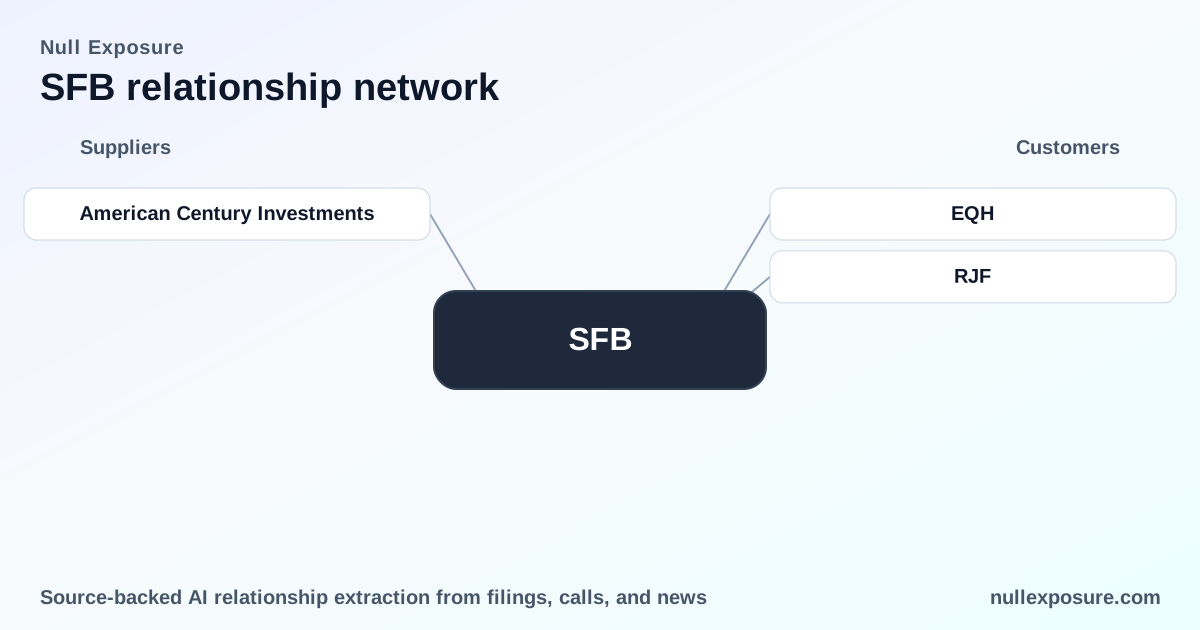
The public record shows concentrated news activity around Equitable and some market chatter about Raymond James; below are every relationship entry captured in the source set, with short, source-linked summaries.
EQH — FY2026
Stifel agreed to sell its small independent brokerage unit to Equitable Advisors, consistent with the CEO’s long-stated preference to deprioritize lower-margin independent channels. Source: AdvisorHub article, March 10, 2026 (https://www.advisorhub.com/stifel-ceo-floats-increasing-recruiting-budget-for-broker-hiring-push/).
Equitable Advisors — FY2026
Equitable Advisors is the announced buyer for the small independent-unit sale, which repositions Stifel away from less-profitable independent brokerage relationships and into a higher-focus recruiting strategy. Source: AdvisorHub, March 10, 2026 (https://www.advisorhub.com/stifel-ceo-floats-increasing-recruiting-budget-for-broker-hiring-push/).
EQH — FY2025
Management framed the spin-off/sale of its independent channel as part of a strategic restructuring that generated market rumors about potential transactions. Source: AdvisorHub, March 10, 2026 (https://www.advisorhub.com/stifel-ceo-toys-with-sale-rumor-mongers/).
Equitable Advisors — FY2025
Market coverage noted that the deal to move the independent channel to Equitable Advisors was announced prior to management’s public commentary about strategy, reinforcing that the choice was an explicit, executed corporate action. Source: AdvisorHub, March 10, 2026 (https://www.advisorhub.com/stifel-ceo-toys-with-sale-rumor-mongers/).
Equitable Holdings Inc. — FY2025
Industry press reported Equitable Holdings Inc.’s formal agreement to acquire Stifel Independent Advisors LLC, which includes both broker/dealer and RIA components, consolidating distribution under Equitable’s platform. Source: PlanAdviser, March 10, 2026 (https://www.planadviser.com/equitable-to-acquire-stifel-independent-advisors/).
EQH — FY2025 (duplicate/proxy mention)
The PlanAdviser and AdvisorHub entries cross-referenced Equitable (EQH) multiple times across FY2025–FY2026 as the counterparty for the independent-advisor business sale, underscoring that Equitable is the strategic buyer in successive reports. Source: PlanAdviser, March 10, 2026 (https://www.planadviser.com/equitable-to-acquire-stifel-independent-advisors/).
Raymond James — FY2025
Trade-press speculation suggested that regional rival Raymond James had shown interest in Stifel, prompting internal management communications. Source: AdvisorHub, March 10, 2026 (https://www.advisorhub.com/stifel-ceo-toys-with-sale-rumor-mongers/).
RJF — FY2025
Stifel’s CEO sent an internal memo telling employees the firm was not for sale after coverage raised rumors about a potential Raymond James approach, indicating active rumor control and defensive communications. Source: AdvisorHub, March 10, 2026 (https://www.advisorhub.com/stifel-ceo-toys-with-sale-rumor-mongers/).
What the relationships and filings imply for contracting posture and risk
The company-level signals in Stifel’s disclosures and the transaction coverage drive a clear set of operating-model conclusions for investors and operators:
- Contracting posture: Fee arrangements include subscription-like advisory components where fees are calculated based on asset values and applied either in advance or periodically. That structure produces recurring revenue that scales with AUM but also requires retention-focused client servicing.
- Concentration and counterparty diversity: Stifel serves individuals, governments, institutions and large enterprises across North America and Europe, which reduces single-counterparty revenue concentration — the company explicitly discloses no individual client accounted for more than 10% of revenue in recent years.
- Criticality of certain funding sources: Despite client-level immateriality, deposits have become a critical funding source, which elevates the importance of retail and commercial banking customers to liquidity and capital management.
- Relationship roles and segments: Stifel operates both as a service provider (brokerage, advisory, investment banking) and as a buyer in certain markets, reflecting a franchise that is part client-facing advisor and part institutional intermediary. The business sits in mature services segments with both recurring fee characteristics and lumpy investment-banking revenue.
- Geographic maturity and expansion: Primary strength remains North America, with an expanding footprint in Europe (EMEA). That geographic mix creates both diversification and regulatory complexity.
Investment implications and risks
- Operational leverage to distribution decisions: The sale of the independent-advisor channel to Equitable shifts Stifel’s distribution economics; the firm will lose some lower-margin transaction volume but improves average fee mix and capital allocation towards recruiting higher-producing brokers. This trade-off should show up in margin expansion versus absolute revenue from retail channels.
- Reputation and rumor management: Public speculation about Raymond James highlights sensitivity to M&A rumors; management’s quick internal memo is a sign that leadership controls the narrative to avoid talent flight or market disruption.
- Funding sensitivity: Given the elevated role of deposits, monitoring deposit trends and net interest income is essential; deposit attrition or cost increases would materially affect funding stability and capital deployment.
Bottom line
Stifel is actively reshaping its distribution and client mix by divesting lower-margin independent brokerage assets to Equitable, while defending franchise stability against acquisition rumors involving peers like Raymond James. For investors, the critical vectors are distribution economics, deposit stability, and management’s ability to redeploy freed capital into higher-return recruiting and advisory initiatives.
For a merchant-grade mapping of these counterparty relationships and the upstream signals that matter to credit and equity investors, see https://nullexposure.com/.