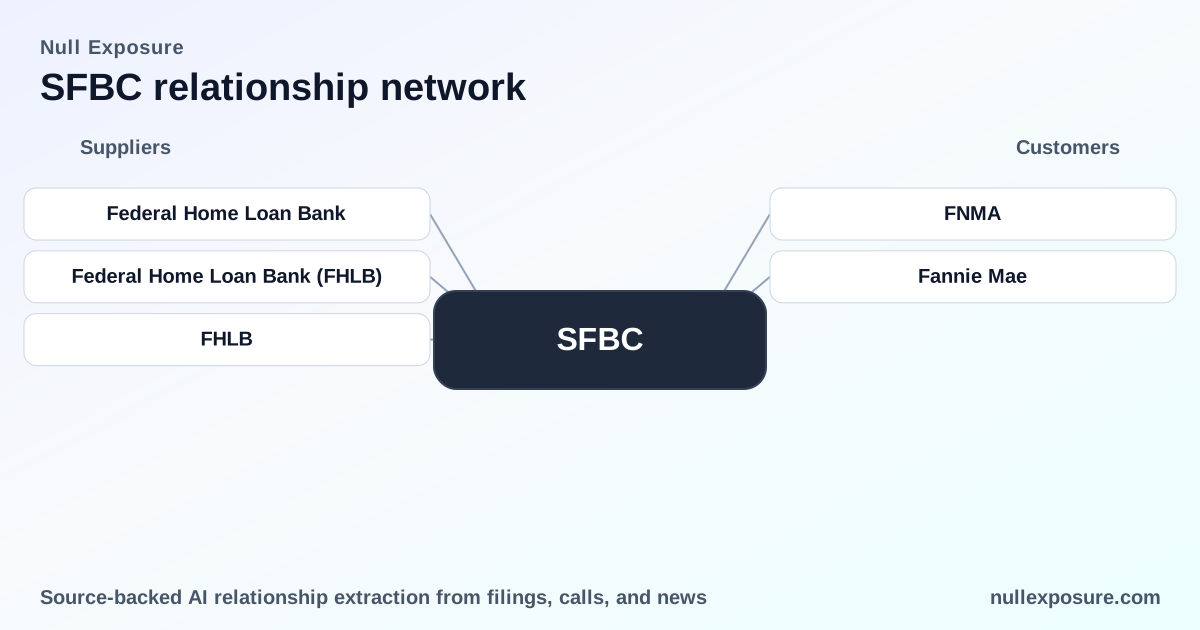
Sound Financial Bancorp (SFBC): Counterparty map and commercial dynamics investors need to know
Sound Financial Bancorp runs a traditional regional banking franchise centered in the Puget Sound region, monetizing through net interest margin on originated and acquired loans, fee income from deposit and card services, and gain-on-sale income from residential mortgage loans sold into the secondary market while often retaining servicing rights. For investors, the key commercial reality is a small-cap bank with a regional footprint that combines long-duration mortgage assets and shorter-duration deposit liabilities, with material secondary-market partnerships that drive noninterest revenue and servicing economics. Learn more at https://nullexposure.com/.
How the bank actually makes money — a concise commercial take
Sound Community Bank, the operating subsidiary, generates revenue through three primary channels: (1) interest income on a loan portfolio concentrated in one- to four-family residential mortgages, commercial real estate and construction loans; (2) noninterest income including service charges, insurance sales, and gains on loan sales; and (3) servicing economics from mortgage servicing rights (MSRs) when loans are sold but servicing is retained.
- The firm funds lending with a mix of retail and commercial deposits that include significant short-term certificates of deposit as well as noninterest-bearing accounts — a structural mismatch that requires active asset-liability management.
- The sale of conforming residential loans into the secondary market provides both immediate gain-on-sale revenue and recurring servicing fees when SFBC retains MSRs.
Key operating trade-off: the mix of short-term deposit funding and long-term fixed-rate mortgage assets creates sensitivity to rate movements and liquidity cycles while the sale/servicing model ties a portion of fee revenue to secondary market relationships.
The commercial counterparties that drive revenue and why they matter
Below I cover every counterparty relationship flagged in public materials for investors evaluating SFBC’s customer-facing partnerships.
Fannie Mae — the central secondary-market partner
Sound Community Bank is an approved Fannie Mae lender and seller/servicer and operates a Loan Production Office in the Madison Park neighborhood of Seattle, which it uses to originate conforming residential mortgages it sells into the secondary market while often retaining servicing. According to multiple company press releases (GlobeNewswire, Q4 2025 results released Jan 27, 2026; Q1 2026 results released Apr 28, 2026) and related coverage (The Globe and Mail, May 3, 2026), the bank explicitly identifies Fannie Mae as a buyer for its conforming loans. Importantly, the company states that sales of residential mortgage loans to Fannie Mae contribute significantly to noninterest income, making this relationship material to SFBC’s revenue mix (company disclosures, FY2025–FY2026).
Sources: GlobeNewswire Q1 2026 press release (April 28, 2026); GlobeNewswire Q4 2025 (Jan 27, 2026); GlobeNewswire Q3 2025 (Oct 28, 2025); The Globe and Mail (May 3, 2026).
Mastercard — a card-volume incentive relationship that affects fee income
Mastercard shows up as a revenue driver through volume-based incentives tied to card processing and merchant activity; the company’s Q1 2026 press release notes a $60,000 decrease in service charges and fee income attributable to the timing of the annual volume incentive paid by Mastercard between 2025 and 2026. That timing moved a noninterest income item and demonstrates the sensitivity of quarterly fee revenue to card partner payment schedules.
Source: GlobeNewswire Q1 2026 press release (April 28, 2026).
Operational constraints and what they say about concentrations and risk
The public disclosures and extracted constraints form a coherent portrait of how SFBC contracts and where its commercial pressures lie:
- Contracting posture: SFBC operates with a mix of short-term liabilities (certificates of deposit maturing within one year and demand deposits) and long-term loan assets (fixed-rate mortgages with maturities up to 30 years). This mismatch demands active asset-liability management and exposes the bank to repricing and liquidity risk on rollovers.
- Counterparty mix: The bank serves individuals, small businesses, mid-market clients and public funds (it is a public funds depository), which diversifies revenue sources across retail deposits, commercial lending and municipal balances.
- Geographic concentration: Substantially all lending and operations are domestic and largely concentrated in Washington state, with primary activity in the Seattle MSA and exposure to Puget Sound and eastern Washington regional economic trends — a regional concentration that amplifies local macro risk.
- Materiality and concentration: The company reports total assets under $1 billion and notes that the sale of residential loans to Fannie Mae is a meaningful contributor to noninterest income, a direct indicator that the Fannie Mae relationship is strategically significant for fee-generation. The five largest lending relationships aggregate roughly $83.4 million (about 9.3% of the loan portfolio at year-end 2024), with the single largest relationship at $19.4 million — meaningful single-counterparty exposure in a sub-$1B balance sheet.
- Relationship roles and maturity: SFBC acts as both seller (loan originator selling conforming mortgages) and service provider (retaining mortgage servicing rights), generating both one-time gains and recurring servicing fees. Several disclosures indicate these are active and established parts of the bank’s model.
These constraints are company-level signals except where an excerpt explicitly names a counterparty (for example, the material contribution from loans sold to Fannie Mae).
Investment implications — risk-adjusted takeaways
Sound Financial Bancorp presents a classic small regional-bank profile: modest market cap (~$98.5M), a trailing P/E of 14.12, a price-to-book below one (0.886), ROE of 7.04%, and a modest dividend yield of 1.88%. The commercial picture implies the following:
- Upside drivers: continued robust mortgage origination and sale activity to Fannie Mae will sustain noninterest income and servicing economics; stable retail deposit gathering in Seattle supports loan growth.
- Risks: local economic shocks in the Puget Sound region, deposit roll-off from short-maturity CDs, or adverse movements in mortgage spreads and MSR valuations would pressure earnings. Card incentive timing (Mastercard) creates small but tangible quarter-to-quarter volatility in fee income.
Bottom line: SFBC’s revenue is tightly linked to its ability to originate conforming mortgages for sale and to extract servicing economics, with Fannie Mae as the central counterparty underpinning those sales and recurring fee streams.
Where to go next
For comparative diligence, benchmark SFBC’s loan-sale and servicing revenue against regional peers and track quarter-to-quarter timing of partner incentives (Mastercard) to separate structural trends from one-off timing effects. For a focused view of counterparties and contract signals, visit NullExposure’s analysis hub at https://nullexposure.com/.
If you want a tailored counterparty risk dossier for a regional bank or an investor note that maps material buyers and fee drivers, NullExposure can prepare a concise relationship-level brief.