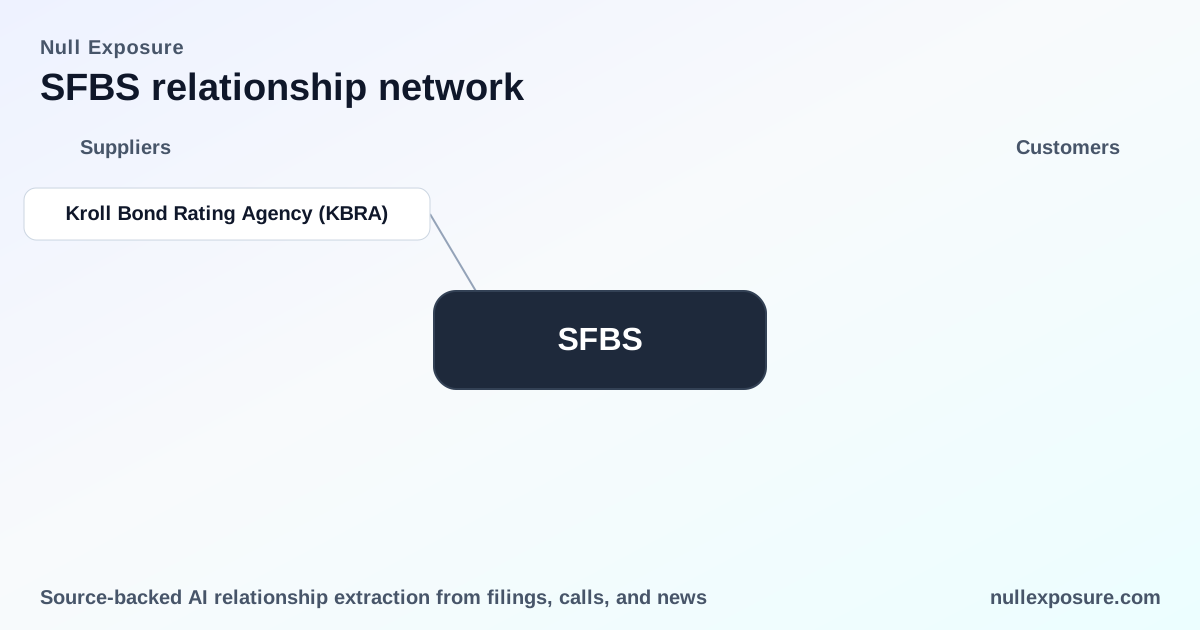
ServisFirst Bancshares (SFBS): Customer relationships, credit posture, and what EQBK amendments signal to investors
ServisFirst Bancshares operates as the holding company for ServisFirst Bank and monetizes primarily by originating loans, taking deposits, and collecting fees from a regional mix of individual and commercial customers. The bank’s income mix is dominated by interest on lending and service charges, and its customer relationships are a combination of long-term commercial lending and short-term deposit and trade facilities that require active credit management. For a structured investor read on how customer signals — including recent loan amendments — inform credit concentration and operational risk, see Null Exposure’s customer intelligence hub: https://nullexposure.com/.
Why customer relationships drive the investment thesis
ServisFirst is a classic regional commercial bank: the balance sheet and income statement reflect a lender that targets mid-market and affluent individual customers, and it delivers services that generate fee income and deposit funding. Key operating characteristics from company filings translate directly into investor-relevant constraints:
- Contracting posture: Evidence shows a mix of long-term loan exposure alongside material short-term commitments. Filings list a total loans figure (excerpted as $12,605,836) and disclose that construction and development loans typically carry 12–36 month terms; letters of credit and large portions of liabilities are short-dated or payable on demand. This combination enforces an active funding-and-liquidity management posture from management.
- Counterparty concentration and profile: The bank targets privately held companies with $2M–$250M in sales, small-to-mid-sized businesses, and affluent individuals — a portfolio tilt that produces higher margin loans but greater idiosyncratic credit risk versus national lenders.
- Geographic focus: ServisFirst operates principally across the Southeastern U.S. (Alabama, Florida, Georgia, the Carolinas, Tennessee and Virginia), creating regional economic sensitivity to housing and commercial real estate cycles.
- Materiality & maturity: Management states its largest loan relationships represent a significant share of total loans, and the bank emphasizes long-term customer relationships and organic growth, indicating a mature, relationship-driven book rather than transactional or highly diversified wholesale exposures.
- Role and revenue model: The company functions primarily as a service provider and seller of lending/deposit services, deriving most revenue from traditional banking activities rather than non-interest income diversification.
These signals together define a bank that generates attractive margins through relationship lending while requiring vigilant credit and deposit-liquidity oversight.
What the public relationship records show — every item in the data
Below are each of the relationship results in the provided records; each entry is a concise, plain-English note about the interaction between ServisFirst and the counterparty, with source context.
Equity Bancshares (EQBK) — Marketscreener notice, FY2025 (first seen Mar 9, 2026)
ServisFirst Bank was the counterparty to a Ninth Amendment to a Loan and Security Agreement with Equity Bancshares, indicating an active, structured loan amendment process and continuing credit support. This was reported in a Marketscreener item that referenced the February 17 amendment. (MarketScreener, March 9, 2026)
Equity Bancshares (EQBK) — Marketscreener earnings flash, FY2026 (first seen May 2, 2026)
Marketscreener’s earnings flash reiterated that Equity Bancshares entered into the Ninth Amendment with ServisFirst Bank, reflecting the same amended-credit relationship contemporaneous with EQBK’s FY2026 reporting cadence and suggesting the amendment was material to public disclosures. (MarketScreener earnings flash, May 2, 2026)
Equity Bancshares (EQBK) — Marketscreener news on Q3 FY2025 results (first seen Mar 9, 2026)
A Marketscreener Q3 FY2025 report again noted the Ninth Amendment between Equity Bancshares and ServisFirst Bank, underscoring that multiple investor-facing communications referenced the amendment as part of EQBK’s financial narrative. (MarketScreener Q3 FY2025 report, March 9, 2026)
Equity Bancshares (EQBK) — Marketscreener Q3 earnings snapshot, FY2025 (first seen Mar 9, 2026)
An earnings snapshot for EQBK cited the same amendment with ServisFirst Bank, consolidating the signal that this lending relationship required repeated investor disclosure across EQBK’s FY2025 materials. (MarketScreener earnings snapshot, March 9, 2026)
What these EQBK entries imply for SFBS stakeholders
All four records reference the same credit amendment event between ServisFirst and Equity Bancshares; the repetition across investor communications signals that the amendment is a noteworthy credit action for the borrower and, by extension, relevant to ServisFirst’s loan-management process. From an investor perspective:
- Active credit management: Multiple amendment disclosures mean ServisFirst is actively monitoring and renegotiating loan terms with at least some large counterparties. That is consistent with a matured relationship-lending model where the bank manages covenant resets, maturities, or collateral terms instead of forcing quick resolutions.
- Potential concentration sensitivity: Because management acknowledges its largest loans form a meaningful share of the portfolio, amendments to sizable relationships can have outsized P&L and capital implications if borrower performance changes.
- Public visibility: The loan amendment was material enough to be included in public filings and earnings commentary by the borrower, making it an observable credit event for market investors rather than a private workout.
For deeper signal mapping on customer disclosures and aggregated counterparty risk, see our suite of relationship intelligence at https://nullexposure.com/.
Operational constraints to monitor as an investor
Investors should track these company-level constraints from filings and customer descriptions as ongoing risk levers:
- Contract mix: Long-term loan stock exists alongside short-term construction and demand-funded liabilities, requiring active liquidity buffers.
- Customer mix: Heavy tilt toward mid-market and small businesses and individual customers, increasing credit idiosyncrasy risk.
- Geography: Southeastern U.S. concentration raises correlation risk with regional CRE and economic cycles.
- Materiality: A non-trivial fraction of loans sits with large relationships that can move portfolio credit metrics materially.
- Business model: Revenue is loan- and deposit-driven, and the bank operates as a service-oriented lender rather than a diversified financial conglomerate.
Bottom line: positioning SFBS in a risk/reward framework
ServisFirst delivers a highly legible regional banking franchise: it earns from loans and deposit spreads, targets mid-market relationships for higher yield, and demonstrates disciplined relationship management as evidenced by multiple credit amendments recorded in market communications. Key positives include strong profitability metrics (noted ROE and profit margins in filings) and a focused deposit base; key risks are concentration in big loans, regional exposure, and the operational requirement to manage short-term funding and construction-cycle lending.
For investors and operators evaluating counterparty credit or portfolio exposure, the EQBK amendments are a concrete example of ServisFirst’s active loan-management posture and the materiality of certain borrower relationships. To monitor evolving customer disclosures and get structured relationship intelligence for underwriting and portfolio oversight, visit Null Exposure’s research portal: https://nullexposure.com/.