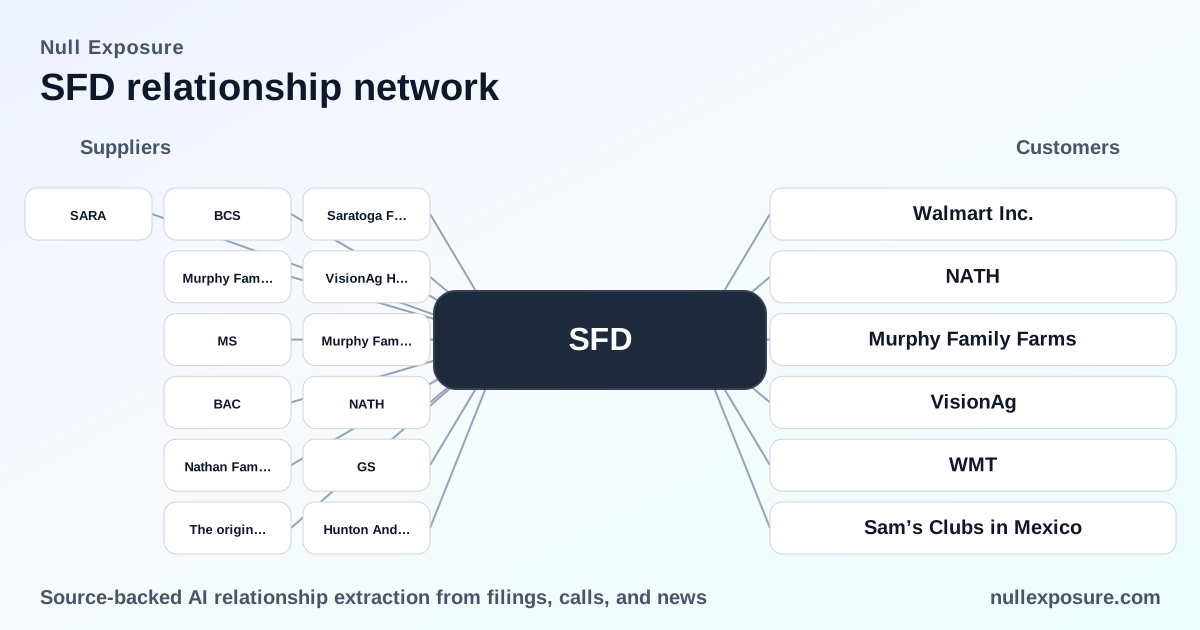
Smithfield Foods (SFD): Customer Map, Concentration Risks and Commercial Leverage
Smithfield Foods sells branded and private-label packaged meats and fresh pork through large retail and foodservice channels, monetizing via manufacturing, distribution and long-standing licensing relationships. The company generates the bulk of its revenue from a concentrated set of large grocery and club customers, while also owning and licensing consumer brands that augment margins and provide strategic shelf presence. For analysts and operators evaluating counterparty exposure, the commercial picture is defined by a small number of high-volume buyers, short-term commercial contracts, and a mix of domestic retail concentration with meaningful export activity. For more relationship intelligence, visit https://nullexposure.com/.
High-level investment thesis: scale, brands and concentrated buyers
Smithfield is a scale manufacturer with integrated production and branded product capabilities; it leverages branded licenses (now including Nathan’s Famous) and large retail distribution to drive volume and incremental margin. Scale gives pricing and operating leverage, but revenue concentration—Walmart alone accounting for double-digit percent of sales—creates tangible counterparty risk that investors must price.
How Smithfield contracts and where the risk concentrates
Smithfield typically operates without long-term take-or-pay sales agreements, which means commercial relationships are largely short-term and transactional; that contracting posture amplifies the bargaining power of large grocery customers. The company sells primarily in North America but exports to over 30 countries, so its commercial footprint is both regionally concentrated (U.S. retail) and globally exposed. Smithfield’s ten largest customers represented roughly 38% of net sales in FY2024, underscoring material concentration risk that can affect near-term cash flows if major customers re-contract or shift sourcing.
- Contract type: short-term, no long-term sales assurances disclosed in filings.
- Counterparty profile: large enterprise buyers with sophisticated sourcing capabilities and pricing leverage.
- Geography: majority U.S. retail sales, with 13% of FY2024 sales from exports to markets including China, Mexico and Canada.
- Relationship stage and criticality: active and in many cases mature, with decades-long retail relationships for certain customers (Walmart explicitly named).
Customer relationships: one-by-one commercial snapshots
Below are every customer relationship referenced in public records and press coverage across FY2024–FY2026, summarized with source context.
-
Walmart Inc. — Walmart has been Smithfield’s largest customer and accounted for approximately 13% of consolidated sales in FY2024, reflecting a multiyear, high-volume buyer relationship that is material to results. According to Smithfield’s FY2024 Form 10‑K filing, Walmart accounted for roughly 13%, 12% and 12% of consolidated sales in fiscal years 2024–2022. (Smithfield FY2024 10‑K; filed Dec 29, 2024)
-
Kroger — Kroger is a national retail channel partner for Smithfield branded launches and seasonal SKUs; recent product rollouts (e.g., Meal Ready Cuts, bratwursts) list Kroger among major national retailers carrying new items. (Company press release and Business Insider coverage, April–May 2026)
-
Albertsons — Albertsons is cited as a national retailer carrying Smithfield’s new Meal Ready Cuts, positioning the grocer as part of Smithfield’s broad retail distribution for new product initiatives. (Business Insider/GlobeNewswire press release, May 2026)
-
Meijer — Meijer is included among the large regional retailers stocking Smithfield’s Meal Ready Cuts nationwide, reflecting distribution into the Midwest mass channel. (Business Insider/GlobeNewswire press release, May 2026)
-
Publix — Publix is referenced as a national outlet for Smithfield’s new bratwurst SKUs, indicating penetration into Southeastern grocery chains for seasonal and branded items. (GlobeNewswire press release, April 2026)
-
Sam’s Clubs in Mexico / Sam’s Club — Smithfield has held distribution rights for Nathan’s products into Sam’s Club stores in Mexico since 2014; that channel has been an explicit geographic licensing territory tied to Nathan’s branded product distribution. (Multiple news reports and company statements, Jan–Mar 2026)
-
Nathan’s Famous (NATH) — Smithfield has manufactured, marketed and distributed Nathan’s Famous retail and foodservice products in the U.S., Canada and Sam’s Clubs in Mexico under an exclusive license since March 2014, and in FY2026 moved to acquire Nathan’s outright in an all-cash transaction priced at $102 per share (~$450 million). That acquisition converts a long-standing licensing partnership into full ownership, consolidating a brand manufacturing relationship into Smithfield’s balance sheet. (Smithfield press release and acquisition coverage; GlobeNewswire, AP News, Food Dive and other outlets, Jan–Mar 2026)
-
Murphy Family Farms — Smithfield disclosed asset sales and gains related to Murphy Family Farms (a buyer of breeding stock and farm assets), indicating transactional farm-level sales and strategic disposals rather than core retail revenue. Smithfield reported a $6 million gain on sale of assets to Murphy Family Farms and referenced prior farm sales in FY2024. (GlobeNewswire earnings release on FY2025 results, Oct 2025 and Mar 2026)
-
VisionAg — VisionAg is referenced in Smithfield’s FY2025 outlook wording where the company excludes Hog Production sales to recently formed Murphy Family Farms and VisionAg for comparability, signaling recent portfolio shifts in hog production and related intercompany or near-market sales. (GlobeNewswire earnings release, Oct 2025)
-
Other retailer mentions in litigation context (Kroger-related advertising claim) — Reporting on legal claims against Kroger referenced Smithfield as one of the large meat suppliers noted in the complaint, underscoring reputational and labeling risk that can flow through retailer-supplier relationships. (LegalReader coverage of Kroger litigation, 2026)
Each of these relationships combines to form a commercial footprint where a handful of large retailers account for outsized volume and where long-term brand agreements (now an acquisition) sit alongside short-term sales contracts.
What this means for valuation and downside risk
- Revenue concentration is a primary valuation risk: with the top ten customers generating ~38% of revenue and Walmart alone ~13%, any meaningful shift in buying patterns or private-label switching will compress volumes and margins quickly. (Smithfield FY2024 10‑K)
- Contracting posture reduces revenue visibility: Smithfield’s public filing discloses it generally does not maintain long-term sales agreements with customers, which increases the sensitivity of near-term cash flows to retailer negotiations.
- Brand ownership is a strategic hedge: converting a long-term license into ownership of Nathan’s Famous reduces supplier dependency for that brand line and should improve margins and shelf strategy over time, but it also raises acquisition integration execution risk. (Press coverage and company transaction announcements, Jan–Mar 2026)
- Geographic mix moderates risk: domestic U.S. retail is dominant, but export exposure to 30+ countries provides diversification across demand cycles.
Bottom line and action points for investors
Smithfield’s operating model blends scale manufacturing with retail channel concentration and growing brand ownership. Investors should value Smithfield for stable cash generation and margin potential from brand integration, while discounting for counterparty concentration and short-term contract risk. For portfolio managers and procurement officers tracking counterparty exposure, the practical priorities are customer retention metrics with Walmart/Kroger/Albertsons and successful integration of Nathan’s Famous.
If you want a structured, machine-readable map of these counterparty relationships and constraint signals for SFD, explore more on NullExposure — https://nullexposure.com/.
Key takeaway: Smithfield is scale plus brands, but revenue concentration and short-term contracting make counterparty risk the central driver of near-term downside.