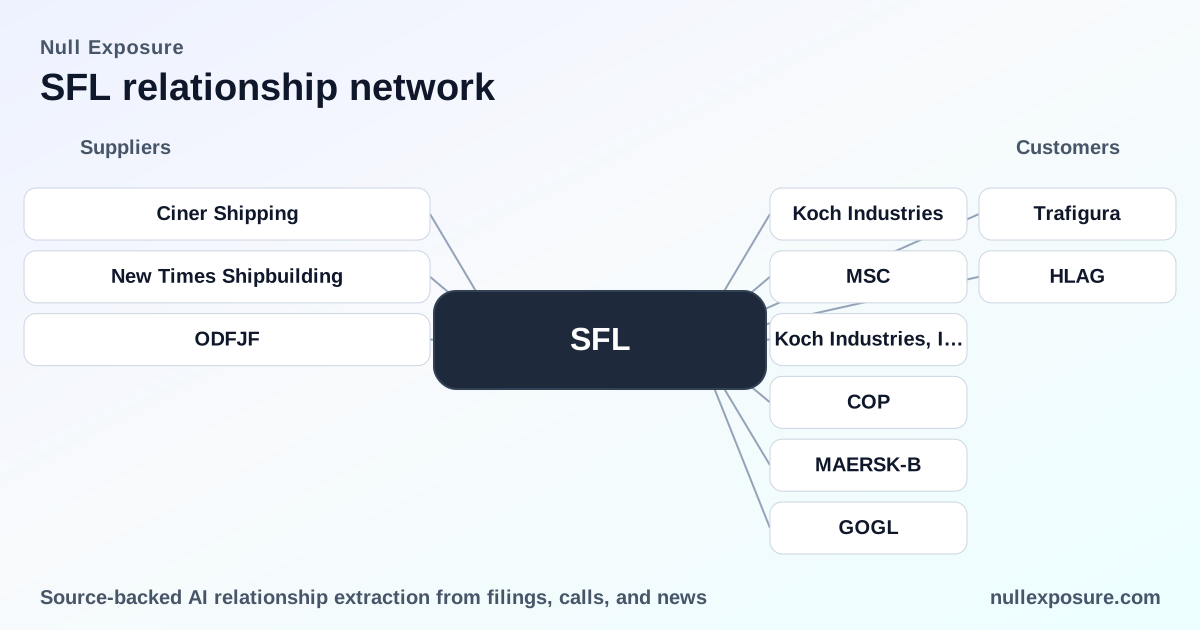
SFL Corporation Ltd — customer map, charter economics and portfolio signals
Thesis: SFL Corporation Ltd. owns and leases a diversified fleet of container ships, dry bulk, tankers and offshore rigs and monetizes through medium- and long-term charters, bareboat contracts and selective asset sales; revenue is driven by long-duration counterparties (major liners and energy companies) that convert vessel ownership into stable charter cashflows and backlog. For investors, the company’s value depends on charter backlog quality, counterparty concentration among global liners and energy firms, and selective asset disposals that refresh fleet economics. Learn more at https://nullexposure.com/.
How SFL runs its business and what that implies for investors
SFL operates as an owner-operator with a charter-first monetization model: it invests capital in ships and rigs, secures multi-year charters to blue‑chip shipping lines and energy firms, and extracts steady charter hire while retaining upside through newbuilds, resales and buyback structures. The company shows a mix of contracting postures — predominantly long-term time and bareboat charters for container and tanker assets, and multi-year drilling or rig agreements in the energy portfolio. That posture produces predictable cashflows (backlog additions such as the reported ~$225m Maersk extension) but exposes SFL to counterparty concentration risk given major liners and energy counterparties represent a significant share of fleet employment.
Key company-level signals (no explicit constraints were provided in the source set):
- Concentration to large liners: a material portion of the container fleet is placed with Maersk, MSC and Hapag‑Lloyd under multi-year charters, supporting repeat business and backlog visibility.
- Diversified asset mix: containers, capesizes, tankers and rigs provide sectoral diversification, yet each sector carries its own cycle and technical obligations.
- Active asset rotation: SFL sells older tonnage (e.g., sale of two 2015 Suezmaxes) while extending or securing charters for newer vessels and newbuilds—this supports balance‑sheet hygiene and fleet renewal.
- Counterparty quality and maturity: counterparties include investment‑grade energy firms and the largest global liner companies, producing high‑quality charter income but also potential concentration events if several large charters roll simultaneously.
If you want a full consolidated view of SFL’s customer relationships and how they feed backlog and earnings, see further details at https://nullexposure.com/.
Relationship inventory — every cited customer mention and source
Below are the relationships cited in the collected coverage. Each entry is a concise investor‑oriented summary with a source reference.
ConocoPhillips (COP)
SFL’s jack‑up drilling rig Linus is on a long‑term charter to ConocoPhillips in Norway through May 2029, representing the primary energy‑asset revenue stream in the period cited. Source: MarineLink (first seen Mar 10, 2026).
COP (duplicate mention reflecting the same charter)
Quarterly commentary confirms energy revenue of about $24m was driven mainly by LINUS on a long‑term charter to ConocoPhillips through May 2029. Source: InsiderMonkey earnings transcript (first seen Mar 10, 2026).
A.P. Moller – Maersk (MAERSK‑B)
SFL secured five‑year charter extensions for three 9,500 TEU container vessels with Maersk, a contract expansion that adds roughly $225 million to backlog. Source: ShippingTelegraph (first seen Mar 10, 2026).
MAERSK‑B (duplicate reporting)
Industry reporting reiterates that the five‑year time charter extensions with Maersk materially increase backlog and secure near‑term cashflows. Source: IndiaShippingNews (first seen Mar 10, 2026).
Maersk (another duplicate format)
Management stated the three new five‑year charters to Maersk add approximately $225m to SFL’s charter backlog from 2026 onwards. Source: InsiderMonkey call transcript (first seen Mar 10, 2026).
MSC
Multiple disclosures show SFL’s container fleet is largely on long‑term charters to MSC and that several older MSC chartered vessels were redelivered at quarter‑end. Source: Splash247 (first seen Mar 10, 2026).
MSC (earnings context)
SFL executives reported container revenue contribution of $82m supported by long‑term charters with MSC among other leading liners. Source: InsiderMonkey earnings transcript (first seen Mar 10, 2026).
MSC (fleet redelivery detail)
Six 2002‑built containerships on bareboat charter to MSC were redelivered at the end of the quarter, with a seventh delivered subsequent to quarter end. Source: ShippingTelegraph (first seen Mar 10, 2026).
Golden Ocean Group (GOGL)
Golden Ocean has purchased or exercised options on eight Capesize vessels previously associated with SFL charter arrangements, reflecting sale/leaseback and charter‑in dynamics between the entities. Source: Splash247 / ShippingTelegraph (first seen Mar 9–10, 2026).
GOGL (detail on charter returns)
Post‑quarter SFL redelivered eight older Capesize bulk carriers to Golden Ocean as part of the chartering agreement, reducing older tonnage exposure. Source: ShippingTelegraph (first seen Mar 10, 2026).
GOGL (historic transaction context)
Golden Ocean’s prior sale‑leaseback and long‑term charter arrangement (2015 transaction) is referenced to contextualize ongoing charters and buyback/purchase options. Source: gCaptain (first seen Mar 9, 2026).
Golden Ocean (duplicate)
Earnings commentary confirmed the redelivery of eight older Capesize bulkers to Golden Ocean during the reporting period. Source: InsiderMonkey (first seen Mar 10, 2026).
Koch Industries, Inc.
SFL announced sale agreements for two 2015‑built Suezmax tankers that were on charter to a Koch subsidiary, with each vessel priced at approximately $57 million in disclosed press releases. Source: GlobeNewswire press release (Dec 19, 2025; first seen Mar 10, 2026).
Koch Industries (market reporting)
MarketScreener summarized SFL’s sale of the two Suezmax tankers to Koch Industries, confirming the transaction terms reported by SFL. Source: MarketScreener (first seen Mar 10, 2026).
Koch Industries (additional coverage)
Splash247 reported SFL’s disposal of the 2015 Suezmaxes SFL Thelon and SFL Ottawa, both chartered to Koch, as part of fleet renewal activity. Source: Splash247 (first seen Mar 10, 2026).
Hapag‑Lloyd (HLAG)
SFL’s container fleet is reported to be largely chartered to major liners including Hapag‑Lloyd, supporting the container segment’s revenue contribution. Source: Splash247 (first seen Mar 10, 2026).
Hapag‑Lloyd (earnings context)
Management acknowledged Hapag‑Lloyd as a leading counterparty supporting container vessel revenues of $82m reported in the period. Source: InsiderMonkey (first seen Mar 10, 2026).
Trafigura
SFL disclosed that four LR2 product tankers have been on multi‑year charter to Trafigura, reflecting a meaningful tanker relationship in the product tanker book. Source: InsiderMonkey earnings transcript (first seen Mar 10, 2026).
Odfjell Drilling (ODF / ODFJF)
SFL secured a drilling agreement for the semi‑submersible rig Hercules in Canada—an estimated US$170m contract for a minimum of ~400 days—with Odfjell Drilling operating the unit after preparatory work. Source: SahmCapital and SimplyWall.St coverage (first seen May 3, 2026).
Odfjell Drilling (alternate mention)
Independent coverage repeated the Hercules contract detail and the estimated contract value, underscoring a material near‑term revenue event in the energy portfolio. Source: Intellectia / SimplyWall.St (first seen May 3, 2026).
Maersk (additional backlog and capex note)
Analytic reporting tied the Maersk charter extensions to ~$225m backlog while also flagging five new vessels under construction that factor into SFL’s capex profile through 2028. Source: Intellectia.ai reporting (first seen Mar 10, 2026).
MAERSK‑B (duplicate of the above)
Coverage reiterated the backlog addition tied to the Maersk time‑charter extensions and associated fleet investments. Source: Intellectia.ai (first seen Mar 10, 2026).
Additional Maersk / MAERSK‑B entries
Several items duplicate the Maersk announcement across news outlets, consistently reporting the five‑year extensions and their backlog impact. Sources: ShippingTelegraph, IndiaShippingNews, InsiderMonkey, Intellectia.ai (first seen Mar 10, 2026).
Portfolio-level implications and investor takeaways
- Backlog‑supporting charters from Maersk, MSC and Hapag‑Lloyd are central to SFL’s near‑term revenue stability; the Maersk five‑year add of ~$225m is an explicit example.
- SFL actively manages age profile via redeliveries and targeted disposals (two 2015 Suezmaxes sold to Koch), which both crystallize gains and reduce technical risk for older tonnage.
- Energy segment upside is visible through rig contracts such as Linus (ConocoPhillips) and Hercules (Odfjell) that provide multi‑year, high‑dollar contracts distinct from liner charters.
- Concentration risk is real but counterbalanced by counterparty quality and contractual tenor; monitor charter roll schedules and the pace of newbuild deliveries because those drive future capital requirements and EBITDA conversion.
For an integrated investor briefing and continuous monitoring of SFL’s counterparty exposures and charter backlog, visit https://nullexposure.com/.