Sweetgreen (SG): Customer relationships that shape near-term positioning
Sweetgreen operates a U.S.-focused fast-casual restaurant chain that monetizes through retail sales of food and beverages across five channels (in-store, pick-up, delivery, marketplace, and catering). The company recognizes revenue on a gross basis for delivery and collects customer personal information to support order fulfillment and loyalty—an operating profile that combines high-frequency retail flows, heavy consumer data handling, and concentrated geographic exposure. For investors, the combination of a commoditized core product, active brand partnerships, and recent strategic asset sales creates a mix of balance-sheet relief and questions about long-term differentiation. Learn more at https://nullexposure.com/.
How Sweetgreen runs the business and where the revenue comes from
Sweetgreen’s revenue stream is straightforward: retail sales in company-owned U.S. restaurants. Company disclosures describe a single revenue stream derived from in-restaurant and digitally fulfilled food and beverage sales, with a core menu of signature items offered year‑round that define the consumer proposition. The company operates as the principal in delivery transactions—taking payments directly from customers—which concentrates cash flow collection and operational obligations on the company rather than on delivery partners.
Operationally this creates four linked characteristics investors should note:
- Contracting posture: Sweetgreen acts as a principal seller for its sales channels, implying direct responsibility for order accuracy, refunds, and consumer claims. This elevates operational and compliance exposure relative to a commission-only model.
- Concentration: Revenue is geographically concentrated in the United States and functionally concentrated on a single retail product line: prepared food and beverages sold through Sweetgreen locations.
- Data sensitivity and fulfillment criticality: The business collects and stores personal data—addresses and phone numbers for delivery orders—and relies on this information for core operations, increasing the importance of privacy and logistics controls.
- Product maturity: The company’s menu features curated signature items that constitute the core offering, a signal of a mature, repeatable product set rather than an early-stage experimental catalogue.
Customer relationships: what the public record shows
Below I cover every customer relationship found in the recent coverage set and what each implies for revenue, distribution, or brand strategy.
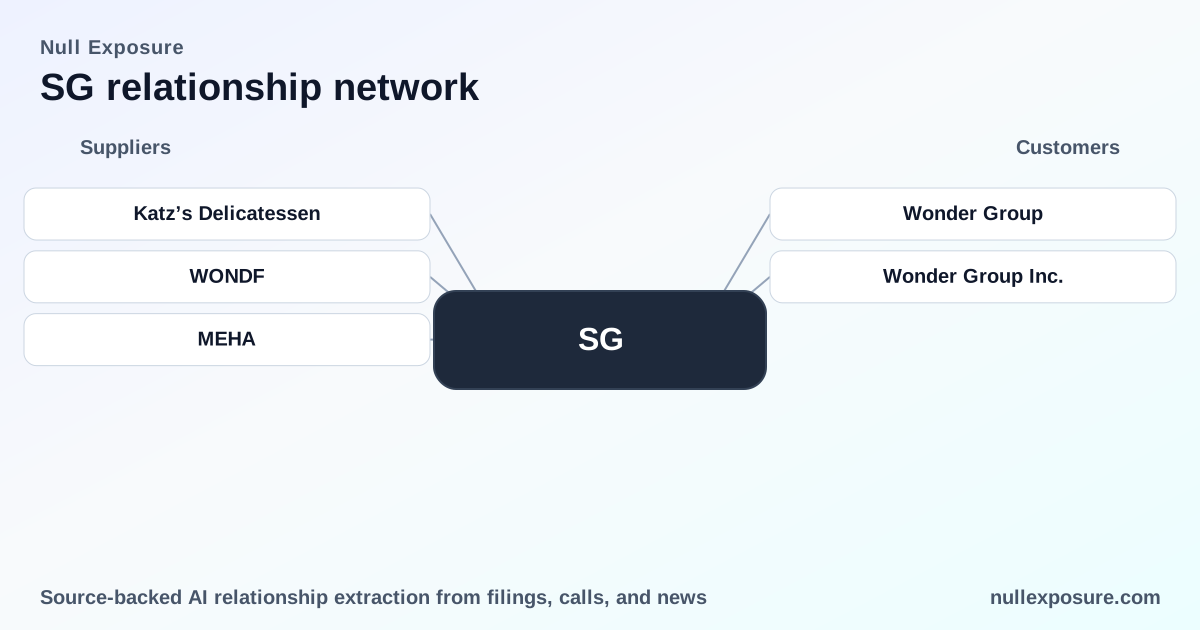
Wonder Group / Wonder Group Inc.
Sweetgreen sold its kitchen automation unit, Infinity Kitchen (also referenced as Infinite Kitchen), to Wonder Group, and the deal generated a meaningful cash infusion for Sweetgreen. According to Fortune’s December 17, 2025 reporting, the sale produced $100 million in cash, indicating a near-term capital boost and a strategic shift away from owning automation hardware. A separate Yahoo Finance piece in March 2026 noted the closing of the sale of Infinite Kitchen to Wonder Group, confirming the transaction’s completion. (Sources: Fortune, Dec 2025; Yahoo Finance, Mar 2026)
Impact takeaway: the transaction materially de-risks capital intensity tied to automation hardware and provides liquidity that can be redeployed into restaurants, marketing, or balance-sheet repair.
BLDE (Blade)
Sweetgreen is appearing as a food supplier on new premium transport and experiential offerings from BLDE, with coverage in the Robb Report and The Independent describing Sweetgreen salads as part of the onboard menu for Blade’s luxury shuttle service to the Hamptons. These mentions reflect a marketing and distribution partnership that places Sweetgreen in curated premium consumer environments and supports brand visibility among affluent, time-constrained consumers. (Sources: Robb Report, Mar 2026; The Independent, Mar 2026)
Impact takeaway: brand-extension placements like Blade offer high-value impressions and incremental revenue opportunities without core-store capital investment, but they remain promotional rather than material to overall revenue given Sweetgreen’s company-owned retail focus.
What the relationships imply about strategy and risk
The documented relationships point to two concurrent strategic motions: disposing of non-core capital-intensive assets (the automation unit sale) while pursuing brand partnerships for distribution and marketing lift. Investors should treat the sale of Infinite Kitchen as a clean-up of an experimental capital allocation rather than a fundamental pivot away from food retail.
Key investor implications:
- Balance-sheet flexibility: The $100 million cash inflow reported in press coverage improves liquidity and optionality for near-term uses—store investment, marketing, or deleveraging—but is a one-time event and not a recurring revenue source. (Source: Fortune, Dec 2025)
- Distribution vs. revenue concentration: Partnerships such as Blade broaden brand reach but do not change the company’s revenue concentration profile, which remains predominantly U.S. retail sales recognized on a gross basis (company filings and disclosures, FY2025–FY2026).
- Operational exposure: Acting as the principal in delivery and collecting consumer data creates operational obligations that scale with digital sales; governance, privacy controls, and logistics execution are material to maintaining margin and brand trust (company filings).
For additional context and signals on customer relationships and partner deals, visit our platform at https://nullexposure.com/.
Constraints and company-level signals for operators and analysts
Public disclosures and sourced excerpts deliver several company-level constraints that shape forecasting and operational diligence:
- Counterparty type — individual customers dominate: Sweetgreen’s operations require collecting customer addresses and phone numbers for delivery and in-store payments, indicating a high volume of individual counterparty interactions and the need for robust consumer data protection.
- Geography — U.S.-centric operations: The company discloses no restaurants outside the United States, concentrating macro and regulatory risk domestically.
- Relationship role — primarily seller: Disclosures state the company recognizes revenue as the principal for delivery and other channels, confirming direct exposure to sales, refunds, and payment processing.
- Segment focus — core product: The business is organized around a single retail food offering with a core menu of signature items; diversification comes through channels and occasional partnerships rather than multiple product lines.
These constraints inform valuation and operational scenarios: expect revenue sensitivity to U.S. same-store trends, cost pressure from wage and input inflation, and the necessity of tight data and logistics controls to preserve margins.
Bottom line for investors and operators
Sweetgreen’s recent disclosures and press coverage show a company re-focusing on its core retail operations while monetizing non-core technology assets. The $100 million sale of its kitchen automation unit provides a one-time financial cushion; brand placements like Blade extend awareness but leave the fundamental U.S.-retail revenue concentration intact. For investors, the critical questions are whether the company can convert one-off proceeds into durable margin improvement and whether operational execution—particularly in delivery and data handling—keeps pace with growth ambitions.
If you want ongoing coverage of partner flows and customer relationship signals for Sweetgreen and peer operators, visit https://nullexposure.com/ for our signal feeds and relationship analytics.