Superior Group (SGC): Customer Relationships and Commercial Posture — What Investors Need to Know
Superior Group of Companies monetizes by manufacturing and distributing branded and private‑label apparel while also selling complementary business process and contact‑center services through its The Office Gurus® (TOG) entities. Revenue comes from product sales (healthcare and workwear apparel), distribution throughput, and near‑shore services, with a mix of order‑by‑order merchandising and recurring service contracts. For a concise overview of the firm, see our company page at https://nullexposure.com/.
Quick scale check and why customers matter here
Superior reported approximately $566 million in trailing revenue and a modest operating margin, highlighting a business where volume, customer mix and contract structure directly shape profitability. Customer concentration and contract type are core value drivers: a single large customer can swing Healthcare Apparel segment results materially, while spot, order‑by‑order relationships create revenue variability quarter to quarter.
How Superior runs its customer engine
Superior’s public disclosures and segment notices describe a mixed commercial model that blends manufacturing, distribution and service provision into a single customer‑facing platform:
- Contracting posture is predominantly spot/order‑by‑order — sales are often executed on an order basis rather than long‑term locked‑in contracts, which increases revenue volatility but preserves pricing flexibility. Company filings explicitly state that “sales to many of our customers are on an order‑by‑order basis.”
- Geographic footprint is North America centric with targeted LATAM presence and offshore support — sales offices in the United States and Brazil serve product markets, while China and India provide vendor support and TOG operates near‑shore service centers in El Salvador, Belize, Jamaica and the Dominican Republic to serve North American clients.
- Multi‑role customer interactions — Superior acts as manufacturer, distributor, reseller and service provider across different product lines; branded products are produced in Superior facilities or through third parties and shipped via distribution centers or direct vendor fulfillment.
- Segment mix blends distribution and services — product distribution is core in Apparel segments while Contact Centers/TOG provide higher‑margin, recurring services that diversify revenue.
- Concentration signal — the Healthcare Apparel segment had one customer representing ~10% of that segment’s 2024 net sales, a company‑level concentration that amplifies exposure to that customer’s purchasing behavior.
These points are drawn from Superior’s public segment disclosures and filings.
Customer relationships called out in recent remarks
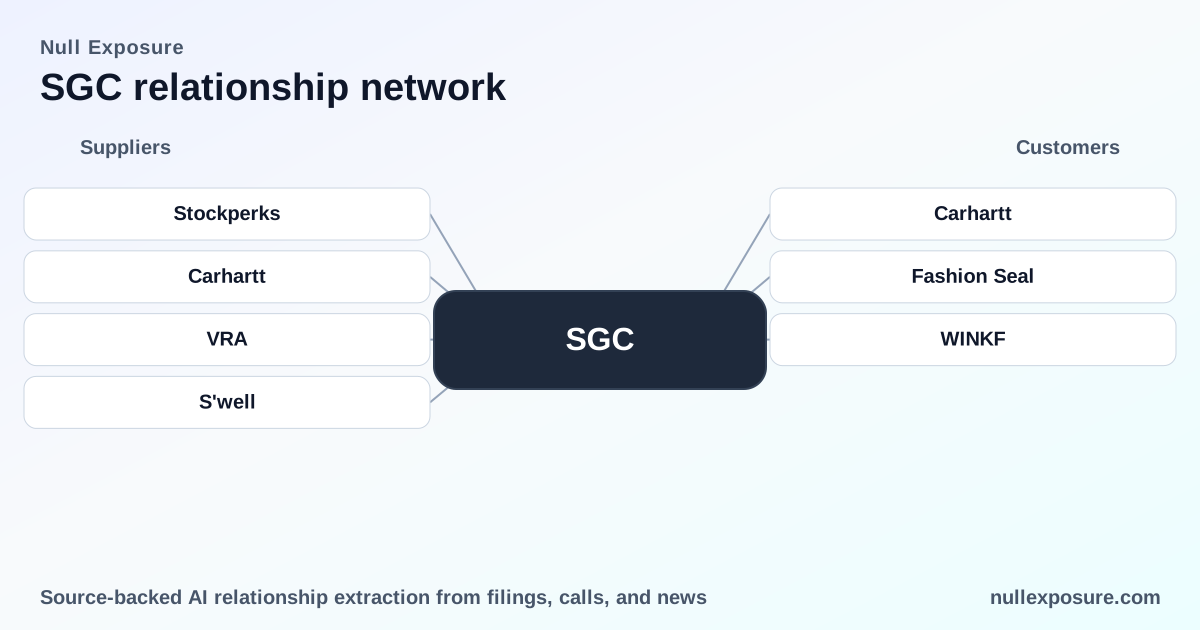
Below I cover every named relationship cited in Superior’s FY2026 earnings commentary.
Carhartt
Superior referenced Carhartt as one of the brand relationships supported by its Healthcare Apparel operations, indicating that Carhartt is part of the suite of brands the Healthcare Apparel business supports while the company focuses on expense control. This was noted in the FY2026 Q4 earnings call synopsis reported by Futunn on March 10, 2026.
Fashion Seal
Fashion Seal is cited alongside other legacy branded customers serviced by the Healthcare Apparel segment, reflecting a distribution and reseller relationship where Superior supplies service apparel and supports brand operations. The mention comes from the same FY2026 earnings call coverage (Futunn, March 10, 2026).
Wink
Wink was named as a brand that Superior’s Healthcare Apparel segment aims to support while managing costs; this signals a customer relationship that is operationally integrated with the segment’s product and expense management strategy. The reference is recorded in the FY2026 Q4 earnings call reported by Futunn on March 10, 2026.
WINKF
WINKF appears as the inferred trading symbol for Wink in the company commentary, and the call explicitly grouped WINKF with the other Healthcare Apparel brands the company services; this reiterates the same commercial linkage as Wink under its market symbol. Source: FY2026 Q4 earnings call coverage by Futunn (March 10, 2026).
What these relationships imply for investors
Superior’s named brand relationships in the earnings call are less about exclusive long‑term contracts and more about scale service provision across multiple brands. Investors should weigh the following:
- Revenue volatility from spot contracting: With many customers served on an order‑by‑order basis, quarterly sales can fluctuate with customer order patterns and inventory turns. That creates earnings variability even when unit economics are stable.
- Concentration risk at the segment level: The Healthcare Apparel segment had a single customer representing roughly 10% of segment sales in 2024, which is a meaningful dependency and a single‑counterparty risk at the segment level.
- Geographic and operational diversification: North American sales and distribution centers anchor product revenue, while TOG’s near‑shore contact centers provide recurring, service‑oriented revenue that cushions product cyclicality. Company filings describe sales offices in the U.S. and Brazil, vendor support in China and India, and TOG entities in multiple near‑shore jurisdictions.
- Multi‑role exposure reduces single‑mode risk — but increases complexity: Acting as manufacturer, distributor and service provider helps capture margins across the value chain but requires execution across sourcing, logistics and labor‑intensive BPO operations.
- Spend scale is material for some customers: Evidence points to customer spend bands in the $10m–$100m range for at least one large Healthcare Apparel counterparty, which implies meaningful contribution but also potential single‑customer earnings sensitivity.
Operational risks that change valuation
- Order‑by‑order contracting limits revenue visibility, constraining forward guidance quality and raising the value of any durable service contracts.
- Distribution and supply‑chain execution are critical; margin recovery depends on inventory turns and vendor sourcing costs, particularly when suppliers operate across China, India and direct vendor shipments.
- Customer concentration amplifies downside; losing a top Healthcare Apparel customer or seeing reduced order cadence would materially compress segment performance.
For a consolidated view of Superior’s positioning and to track client relationships at scale, visit our research hub at https://nullexposure.com/.
Bottom line for investors
Superior’s business sits at the intersection of low‑margin, volume‑driven apparel distribution and higher‑value, recurring contact‑center services. Investor returns will be driven by the company’s ability to stabilize order‑by‑order revenue via deeper commercial ties, protect top Healthcare Apparel customers, and scale the TOG services franchise to offset apparel cyclicality. Monitor order patterns for named brands (Carhartt, Fashion Seal, Wink/WINKF) and segment concentration metrics; these will be the clearest near‑term indicators of downside risk and upside operational leverage.