Sight Sciences (SGHT) — Customer relationships and commercial posture investors should price in
Sight Sciences sells minimally invasive ophthalmic devices and office-based therapies and monetizes through point-of-sale product sales to surgical facilities and eye care providers, supplemented by procedure-level reimbursement where available. Revenue is overwhelmingly driven by Surgical Glaucoma products (OMNI, SION) sold to ambulatory surgery centers and hospital outpatient departments, while TearCare is sold to eye care professionals and has historically relied on cash-pay until reimbursement codes are established. For a concise view of coverage and signals on customer counterparties, visit https://nullexposure.com/.
Business model and operating constraints that drive customer risk and upside
- Contracting posture: spot sales dominate. Sight Sciences recognizes revenue at the point in time when product control transfers to the buyer, and TearCare has historically been sold on a cash-pay basis while reimbursement is developed. This indicates transactional, non-recurring revenue patterns for many customer engagements.
- Geography concentrated in North America with selective EMEA presence. About 95% of revenue is U.S.-based, though the company maintains direct operations in the U.K. and Germany and uses distributors elsewhere in Europe.
- Customer concentration is low by account but concentrated by segment. No single customer accounted for 10%+ of revenue in 2023–2024, yet the Surgical Glaucoma segment produced ~95% of total revenue—making the product mix critical even if no single buyer dominates.
- Role mix: Sight Sciences is principally a seller to facilities and ECPs, uses distributors, and treats customers as buyers in transactional sales. This creates typical commercial execution risks (salesforce coverage, distributor performance, procedure adoption).
- Product maturity: core surgical products are the revenue engine today. Revenue is tied to procedure adoption curves, CPT coding and reimbursement, and surgeon/system adoption timelines.
These constraints frame the commercial dynamics: highly concentrated revenue by product class, geographically U.S.-centric, transactional sales that require sustained procedural adoption and reimbursement to scale recurring revenue.
What investors need to know about specific counterparties in the public record The items below summarize every customer-related relationship flagged in available coverage.
Alcon Inc. — litigation outcome creates a near-term monetization channel
Alcon was the defendant in a patent infringement dispute with Sight Sciences; a court awarded Sight Sciences $34 million in past damages plus supplemental damages and interest, and established an ongoing royalty of 10% of Hydrus revenue through November 10, 2028, the expiration of Sight’s last asserted patent. This is a material legal monetization event that creates a time-limited royalty stream tied to a competitor product. According to a Yahoo Finance report on May 3, 2026, the order did not disturb the underlying jury verdict and affirms both damages and the royalty structure.
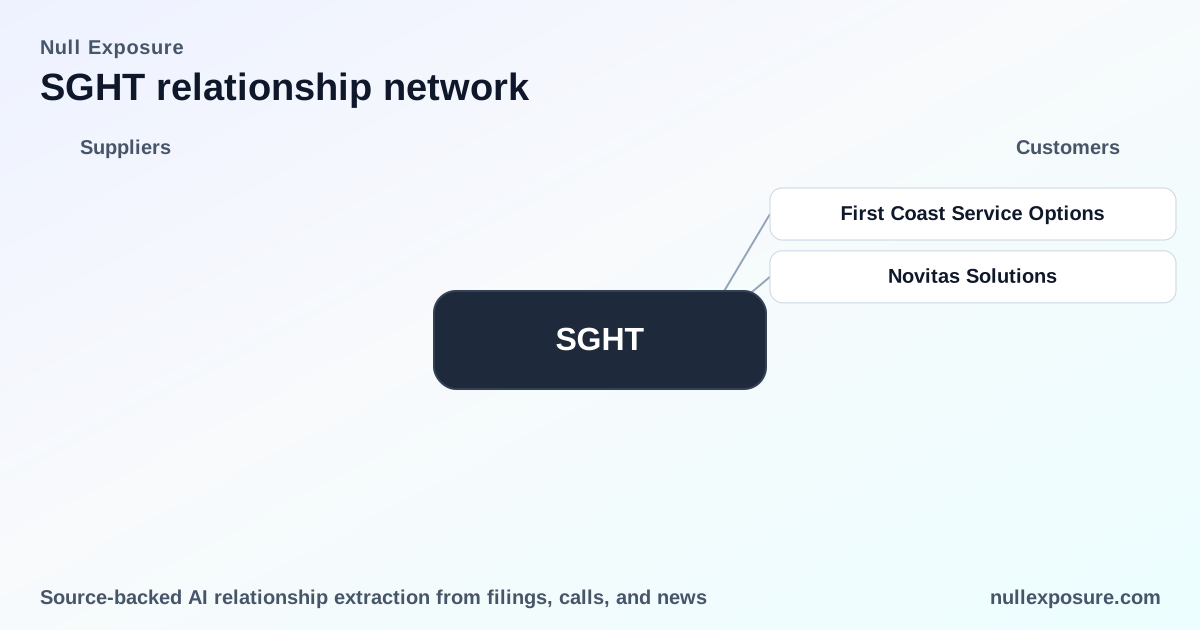
First Coast Service Options — reimbursement pricing for TearCare in a U.S. MAC region
First Coast Service Options is one of the Medicare Administrative Contractors that established pricing for CPT code 0563T, which is the code associated with the TearCare procedure. Establishment of CPT-level pricing by MACs directly affects procedure-level reimbursement and the addressable market for TearCare when public payors are considered. This pricing action was disclosed during Sight Sciences’ Q4 2025 earnings call transcript published March 10, 2026.
Novitas Solutions — another MAC that set TearCare CPT pricing
Novitas Solutions also established pricing for CPT code 0563T for TearCare in its MAC jurisdiction, matching the broader pattern of localized Medicare coverage and reimbursement decisions that convert a cash-pay procedure into a billable, reimbursable one. Sight Sciences publicly noted this development in the Q4 2025 earnings call transcript (March 10, 2026), underscoring the incremental commercial importance of MAC-level decisions to TearCare uptake.
How these relationships influence revenue quality and growth optionality
- Legal monetization vs. recurring sales. The Alcon ruling produces a finite royalty and damages payment; it is valuable cash flow but not a structural recurring revenue replacement. Investors should treat the judgment as a near-term inflow and a competitive deterrent rather than a transformational recurring revenue stream.
- Reimbursement is the throttle for TearCare adoption. MAC decisions by First Coast Service Options and Novitas Solutions converting CPT 0563T into priced reimbursement are operationally significant—they lower the out-of-pocket hurdle for patients and broaden provider willingness to adopt TearCare, thereby improving lifetime monetization per installed base.
- Product concentration raises sensitivity to procedure economics. With ~95% of revenue driven by Surgical Glaucoma, the company’s commercial success depends on procedure volumes, surgical reimbursement, and ASCs/HOPDs stocking behavior; the lack of large single customers reduces counterparty concentration risk but increases exposure to product-cycle and reimbursement risks.
Risk and timing considerations investors must price
- Reimbursement timing and patchwork coverage. MAC pricing decisions are necessary but not sufficient for uniform payer coverage; regional MACs and private payors can diverge. The company’s historic reliance on cash-pay for TearCare implies slower adoption until broader payor acceptance.
- Revenue still transactional. The company recognizes revenue at product delivery; recurring, subscription-like predictability is limited absent OEM service contracts or device replacement cycles.
- Legal outcomes are finite and asymmetric. The Alcon royalty provides a measured revenue uplift through 2028, but it does not change the underlying dependence on procedural adoption and U.S. market penetration beyond that timeframe.
- Execution risk in international expansion. EMEA presence through direct operations and distributors exists, but international sales are a minority today, so upside depends on successful commercialization outside the U.S.
Investor takeaway and next steps Sight Sciences operates a high-leverage, procedure-driven commercial model with concentrated product exposure and transactional customer contracts. The Alcon award provides a finite royalty and cash recap but does not eliminate the company’s fundamental dependence on reimbursement dynamics and surgical adoption. MAC-level pricing actions—specifically First Coast Service Options and Novitas Solutions establishing CPT 0563T pricing—are the key operational catalysts for TearCare commercialization and should be monitored for expansion to additional MACs and private payors.
For focused monitoring of customer-signals, reimbursement updates, and legal developments that affect SGHT’s commercial runway, see the full coverage at https://nullexposure.com/.